Roulette House Edge
The share of each stake the casino keeps on average.
European roulette: 2.70% on every standard bet, because payouts are computed as if there were 36 pockets and there are 37.
Derivation
Fair odds for a straight upbetStraight upA wager on one number, ordinarily paying a profit of 35 to 1.Read full definition → would be 36 to 1, because there are 36 ways to lose for every one way to win. The casino pays 35 to 1. The missing unitmoneyUnitA base amount used to express stakes or results.Read full definition →, spread over 37 equally likely outcomes, is 1/37 = 2.70% of the stake per spin. The same shortfall appears in every payoutmoneyPayoutThe amount paid on a winning wager. Check whether the quoted figure is net profit or total return including the stake.Read full definition → because every payout uses the 36/n − 1 rule: a splitbetSplitA wager on two numbers sharing an allowed layout boundary, ordinarily paying 17 to 1.Read full definition → pays 17 instead of 17.5, a dozenbetDozenA bet on 1–12, 13–24 or 25–36, ordinarily paying 2 to 1.Read full definition → 2 instead of 2.083, redbetRedAn even-money wager on the 18 red numbers. French: rouge.Read full definition → 1 instead of 1.056. The gap is always 1/n units per win, and n/37 wins per spin, so always 1/37 per spin.
Edge versus hold
House edgemathHouse edgeThe casino’s expected net gain expressed as a fraction of the stake, under specified probabilities and payouts.Read full definition → is expected lossmathExpected lossThe probability-weighted average net loss under a stated model. With a constant edge, it equals edge times expected total stakes.Read full definition → divided by the amount wagered. Table-game hold compares actual casino win with the money bought in or dropped, depending on the reporting definition. They have different denominators. Completing 200 standard single-zerowheelZeroThe 0 outcome, conventionally shown in green. Ordinary color, parity, high/low, dozen and column bets do not include it.Read full definition → spins at $10 creates $2,000 of turnovermoneyTurnoverThe sum of amounts wagered over a session or period, including money wagered again after a return. Also called handle or action.Read full definition → and an expected loss of $54.05. The actual loss may be very different, and a $100 starting bankrollmoneyBankrollThe amount set aside for play. Bankroll management concerns stakes and limits within that amount.Read full definition → may run out before all 200 spins are completed.
| measure | definition | single-zero example |
|---|---|---|
| House edge | expected loss ÷ amount wagered | 2.70% |
| RTP | 1 − edge | 97.30% |
| Hold | actual casino win ÷ buy-ins or drop | varies with actual results and reporting basis |
| Theoretical win | edge × total amount wagered | $54.05 on $2,000 wagered |
Why every bet has the same edge
Standard single-zero payouts follow 36/n − 1, which gives the same 1/37 expected loss per unit on each bet. A fair single-zero straight-up payout would be 36 to 1, giving neither side an expected profit. Other rules need separate calculations: the American five-number bet has a 7.89% edge, while la partageruleLa partageA rule returning half of a qualifying even-money stake when zero lands. On a fair single-zero wheel it gives an edge of 1/74, about 1.35%.Read full definition → reduces the edge on single-zero even-money betsbetEven-money betA bet paying a profit equal to the stake, such as red/black, odd/even or high/low.Read full definition → to 1.35%.
What the roulette edge is not
It is not the probabilitymathProbabilityA measure of how likely an event is, from zero to one. Percentages express the same scale from 0% to 100%.Read full definition → of losing a session. For example, exactly 100 independent, fixed-stake bets on red on a fair single-zero wheel finish in profit about 35.53% of the time. The edge is not a fixed session fee: expected loss scales with the total amount wagered. Combining standard bets does not reduce it; their expected losses add.
In money
Per $1,000 wagered the expected loss is $27.03 in European roulettevariantEuropean rouletteUsually single-zero roulette: 37 pockets. Ordinary standard-payout bets have a fair-wheel edge of 1/37, about 2.70%.Read full definition →, $52.63 in American, $13.51 on even-money bets with la partage. Wagering $500 per session, twice a week for 52 weeks, creates $52,000 of turnover. On standard single-zero bets the expected loss is about $1,405; the actual result can differ substantially.
Per spin or per resolved bet
Standard roulette bets settle on one spin. A bet that stays on the layoutequipmentLayoutThe marked betting surface, whether printed on a table or displayed on a screen.Read full definition → after a push needs two measures: expected loss per spin and expected loss per completed bet. In the Riverboat Roulette rules described by Michael Shackleford, teal covers three of 38 pocketsequipmentPocketA compartment on the rotor in which the ball can settle. The number of pockets depends on the wheel.Read full definition → and pays 2:1. Eight white pockets lose; the other 27 outcomes push.
Assuming independent, equally likely outcomes and leaving the bet up until it settles, the expected loss is 2/11 of the original stake per completed bet (18.18%). While the bet is active, its expected loss per spin is 2/38 (5.26%). It takes an average of 38/11 spins to settle. To estimate an hourly cost, you also need the stake and the number of spins for which it stays active; neither percentage predicts an actual session result.
| Riverboat bet | numbers | pays | edge per resolved bet | edge per spin |
|---|---|---|---|---|
| teal, yellow | 3 | 2 to 1 | 18.18% | 5.26% |
| pink, purple | 4 | 8 to 5 | 13.33% | 4.21% |
| orange, blue | 5 | 7 to 5 | 7.69% | 2.63% |
When a casino gets the price wrong
A payout error can give players a mathematical advantage. Hunacek (2025), citing Bollman, describes an October 1994 Grand Casino Biloxi bet paying 80 to 1 on three dice totaling 4. Three dice fall 216 ways and only 3 of them total 4, so the bet returned 81 × 3/216 = 1.125 for every unit staked: a 12.5% edge to the player. The account says the casino lost about $180,000 in a day and later lowered the payout to 60 to 1. That payout turns the same 3 chances in 216 into a 15.3% house edge. These historical details are a published account, not a result established by the calculation. The lesson is to calculate the expected return from the actual rules and payout table.
Side bets in the other table games
The examples below compare main bets with selected side betsbetSide betAn additional wager tied to a game, such as a streak, card hand, bonus event or jackpot. It may be optional or required by the product.Read full definition → described by Bollman (2021). In these examples, the blackjack, baccarat and craps side bets have higher edges than the main bets. That is not a rule for every side bet or every set of conditions. Colors and WINGO illustrate the reverse: their quoted edges are below the 5.26% on standard American roulettevariantAmerican rouletteRoulette with 0 and 00: 38 pockets. Ordinary bets at standard payouts have a 5.26% house edge on a fair wheel.Read full definition → bets.
| game | main bet | house edge | side bet | house edge |
|---|---|---|---|---|
| blackjack | player hand, by rules and play | 0.5–5% | Lucky Ladies | 24.94% |
| WINSURE | 10.20% or more | |||
| baccarat | Player | 1.36% | Baccarat World | 2.32% or more |
| Banker | 1.17% | WINSUIT | 2.89% | |
| craps | Pass | 1.41% | Field | 5.56% |
| Don’t Pass | 1.36% | All Tall, All Small | 7.76% | |
| American roulette | any bet but the five-number | 5.26% | Colors | 4.34% |
| five-number bet | 7.89% | WINGO | 3.78% |
Formula
Questions
No. It is 2.70% of what you wager. Re-betting the same money wagers it again.
No. It is a proportion. The expected loss in dollars scales with the stake.
Measured by the edge, all standard European bets are equal; they differ only in how often they win and how much they pay. With la partage, even-money bets are half the others.
Fun with Math
Try these yourself first. Each solution is folded; open it when you are ready.
On a fair single-zerowheelZeroThe 0 outcome, conventionally shown in green. Ordinary color, parity, high/low, dozen and column bets do not include it.Read full definition → wheel with standard payoutsmoneyPayoutThe amount paid on a winning wager. Check whether the quoted figure is net profit or total return including the stake.Read full definition →, why do a straight-up bet and redbetRedAn even-money wager on the 18 red numbers. French: rouge.Read full definition → both have a house edgemathHouse edgeThe casino’s expected net gain expressed as a fraction of the stake, under specified probabilities and payouts.Read full definition → of 1/37?
Show the solution
Answer Both return 36/37 of the stake on average, despite their different win probabilities.
For a one-unitmoneyUnitA base amount used to express stakes or results.Read full definition → standard bet covering n pocketsequipmentPocketA compartment on the rotor in which the ball can settle. The number of pockets depends on the wheel.Read full definition →, a win returns 36/n units including the stake. The win probabilitymathProbabilityA measure of how likely an event is, from zero to one. Percentages express the same scale from 0% to 100%.Read full definition → is n/37. Expected gross return is therefore (n/37)×(36/n)=36/37, leaving an expected lossmathExpected lossThe probability-weighted average net loss under a stated model. With a constant edge, it equals edge times expected total stakes.Read full definition → of 1/37, about 2.70%.
This covers the ordinary payout pattern. An American five-number bet, special payouts and French half-back even-money rules need their own calculations. Equal edges per unit do not mean equal risk or equal expected loss when the stakes differ.
If zeros were added to a roulette wheel while standard payouts stayed unchanged, how many zeros would give a 25% house edge?
Show the solution
Answer Twelve zeros: a 48-pocket wheel.
With z zeros the wheel has 36 + z pockets, and the payouts still assume 36. By the rule in the puzzle above, every standard bet loses z units on average in 36 + z spins, so the house edge is z/(36 + z).
Set that equal to one quarter: 4z = 36 + z, so z = 12. Twelve zeros on a 48-pocket wheel would cost 25%.
A triple-zero wheel has one quarter of that many zeros; with standard payouts its house edge is 3/39, about 7.69%.
zeros pockets house edge 1 37 2.70% 2 38 5.26% 3 39 7.69% 4 40 10.00% 12 48 25.00% Suppose a uniform 36-number wheel has no zero. A single-number bet returns 25 for 1, while a $2 red bet returns $3 on a win. Red covers 18 numbers. Is this cheaper per dollar than standard single-zero roulette?
Show the solution
Answer No. The model’s edges are 30.56% on a number and 25% on red, versus about 2.70% on standard single-zero bets.
“For 1” includes the returned stake. A one-unit number bet has expected gross return 25/36, so the edge is 11/36, about 30.56%.
The $2 red bet returns $3 with probability one-half. Its expected return is $1.50 on $2 staked: a 25% edge.
Removing zero does not ensure a fair gamemathFair gameIn expected-value terms, a game or wager with zero expected net profit for each side under the stated strategy and rules.Read full definition →. Probabilities and payouts must be considered together. These are hypothetical terms, not a claim about a particular lottery product.
A casino wants a new bet on the eleven prime numbersmathPrime numberA whole number greater than one with exactly two positive divisors: one and itself.Read full definition → from 1 to 36: 2, 3, 5, 7, 11, 13, 17, 19, 23, 29 and 31. What should it pay to cost the same 2.70% as every other bet on a European wheel? What would it cost at 2 to 1?
Show the solution
Answer 25 to 11, about 2.27 to 1. At 2 to 1 it would cost 10.81%.
Use the rule from the first puzzle: a bet on n numbers pays (36 − n)/n to 1. With n = 11 that is 25/11 to 1, a fractional payout: a $10 stake would win $250/11, about $22.73, before any rounding rule.
At 2 to 1, a $1 bet wins $2 on 11 spins in 37 and loses $1 on the other 26: 22 − 26 = −4 units every 37 spins, 10.81%.
This is why roulette sells bets on 1, 2, 3, 4, 6, 12 and 18 numbers: 36 divides by each of them, so the standard payout is a whole number. These are not fair payouts on a 37-pocket wheel: fair odds would use 37 rather than 36.
Comic relief
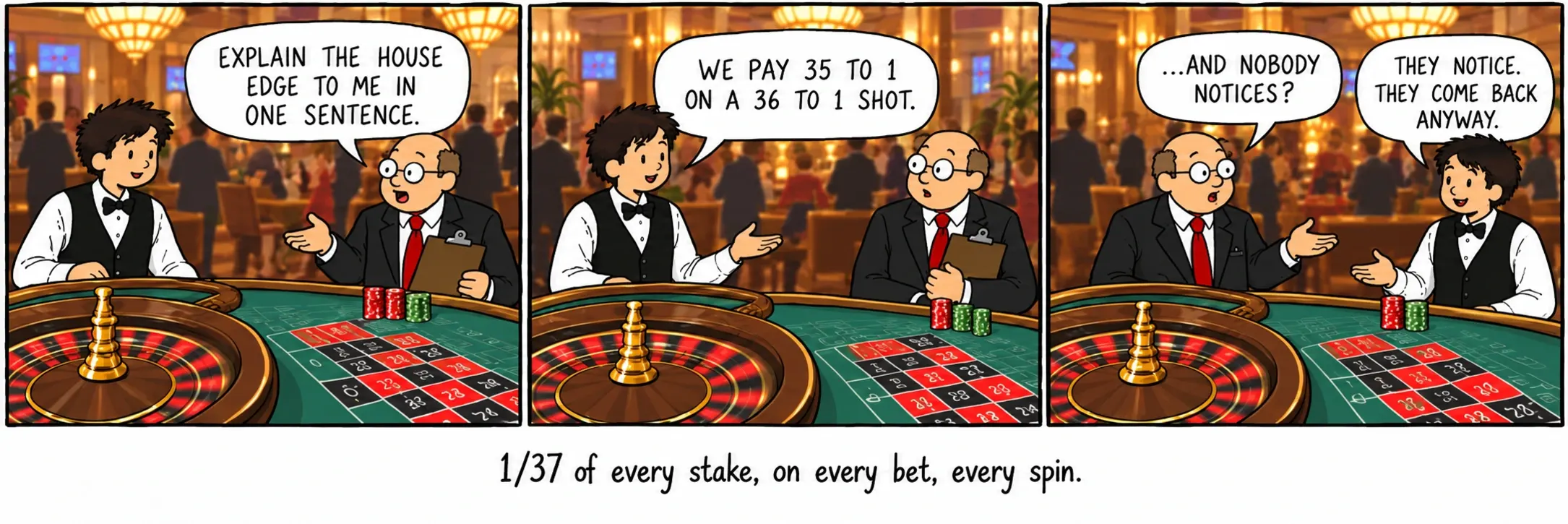
On standard single-zero bets, the expected loss is 1/37 of the stake per spin.
Sources
- Ethier, S. N. The Doctrine of Chances: Probabilistic Aspects of Gambling.
- Epstein, R. A. The Theory of Gambling and Statistical Logic, 2nd ed.
- Bollman, M. Mathematics of the Big Four Casino Table Games: Blackjack, Baccarat, Craps, & Roulette.
- Hunacek, M. Quantitative Literacy Through Games and Gambling.