Roulette Rotor Speed
Convert a rotation time into speed—and timing error into pocket widths.
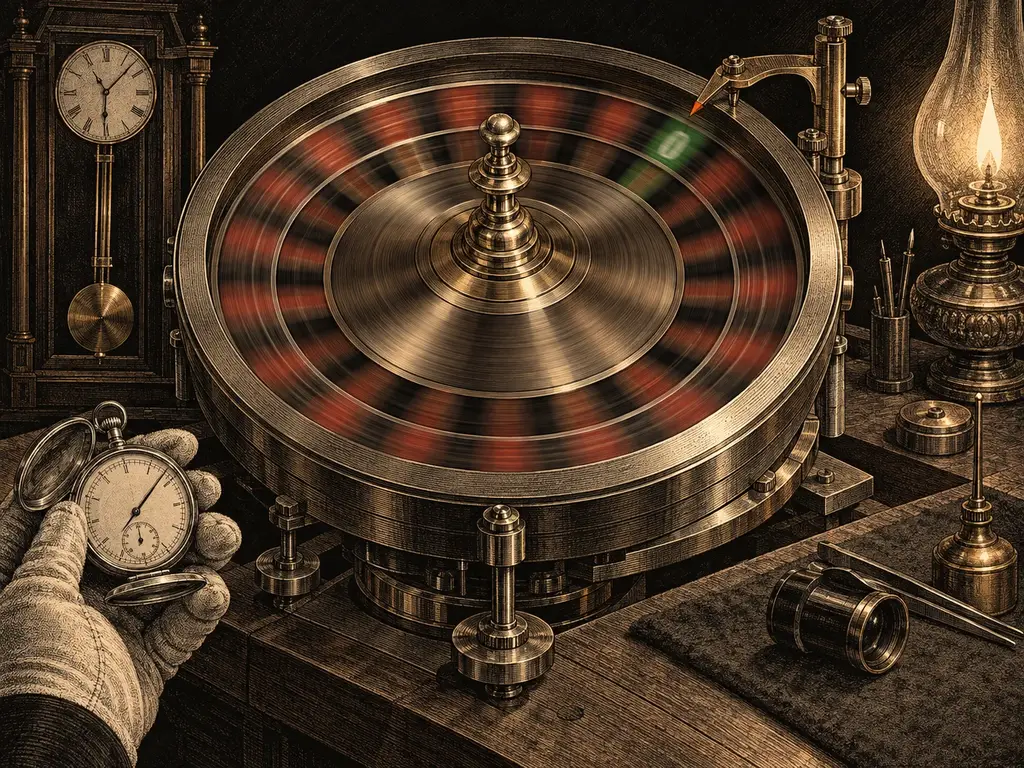
A rotor completing one revolution in 2.5 seconds turns at 0.4 revolutions per second. On a 37-pocket wheel, that is 14.8 pocket widths per second. These conversions do not establish a predictive advantage.
Measuring it
Time the same pocketequipmentPocketA compartment on the rotor in which the ball can settle. The number of pockets depends on the wheel.Read full definition → passing a fixed reference over one or more complete revolutions. Revolutions per second equal revolutions divided by elapsed time. Video frame rate, dropped frames and measurement choices affect accuracy. The table gives mathematical conversions, not an industry range of normal speeds.
| rotor speed | seconds per lap | pockets per second | pockets per 0.1 s error |
|---|---|---|---|
| 0.25 rev/s | 4.00 | 9.25 | 0.93 |
| 1/3 rev/s | 3.00 | 12.33 | 1.23 |
| 0.40 rev/s | 2.50 | 14.80 | 1.48 |
| 0.50 rev/s | 2.00 | 18.50 | 1.85 |
| 0.60 rev/s | 1.67 | 22.20 | 2.22 |
Why predictors care
An estimate of ballequipmentBallThe small ball that settles in a numbered pocket to determine a physical roulette result.Read full definition → departure must be related to the rotorequipmentRotorThe rotating part of a physical roulette wheel, carrying the numbered pockets.Read full definition →’s position at the relevant time. At 15 pocket widths per second, 0.1 seconds corresponds to 1.5 pockets and 0.5 seconds to 7.5 pockets. Later travel and collisions add further uncertainty; this conversion covers rotor motion only.
Decay
A constant-speed approximation may be adequate over a short interval, but it should be checked against measurements. If the rotor slows appreciably, integrate the changing speed rather than multiplying one speed by the entire duration.
Direction
The ball and rotor run in opposite directions under the conventional procedure. Any change of direction or operating method should be recorded when comparing spins. Do not assume that every house alternates direction on the same schedule.
What a player can take from this
Rotor speed alone does not tell you the winning pocket. It describes motion, while a prediction also needs information about the ball and its later path. For a frequency study, record operating changes rather than assuming speed can never matter.
Questions
No. A faster rotor converts a given timing error into more pocket widths, but uniformity is a separate claim.
To maintain motion under the table’s procedure. The required speed and timing depend on that procedure.
Comic relief
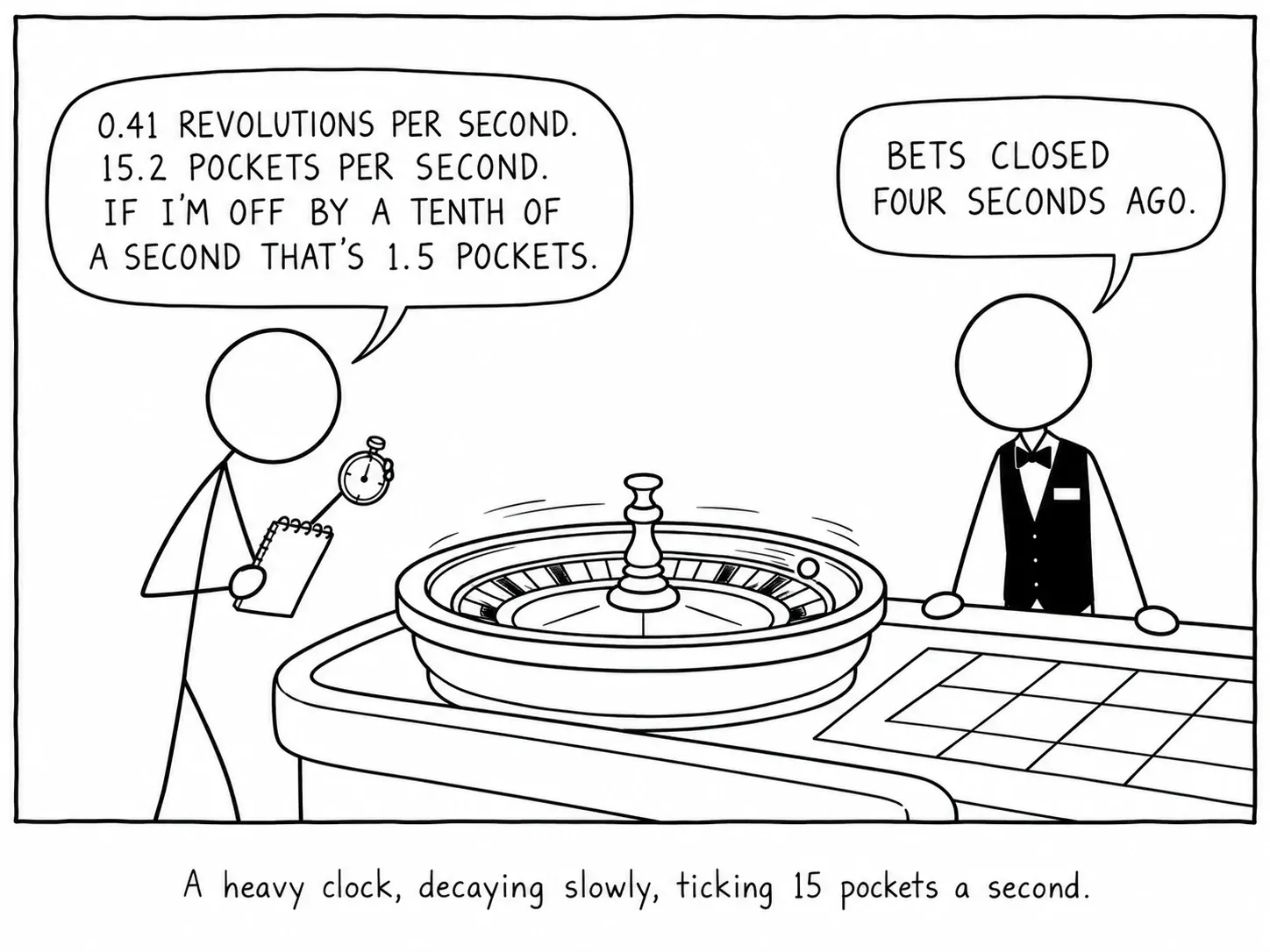
Timing arithmetic does not guarantee a useful prediction.
Sources
- Illustrative kinematics
- Small and Tse (2012), Predicting the outcome of roulette