Roulette Red or Black Bet
In roulette, red or black covers eighteen numbers of one color: the reference even-money bet.
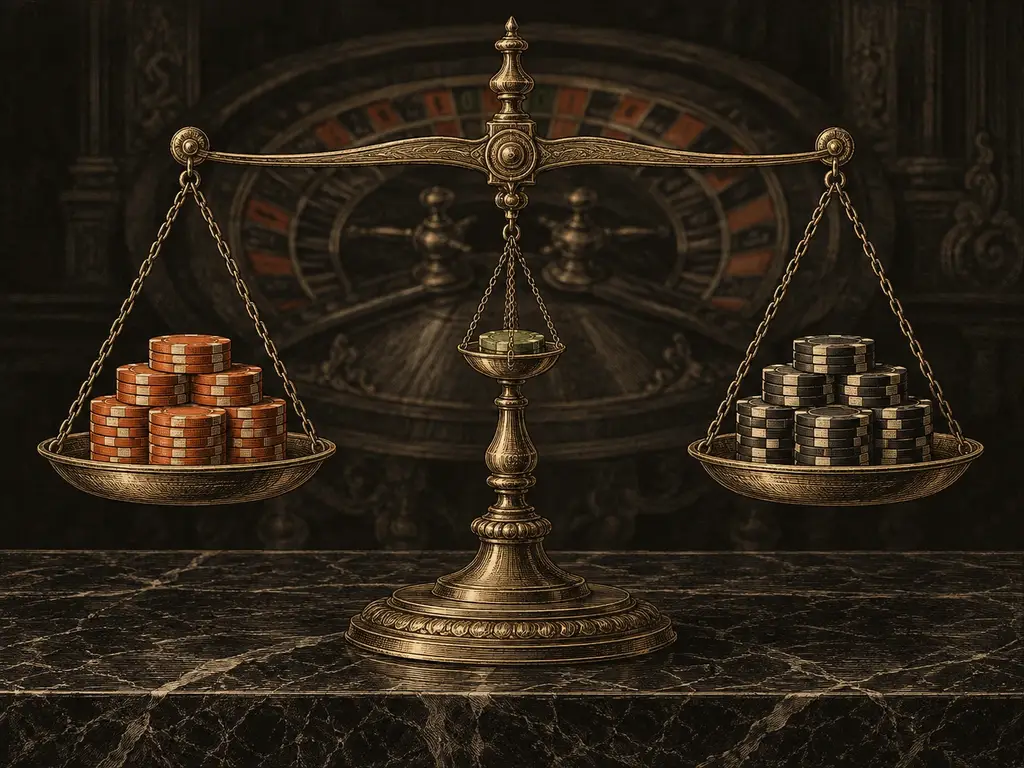
Eighteen numbers, pays 1:1. Probability 48.65%, not 50%: zero is the difference.
Placement
The redbetRedAn even-money wager on the 18 red numbers. French: rouge.Read full definition → diamond and blackbetBlackAn even-money bet on the 18 black numbers. French: noir.Read full definition → diamond boxes among the outside betsbetOutside betA bet in the areas surrounding the numbered grid, including dozens, columns and the six even-money options.Read full definition →, or the words rouge and noir on a French layoutequipmentLayoutThe marked betting surface, whether printed on a table or displayed on a screen.Read full definition →. Each must meet the table minimum. Red numbers: 1 3 5 7 9 12 14 16 18 19 21 23 25 27 30 32 34 36. Black: the other eighteen. ZerowheelZeroThe 0 outcome, conventionally shown in green. Ordinary color, parity, high/low, dozen and column bets do not include it.Read full definition → is green and belongs to neither.
Payout and the odds of winning at roulette on red or black
Fair odds against 18 in 37 are 1.056 to 1; the table pays 1. A $10 roulette bet on red that hits wins $10, plus the return of the $10 stake. Expected counts over 37 spins: 18 wins (+$180), 18 losses (−$180), one zero (−$10). Net −$10 on $370.
| $10 × 100 spins | red |
|---|---|
| probability per spin | 48.65% |
| expected wins in 100 spins | 48.6 |
| expected result | −$27.03 |
| standard deviation | $100 |
| p(no win in 100 spins) | 0.000000% |
Streaks
Red and black alternate on the wheel but not in time. Ten reds in a row has probabilitymathProbabilityA measure of how likely an event is, from zero to one. Percentages express the same scale from 0% to 100%.Read full definition → (18/37)¹⁰ = 0.074%, about once every 1,350 ten-spin windows; this is a probability for a specified ten-spin window, not a promise about when a run will occur. None of it says anything about spin eleven, which is 18/37 red like every spin before it.
Why systems live here
Red/black is as close as the table comes to a coin flip, which makes it the natural base for progressionsstrategyProgressionA rule that changes stakes over a sequence of bets, often using previous wins or losses.Read full definition →: MartingalestrategyMartingaleA progression that doubles after each loss and usually returns to the base stake after a win.Read full definition →, D’Alembert, FibonaccistrategyFibonacciA staking progression using 1, 1, 2, 3, 5, 8, 13 and so on, commonly moving forward after a loss and back two places after a win.Read full definition →, LabouchèrestrategyLabouchèreA cancellation progression: bet the sum of the two end numbers, remove them after a win, and append the stake after a loss. With one number left, bet that number.Read full definition → and ParolistrategyParoliA positive progression that raises stakes after wins. A common version uses 1, 2 and 4 units, resetting after a loss or three wins.Read full definition → all assume an even-money betbetEven-money betA bet paying a profit equal to the stake, such as red/black, odd/even or high/low.Read full definition →. For a bounded session under the stated independent model, expected lossmathExpected lossThe probability-weighted average net loss under a stated model. With a constant edge, it equals edge times expected total stakes.Read full definition → is 1/37 of expected turnovermoneyTurnoverThe sum of amounts wagered over a session or period, including money wagered again after a return. Also called handle or action.Read full definition → on standard single-zero red/black, or 1/74 with la partageruleLa partageA rule returning half of a qualifying even-money stake when zero lands. On a fair single-zero wheel it gives an edge of 1/74, about 1.35%.Read full definition →. Realized loss need not equal that percentage of realized turnover. The strategy pages show what each does to the shape of a session.
- p10 −$420
- p25 −$280
- median −$140
- p75 +$20
- p90 +$140
French rules
La partage halves the standard single-zero even-money edge to 1/74, about 1.35%. En prisonruleEn prisonA zero rule that holds an even-money stake for possible recovery on a later spin. The details vary by game.Read full definition → depends on the repeated-zero conditions. Check the actual rules and stakes rather than relying on a “French” label.
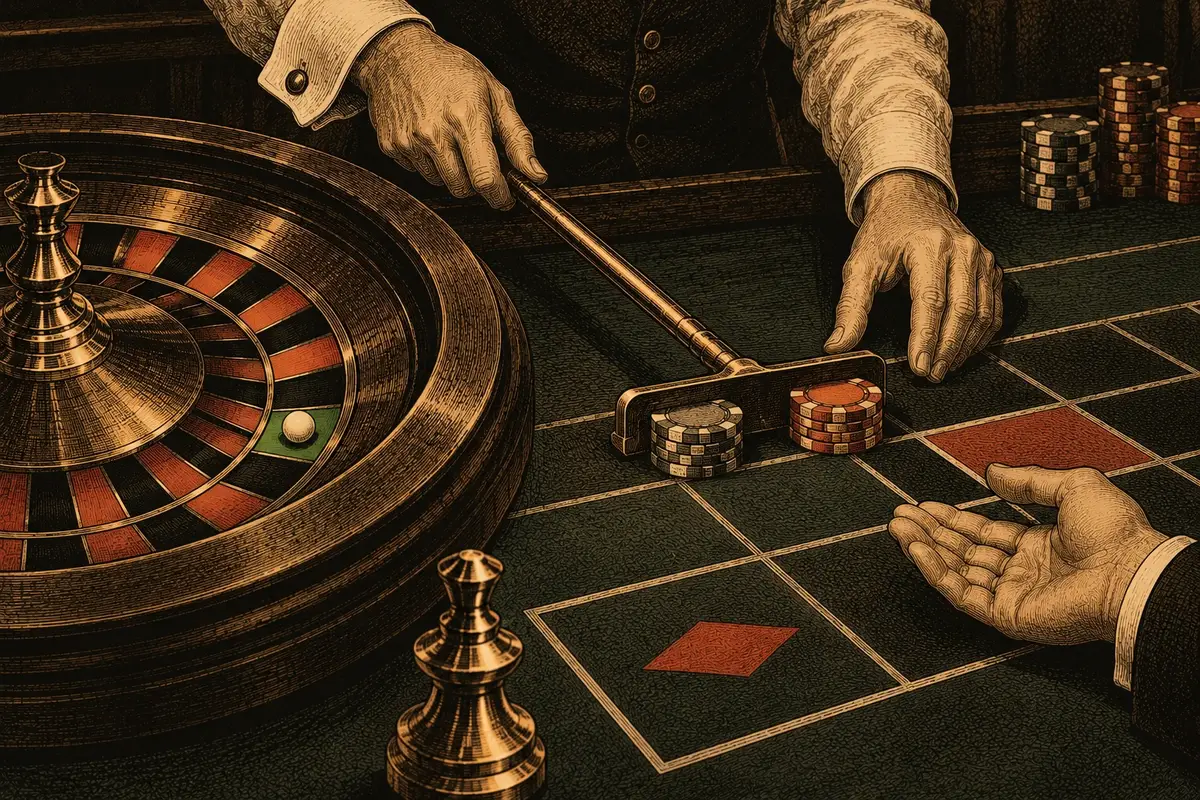
The 1913 run
A 1938 TIME report recounted 26 consecutive blacks at Monte Carlo in 1913. That retrospective account is not a contemporary spin record and does not verify every detail repeated about the event. In the independent single-zero model, a specified run of 26 blacks has probability (18/37)²⁶, about one in 137 million. Seeing a long run somewhere across many trials is a different event.
Questions
No. 18 each.
That requires data from a specified group of players; there is no universal preference assumed here. Popularity does not change the model’s 18/37 probability for either color.
The red and black pocketsequipmentPocketA compartment on the rotor in which the ball can settle. The number of pockets depends on the wheel.Read full definition → alternate, with green zero separating 26 and 32 on the single-zero wheel. The layout uses counting order, so its colors look different.
Comic relief
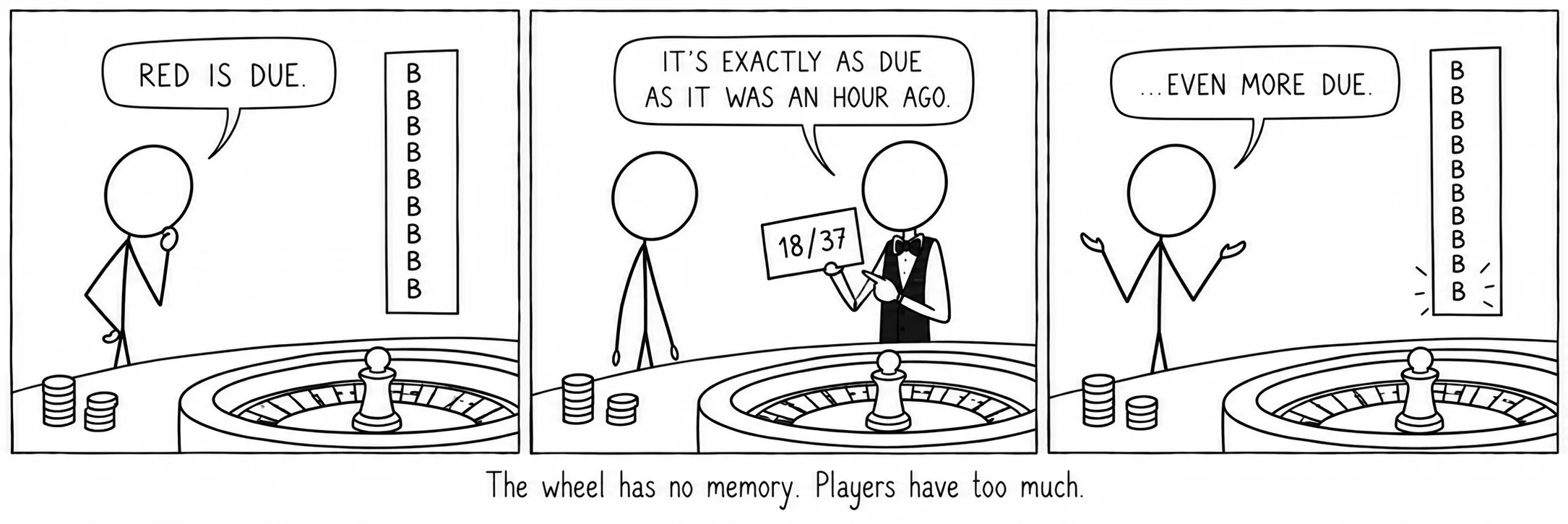
The wheel has no memory. Players have too much.
Sources
- Ethier, S. N. The Doctrine of Chances: Probabilistic Aspects of Gambling.
- Feller, W. An Introduction to Probability Theory and Its Applications, Vol. 1.
- Schwartz, D. G. Roll the Bones: The History of Gambling.