Who Invented Roulette? The Origin of Roulette
Roulette’s history is easier to follow when the name, the wheel and the betting rules are treated separately.
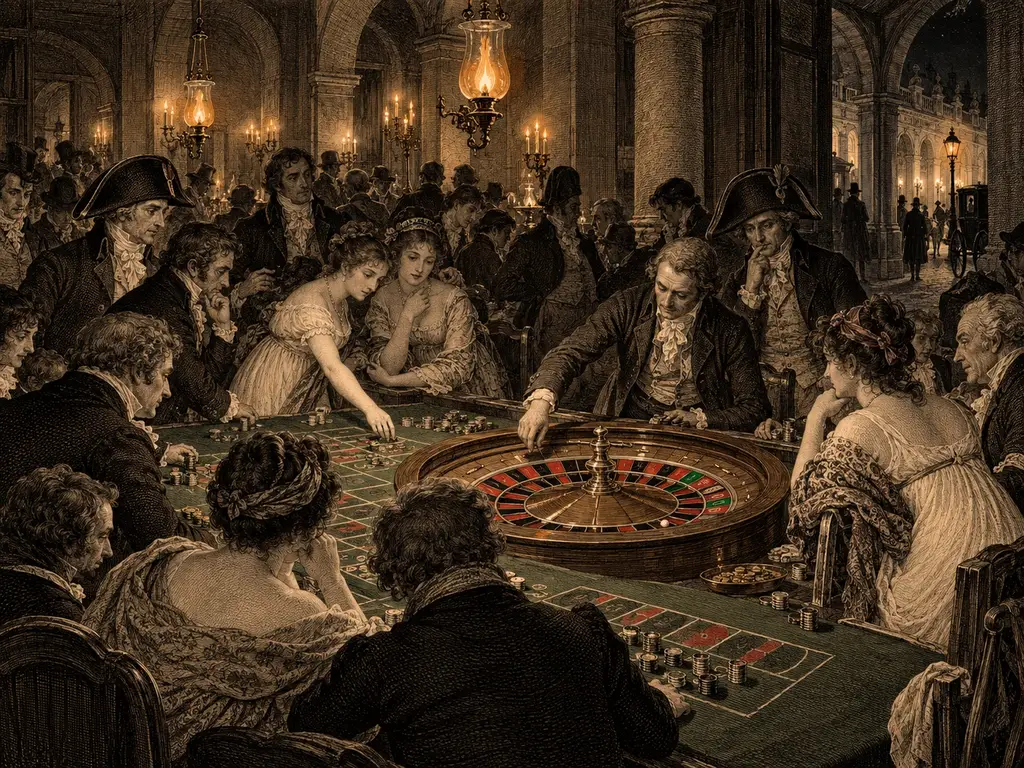
The familiar origin story combines earlier wheel games and numbered betting games, but a resemblance does not identify a single inventor. Jacques Lablée’s La Roulette, ou Histoire d’un joueur survives in an 1802 edition; later developments include the single-zero game associated with the Blanc brothers.
Ancestors
Earlier games offer comparisons rather than a proven family tree. Biribi used numbered betting spaces; the Académie’s modern dictionary describes 70 such spaces. Its 1762 entry states a banker’s advantage of six in seventy. That is 8.57%, but the short entry does not by itself establish every rule, a Genoese invention date or a direct line from biribi to roulette.
| comparison | what it can show |
|---|---|
| a wheel game | a similar outcome mechanism |
| a numbered betting board | a similar way to place wagers |
| a name in an old regulation | that the name was used, not necessarily the modern rules |
| a detailed rule description | the particular form described at that date |
An early description: Lablée’s novel
The catalog record and digitized 1802 volume identify the author as Jacques Lablée and the title as La Roulette, ou Histoire d’un joueur. This is an early source to consult for the game’s rules. A publication date, the date of a scene in a novel and the date a game was invented are different claims; the existence of this edition alone cannot establish a first-ever roulette game in 1796.
Bad Homburg and the Spa CasinosInside vs Outside Bets in Roulette
The name
Roulette is a French word for a little wheel. It also has uses outside gambling, so finding the word in an early text is not enough to identify the casino game. The same caution applies to Pascal’s mathematical work on a rolling curve: a shared name is not evidence that he invented roulette’s wheel or betting layoutequipmentLayoutThe marked betting surface, whether printed on a table or displayed on a screen.Read full definition →.
The two zeros
For modern standard payoutsmoneyPayoutThe amount paid on a winning wager. Check whether the quoted figure is net profit or total return including the stake.Read full definition →, the difference is straightforward: a straight-up bet pays 35:1 whether a uniform wheel has 37 or 38 pocketsequipmentPocketA compartment on the rotor in which the ball can settle. The number of pockets depends on the wheel.Read full definition →. Adding the double zerovariantDouble zeroThe 00 pocket on a conventional 38-pocket wheel. With ordinary payouts, the fair-wheel edge is 2/38, about 5.26%.Read full definition → raises the house edgemathHouse edgeThe casino’s expected net gain expressed as a fraction of the stake, under specified probabilities and payouts.Read full definition → from 1/37 to 2/38. That calculation does not establish which historical wheel came first or why a particular operator chose it.
| standard straight-up bet | single zero | double zero |
|---|---|---|
| pockets | 37 | 38 |
| winning chance | 1/37 | 1/38 |
| net payout | 35:1 | 35:1 |
| house edge | 2.70% | 5.26% |
Why it spread
Roulette allows several players to bet against a common outcome, and its standard payouts give the operator a mathematical advantage under a uniform model. Those features help explain its business appeal, but they do not guarantee profit or a fixed one-minute pace. A historical explanation of its spread also needs evidence about venues, transport, licensing and demand.
Monte Carlo RouletteLong-Run Convergence: The Law of Large Numbers in Roulette
What has not changed
The wheel-and-layout format is recognizable, while rules and technology vary. Single-zerowheelZeroThe 0 outcome, conventionally shown in green. Ordinary color, parity, high/low, dozen and column bets do not include it.Read full definition →, double-zero and triple-zero games have different standard edges; special zero rules and bonus payouts can change them further. Single zero was therefore not the only change capable of improving a player’s odds. Compare the actual payout rules instead of assuming that every historical or modern roulette game is identical.
Questions
The sources reviewed here do not establish that attribution. His contribution to probabilitymathProbabilityA measure of how likely an event is, from zero to one. Percentages express the same scale from 0% to 100%.Read full definition → is a separate, documented story.
No. Check what equipment and rules the source actually describes.
It defines physical neighborsbetNeighborsPockets adjacent to a selected number around the wheel. A neighbors bet includes a chosen number of them on each side.Read full definition → and sectorwheelSectorA continuous arc of neighboring pockets around the wheel, rather than a group defined by the betting layout.Read full definition → bets. For independent uniform outcomes, changing that order alone does not change the probability of a specified pocket.
Fun with Math
Try these yourself first. Each solution is folded; open it when you are ready.
Biribi paid back 64 for 1 on one number out of 70, the stake included: 63 to 1. What edge is that? If it had offered a bet on two numbers, what payoutmoneyPayoutThe amount paid on a winning wager. Check whether the quoted figure is net profit or total return including the stake.Read full definition → would keep the same edge?
Show the solution
Answer The edge is 6/70, 8.57%. A two-number bet would pay 31 to 1, a whole number.
A single number wins once in 70 draws and pays 63 unitsmoneyUnitA base amount used to express stakes or results.Read full definition →; the other 69 draws lose 1: (63 − 69)/70 = −6/70, an edge of 8.57%. Put another way, the bank pays 64 back where a fair gamemathFair gameIn expected-value terms, a game or wager with zero expected net profit for each side under the stated strategy and rules.Read full definition → would pay 70.
A two-number bet at x to 1 wins twice in 70 draws: 2x units won against 68 lost, an expected valuemathExpected valueThe sum of each possible net result multiplied by its probability. It can be positive, zero or negative.Read full definition → of (2x − 68)/70. Set 2x − 68 = −6: x = 31. That is 32 back for 1, half of 64.
Biribi’s payouts follow 64/n back for 1, and 64 halves cleanly for 1, 2, 4, 8, 16 and 32 numbers, so those bets come out whole. Roulette’s 36 divides by 1, 2, 3, 4, 6, 9, 12, 18 and 36, which suits a layoutequipmentLayoutThe marked betting surface, whether printed on a table or displayed on a screen.Read full definition → of rows of three.
For a hypothetical three-number bet on Biribi’s 70-number model, what net payout preserves the edge of a single-number bet returning 64 for 1? What edges result at the neighboring whole-unit payouts?
Show the solution
Answer 20⅓ to 1. Paying 20 to 1 would cost 10%; paying 21 to 1, 5.71%.
The rule from the puzzle above: a bet on n numbers pays 64/n back for 1. For three numbers that is 64/3 = 21⅓ back, or 20⅓ to 1, which is a fractional payout.
A three-number bet at x to 1 wins 3 times in 70 draws and loses 67 times: an expected value of (3x − 67)/70. At 20 to 1: −7/70, 10%. At 21 to 1: −4/70, 5.71%.
Rounding down by a third of a unit costs the player almost a point and a half; rounding up gives back nearly three points. Many ordinary roulette coverage counts divide 36 exactly. That explains their whole-unit payouts; it is not a rule for every special bet.
Consider a hypothetical uniform 31-pocketequipmentPocketA compartment on the rotor in which the ball can settle. The number of pockets depends on the wheel.Read full definition → wheel with 28 numbered pockets and three special symbols. What gross payout on a four-number bet gives edge 3/31, about 9.68%?
Show the solution
Answer Seven for one, equivalent to a net payout of 6:1.
If a one-unit bet returns X units in total when it wins, expected gross return is 4X/31. To leave an edge of 3/31, require 4X/31 = 28/31, so X=7.
At 8 for 1, expected return would be 32/31, giving the player an edge of 1/31. The answer depends on the stated payout target, not an assumed historical paytable.
Comic relief
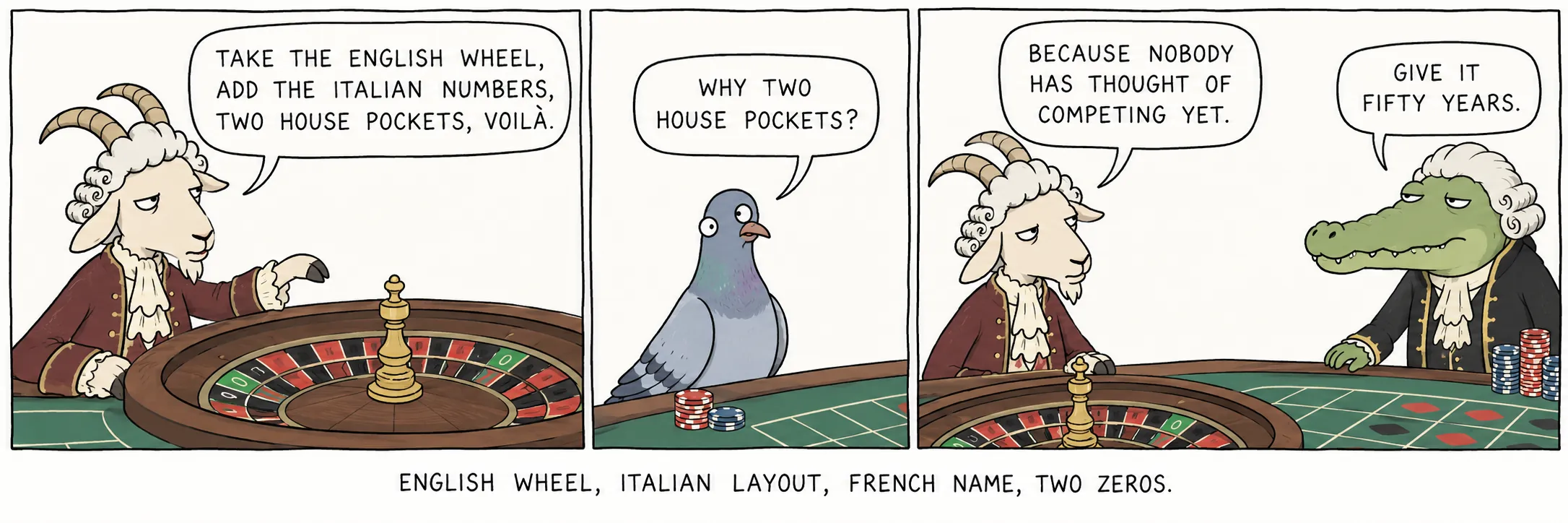
The name, the wheel and the rules have separate histories.
Sources
- Lablée, La Roulette, ou Histoire d’un joueur — digitized 1802 edition
- CAT19, La roulette, ou histoire d’un joueur — 1802 edition
- Académie française, Biribi, fourth edition (1762)
- Académie française, Biribi, ninth edition
- Académie française, Roulette, ninth edition