Problem: The Birthday Wheel
How many spins before some number repeats? Far fewer than most people guess.
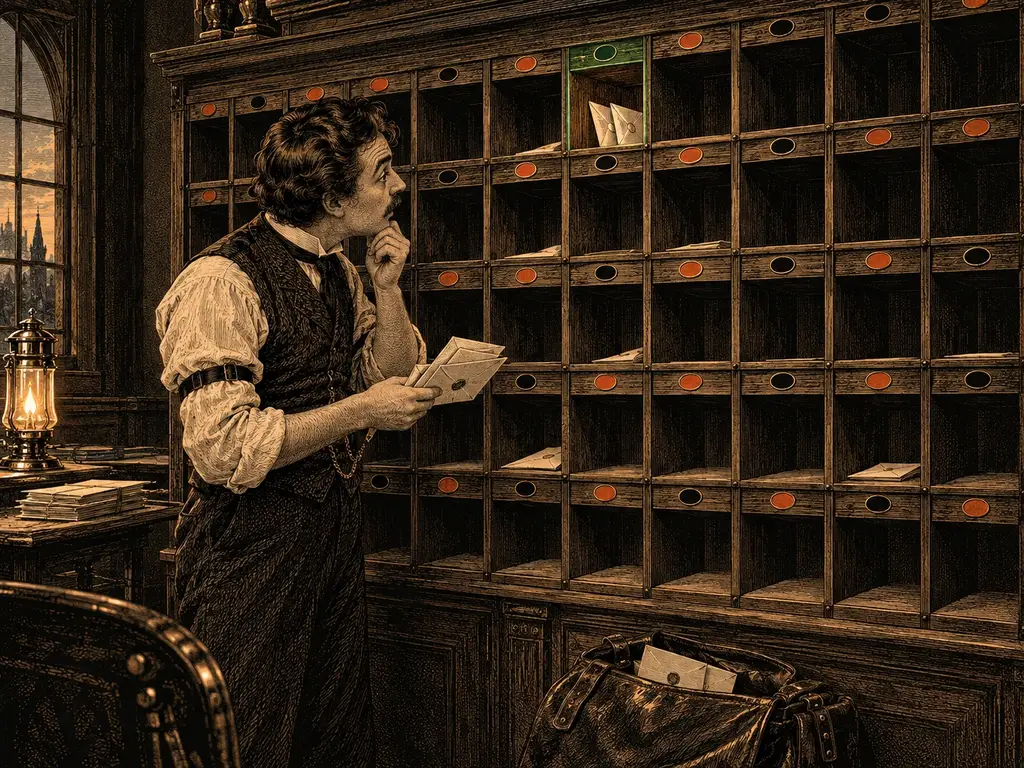
The birthday problem on a 37-pocketequipmentPocketOne of the 37 numbered compartments on the rotor. Also: slot, cup.Read full → wheel: after just 8 spins there is a better-than-even chance that some number has already appeared twice. Players read repeats as patterns; they are the expected behavior of a fair wheel.
The problem
Spin a fair European wheel. How many spins until the probabilitymathProbabilityChance of an outcome, from 0 to 1 or 0% to 100%. One number: 1/37 = 2.70%.Read full → that at least two spins have shown the same number exceeds one half? Most players guess somewhere around 18 or 19, half of 37. The answer is 8.
The solution
Compute the probability of no repeat and subtract from one. After k spins, p(all different) = (37/37)(36/37)(35/37)…((38 − k)/37). For k = 8: 1 × 0.973 × 0.946 × 0.919 × 0.892 × 0.865 × 0.838 × 0.811 ≈ 0.44, so p(some repeat) ≈ 0.56. For k = 14 it is 0.93; for k = 20 it is 0.996. The intuition fails because the number of pairs of spins grows as k², and any pair can match.
Why it matters at the table
A results board of the last 20 numbers will almost always show at least one repeat, often two or three. Players see “17 came twice in ten spins” and conclude 17 is hot; the birthday arithmetic says a repeat within ten spins happens 74% of the time and the repeated number is random. The pattern is real; the meaning is not.
The follow-up problem
How many spins until a specific number, say 17, has appeared twice? That is a different question with a much larger answer: the expected wait is 74 spins, and the probability of two 17s within 20 spins is about 10%. The difference between “some number repeats” (8 spins) and “this number repeats” (74 spins) is the whole difference between a pattern you notice afterwards and a prediction you make in advance.
Try it
Run the Demo Game for ten spins and look at the history. There will usually be a repeat. Run it again. The repeated number will be different. Do this ten times and you have seen the birthday problemmathBirthday problemHow many people it takes before two probably share a birthday, or how many spins before a number probably repeats. On a 37-pocket wheel, 8 spins are enough for a better-than-even chance.Read full →; do it a thousand times (the simulators can) and you have measured it.
Formula
Questions
Exactly, with 37 pockets instead of 365 days. 23 people give 50% for birthdays; 8 spins give 56% for the wheel.
50% after about 19 spins. Still routine.
No. Thousands of spins from one wheel would; a repeat never does.
Fun with Math
Try these yourself first. Each solution is folded; open it when you are ready.
A results board beside an American wheel shows the last 16 spins. How likely is it that no number appears twice on it?
Show the solution
Answer About 2.5%: roughly 39 boards in 40 show at least one repeat.
Go spin by spin. The first spin can be anything. The second must miss it: 37 chances in 38. The third must miss both: 36 in 38. The sixteenth must miss fifteen numbers: 23 in 38.
Multiply: 38/38 × 37/38 × 36/38 × … × 23/38 ≈ 0.0246.
A board with no repeat is the rare one. A board with a repeat says nothing about the wheel.
In ten spins of a European wheel, what is the chance that 17 comes up exactly five times? That some number, any number, comes up five or more times? And that some number comes up at least three times in four spins?
Show the solution
Answer 17 exactly five times: 1 in 315,576. Some number five or more times: about 1 in 8,333. Some number three or more times in four spins: 1 in 349.
17 five times: choose which five of the ten spins, 252 ways, each with chance (1/37)⁵ × (36/37)⁵. Together, 1 in 315,576.
Some number: each of the 37 numbers has a chance of 1 in 308,325 of five or more hits, which gives 37 in 308,325, or 1 in 8,333. The rare case of two numbers with five hits each is counted twice, but taking it out changes nothing at this precision.
Three times in four spins: for one number, 4 × 36 + 1 = 145 of the 37⁴ possible results; for any of the 37 numbers, 145/37³ = 1 in 349.
The Wizard of Odds answered the double-zerowheelZeroThe single green pocket that no even-money, dozen or column bet covers; the source of the house edge. Also: single zero, 0.Read full → versions of these questions; our figures for that wheel are 1 in 359,275, 1 in 9,243 and 1 in 368. The gap between “17” and “some number” is the birthday problemmathBirthday problemHow many people it takes before two probably share a birthday, or how many spins before a number probably repeats. On a 37-pocket wheel, 8 spins are enough for a better-than-even chance.Read full → again: there are 37 ways to be surprised.
Comic relief
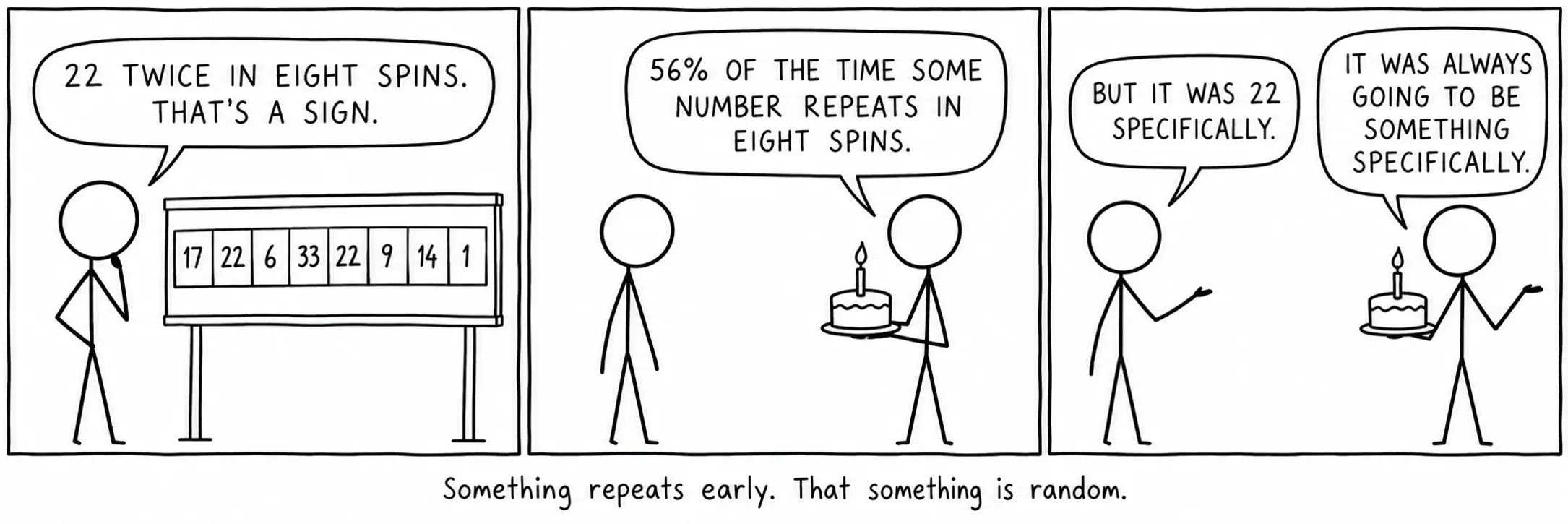
Something repeats early. That something is random.
Sources
- Feller, W. An Introduction to Probability Theory and Its Applications, Vol. 1.
- Wizard of Odds. “Ask the Wizard”, roulette questions.