Roulette Strategy Simulator
Compare simulated results across thousands of roulette sessions. Explore built-in even-money systems or write custom rules for number and outside bets.
- p10 −$1,000
- p25 −$1,000
- median +$400
- p75 +$490
- p90 +$540
Save this example: 1,000 sessions, up to 100 spins each. Seed 0; model 1. Amounts are in USD.
Martingale over 100 spins from a $1,000 bankroll: 62.5% of 1,000 sessions ended ahead and 28.7% lost the entire bankroll. The median net result was +$400, and the mean net result was −$69.11. The simulated mean is below the benchmark of −$27 for funding every scheduled spin at a fixed stake. Higher total stakes increase expected loss, and simulation results also vary by chance. Standard bets in this single-zero model have a house edge of 2.70%.
Flat betting versus Martingale: a reproducible example
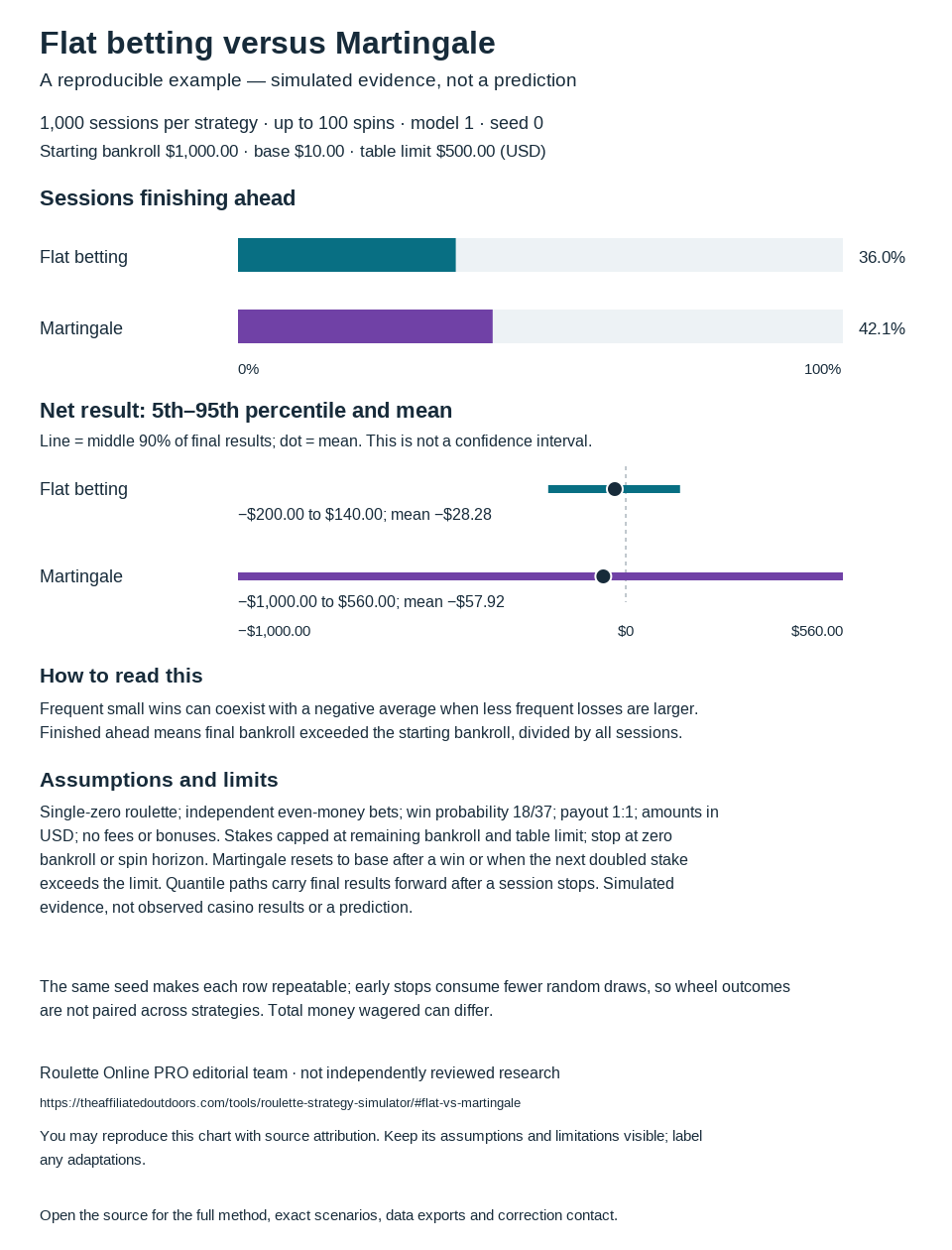
Both rows use a $1,000 starting bankroll, $10 base stake, $500 table limit and 1,000 simulated sessions of up to 100 spins. The model is single-zero roulette with even-money bets: 18/37 chance of winning 1:1 on each independent spin. The fixed seed is 0, model 1.
| Strategy | Finished ahead | Bankroll reached zero | Mean net result | Median net result | 5th / 95th percentile net result |
|---|---|---|---|---|---|
| Flat betting: open scenario | 36.0% | 0.0% | -$28.28 | -$20.00 | -$200.00 / $140.00 |
| Martingale: open scenario | 42.1% | 14.8% | -$57.92 | -$120.00 | -$1,000.00 / $560.00 |
What this comparison means
“Finished ahead” counts sessions ending above their starting bankroll, divided by all 1,000 sessions. “Mean net result” averages the gains and losses of all those sessions. Frequent small wins can coexist with a negative average when less frequent losses are larger. Neither row is a promise about your next session.
The middle 90% of simulated final results is summarized by the 5th and 95th percentiles. These describe the simulated outcome distribution, not a confidence interval for a real player’s return.
Stopping and limit rules matter
Flat betting requests $10 each spin. Martingale doubles after a loss and returns to $10 after a win. In this simulator, if the next doubling would exceed $500, Martingale resets to $10 and continues; it does not recover the preceding losses automatically. Each stake is capped at the remaining bankroll and table limit. A session stops at zero bankroll or at 100 spins.
The same seed makes each row repeatable. It does not pair the same wheel outcome to every spin across strategies: sessions that stop early consume fewer random draws. The rows share starting assumptions, not equal total money wagered. No fees, promotions or zero concessions are modeled.
Select either scenario above to inspect its charts and download its data. Changing the interactive settings does not change this fixed reference table. The share link records settings and model version; it contains no custom code. Read why Martingale encounters limits, how expected loss works, or what a bankroll limit can and cannot do.
Prepared by the Roulette Online PRO editorial team. These are model-generated results, not casino observations or independently reviewed research. Methodology · Report a correction.
Reuse this comparison
Download a scalable chart of this fixed example, including its assumptions and source. It does not change when you adjust the simulator above.
Download comparison chart (SVG)
Cite this result
Roulette Online PRO editorial team. Flat betting versus Martingale: a reproducible example. Simulation model 1; seed 0; 1000 sessions per strategy, up to 100 spins per session. https://theaffiliatedoutdoors.com/tools/roulette-strategy-simulator/#flat-vs-martingale. Simulated results, not casino observations or independently reviewed research.
Select and copy the citation above. Add the date you accessed the example if your citation style requires it.
You may reproduce this chart with source attribution. Keep its assumptions and limitations visible; label any adaptations.