Base Five Roulette Strategy
Base Five advances an even-money wager after wins through 5, 10, 15, and 25 units. A four-win run is uncommon, and a loss at each stage has a different cycle result.
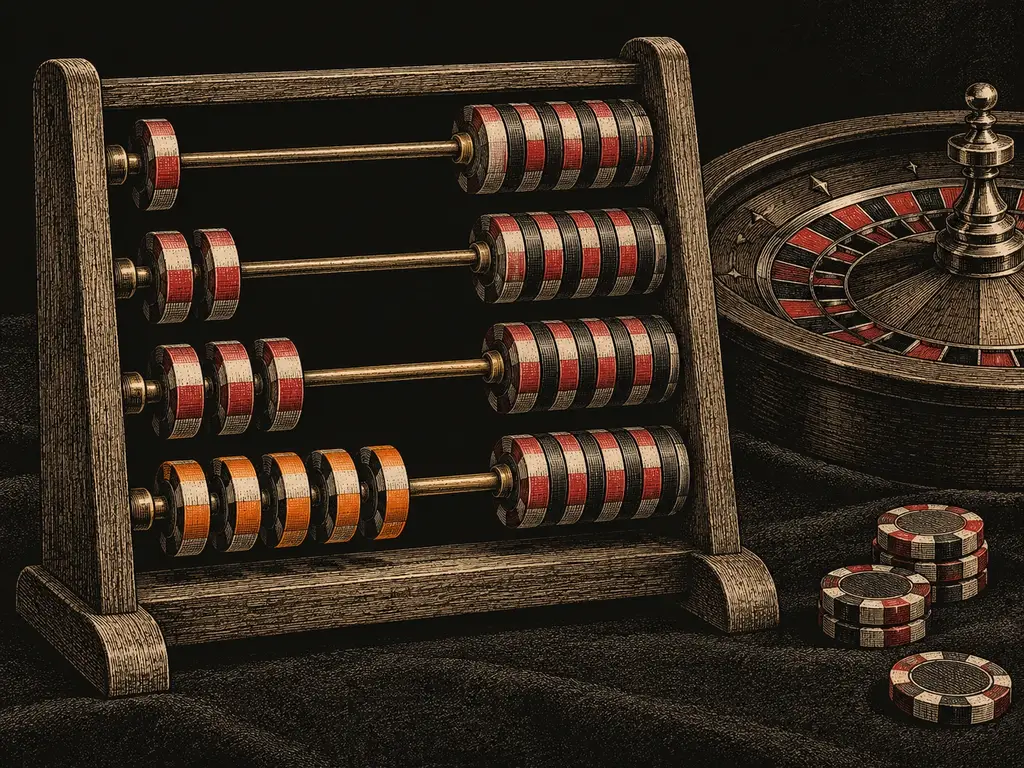
Reset to 5 after any loss or after the fourth win. Four successive wins net 55 units, while losses at stages one through four net −5, −5, 0, and +5.
Steps and reset
Choose one even-money wager. Stake 5 unitsmoneyUnitA base amount used to express stakes or results.Read full definition → first, then increase after each consecutive win to 10, 15, and 25. A loss resets the next wager to 5, as does completing the fourth win. This is a capped positive progressionstrategyProgressionA rule that changes stakes over a sequence of bets, often using previous wins or losses.Read full definition →: it asks for larger bets after success, not after a losing streak. The calculation assumes standard single-zerowheelZeroThe 0 outcome, conventionally shown in green. Ordinary color, parity, high/low, dozen and column bets do not include it.Read full definition → roulette, where an even-money betbetEven-money betA bet paying a profit equal to the stake, such as red/black, odd/even or high/low.Read full definition → wins on 18 of 37 pocketsequipmentPocketA compartment on the rotor in which the ball can settle. The number of pockets depends on the wheel.Read full definition →.
Cycle outcomes
The table treats a cycle as ending at its first loss or after four wins.
| cycle ending event | stakes already resolved | cycle net |
|---|---|---|
| loss at step 1 | 5 | −5 |
| loss at step 2 | 5, 10 | −5 |
| loss at step 3 | 5, 10, 15 | 0 |
| loss at step 4 | 5, 10, 15, 25 | +5 |
| four wins | 5, 10, 15, 25 | +55 |
Worked example
A win at 5 followed by a loss at 10 gives +5 − 10 = −5, so the next wager returns to 5. Three wins then a loss gives +5 + 10 + 15 − 25 = +5. If all four wagers win, the net is 5 + 10 + 15 + 25 = +55. The 25-unit win produces a 50-unit gross return including its own stake, but only 25 of that return is profit.
Expectation and risk
The probabilitymathProbabilityA measure of how likely an event is, from zero to one. Percentages express the same scale from 0% to 100%.Read full definition → of exactly the four wins required for the full cycle is (18/37)^4 = 5.6012%. A visible winning cycle therefore does not make it a likely outcome. More generally, each European even-money unit carries expected lossmathExpected lossThe probability-weighted average net loss under a stated model. With a constant edge, it equals edge times expected total stakes.Read full definition → 1/37, so the expected loss depends on the total amount the progression actually puts at risk. The largest wager is five times the opening wager, and repeated cycles create repeated chances to reach it.
Questions
No. A loss at the third stake breaks even and a loss at the fourth stake leaves a +5-unit cycle; the loss position matters.
A single-zero wheel has 18 winning pockets out of 37 for an even-money bet, because zero loses. The calculation is therefore (18/37)^4.
Comic relief
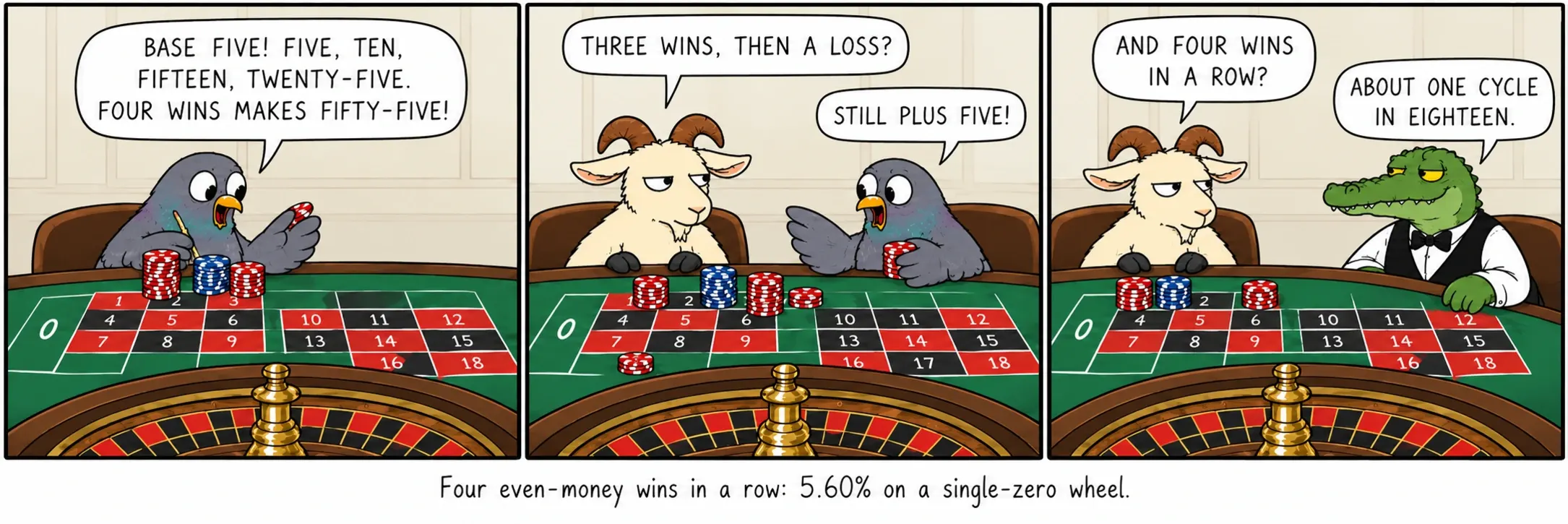
On independent fair single-zero spins, a standard even-money bet wins all four opening wagers with probability (18/37)^4, about 5.60%.
Sources
- RouletteDoc, Strategy overview
- Roulette77, “Base Five” — stated four-step win progression
- Wizard of Odds, Roulette Basics — even-money outcomes and edge
- Wizard of Odds, The Truth about Betting Systems — progression analysis