Chi-Square Test
The standard test for “are these 37 counts what a fair wheel would produce?”
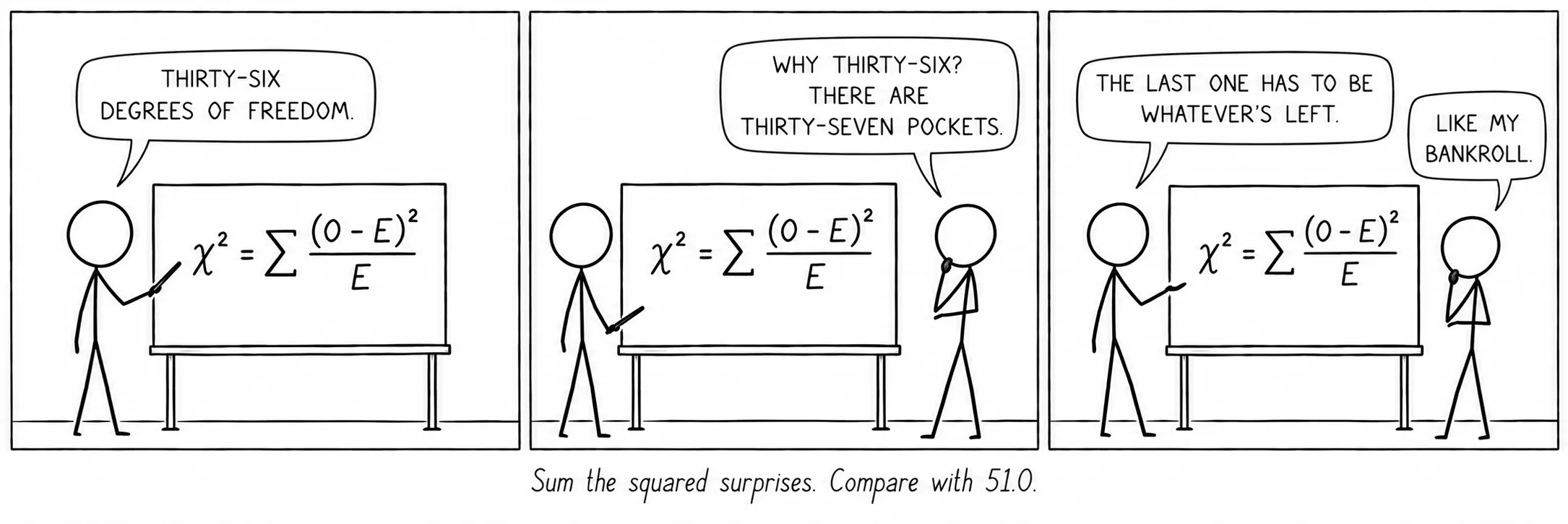
χ² = Σ (observed − expected)² / expected over all 37 pockets. Compare with the chi-square distribution on 36 degrees of freedom to get a p-value.
Computing it
Expected count per pocketequipmentPocketOne of the 37 numbered compartments on the rotor. Also: slot, cup.Read full → is n/37. For each pocket, square the difference between observed and expected and divide by expected; add the 37 terms. A fair wheel gives values around 36 on average (the degrees of freedomlabDegrees of freedomThe number of independent values in a statistic. For a chi-square test on 37 pockets it is 36, because the counts must add up to the total.Read full →), with a standard deviationmathStandard deviationSquare root of variance; the typical distance of a result from the expected value.Read full → of about 8.5. Above 51.0 is significant at the 5% level; above 58.6 at 1%. The Wheel Bias Analyzer computes the statistic and the exact p-valuelabp-valueThe probability of seeing a deviation at least as large as the one observed if the wheel were fair.Read full → from the regularized incomplete gamma function.
A worked example
1,000 spins. Thirty-six pockets land between 20 and 34 hits; pocket 8 has 41. Expected is 27.03. The pocket-8 term alone is (41 − 27.03)²/27.03 = 7.2. Suppose the other 36 terms sum to 38 (typical). χ² = 45.2 on 36 df, p ≈ 0.14. Not significant: a fair wheel does this one time in seven. Pocket 8 is a candidate, not a finding, and the answer is another thousand spins.
Assumptions
Independent spinsmathIndependent spinsEach spin has the same probabilities regardless of history. The basis for every calculation on this site.Read full →, and expected counts of at least 5 per pocket, which means n ≥ 185 for the test to be valid at all and far more for it to be useful. Pooling spins across wheels violates the first assumption in spirit (you are testing a mixture, not a wheel). A dealer-signature effect would violate it in fact, and would inflate χ² without any pocket being physically favored.
Pearson and Monte Carlo
Karl Pearson published the test in 1900, and one of his first worked examples was 26,306 recorded Monte Carlo roulette spins, which he found far too non-uniform to be chance and declared that “Monte Carlo roulette… is not a game of chance”. Later writers concluded that the journalists who recorded the spins for a newspaper had invented many of them, which is its own lesson about data provenance.
Pearson publishes the chi-square goodness-of-fit test, with Monte Carlo spins as an example.
The spin data is questioned; recorders appear to have fabricated runs.
Fisher formalizes degrees of freedom; the 5% convention takes hold.
Statisticians use roulette spins as textbook data for uniformity tests.
The García-Pelayo family apply the method with real recorded data and win in Madrid.
Casinos run the same test on their own wheels as routine maintenance.
A real test: automatic wheels in Las Vegas
Players often suspect that an automatic wheel steers the ballequipmentBallThe small ball launched along the track against the rotor. Modern balls are ivorine or Teflon, 18–21 mm.Read full → away from big bets. In 2017 the Wizard of Odds put the suspicion to the test on Interblock’s dealerless double-zerowheelZeroThe single green pocket that no even-money, dozen or column bet covers; the source of the house edge. Also: single zero, 0.Read full → wheels in Las Vegas, betting on an arc of five neighboring numbers, the kind of bet a wheel clocker makes. In 299 spins the arc won 29 times against 39.3 expected, a shortfall a fair wheel produces about 4% of the time. The chi-square over all 38 pockets was 45.29 on 37 degrees of freedom: p = 16.5%. A second sample of 1,204 spins on three wheels gave χ² = 34.79, p = 57%, and no arc of any size he tried was significant. Both samples together, 1,503 spins, gave χ² = 41.75, p = 27%. The verdict was no evidence of steering. The first sample alone looked suspicious; the second is what settled it.
Beyond chi-square
For a single suspected pocket a binomial test is more powerful. For a suspected arc, the sectorwheelSectorA contiguous arc of pockets on the wheel, as distinct from a group on the layout.Read full → z-test on the sector analysis page. Chi-square is the omnibus test: it tells you something is off without saying what. Use it first, then look.
Formula
Questions
The 37 counts must sum to n, so only 36 are free to vary.
A wheel with one pocket at 1/25 in 10,000 spins would give a pocket term around 70 alone; χ² well over 100, p effectively zero.
Technically yes, with expected 5.4 per pocket. It will detect nothing short of a wheel with a pocket glued shut.
Comic relief
Sum the squared surprises. Compare with 51.0.
Sources
- Pearson, K. “On the criterion that a given system of deviations from the probable…”
- Feller, W. An Introduction to Probability Theory and Its Applications, Vol. 1.
- Wizard of Odds. “Organic Roulette Experiment.”