Andrucci Roulette Strategy
Watch the wheel for a while, find the number that came up most, then bet on it. It sounds like hunting for a biased wheellabBiased wheelA wheel whose outcomes do not have equal probabilities. The cause and strength of any bias require investigation.Read full definition →; the numbers say it is not.
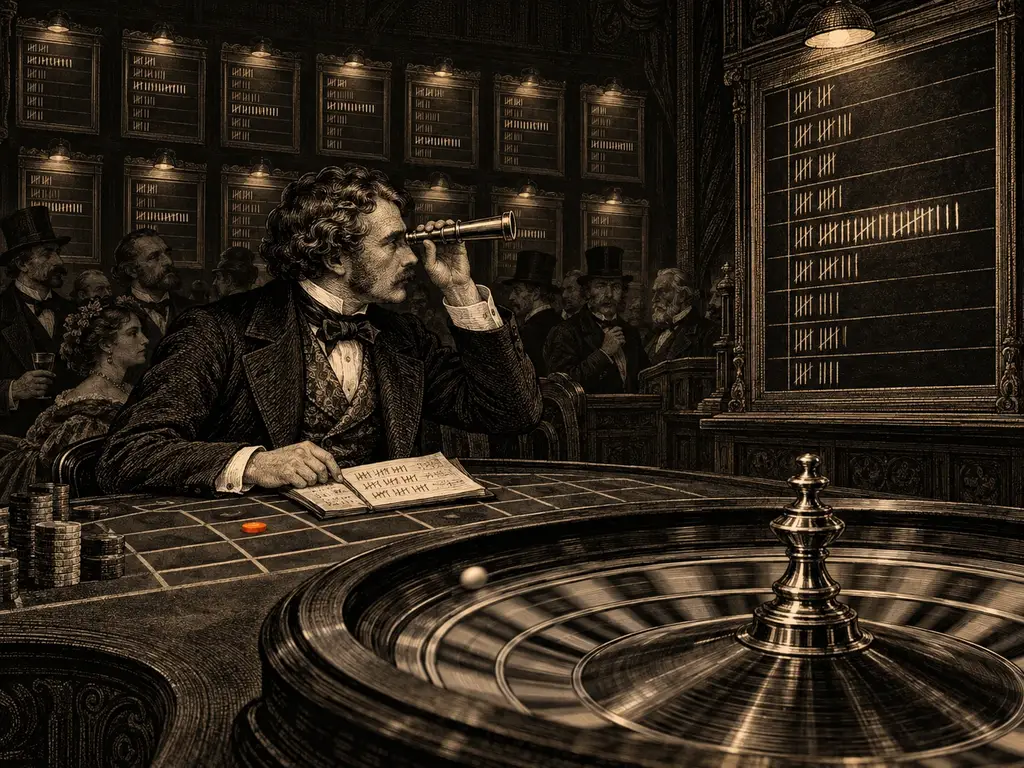
Every wheel shows a “hot” number after 37 spins, biased or not: the busiest number has usually come up three or four times by chance alone. Betting it straight up for the next 37 spins costs 2.70% of every chipmoneyChipA token used to place a wager, with a printed or assigned value. Also called a check in some casino terminology.Read full definition →, like any other number. A short sample alone does not establish a bias or identify a profitable pocket.
How is the Andrucci system played?
Observe and record 30 to 37 spins; observation does not require placing bets. Pick the number that came up most often. Then bet one unitmoneyUnitA base amount used to express stakes or results.Read full definition → straight upbetStraight upA wager on one number, ordinarily paying a profit of 35 to 1.Read full definition → on it for about as many spins again. Some versions follow two or three hot numbersmythHot numberA number appearing frequently in a specified recent record. On independent spins, that label alone does not improve its next-spin chance.Read full definition →, and some switch to whichever number leads the count as play goes on. The name does not supply evidence that the method predicts future results.
Why does every wheel have a hot number?
In 37 spins of an unbiased wheel each number appears once on average, but the spins are not shared out evenly. The busiest number has come up exactly three times in about 47.38% of such runs, exactly four times in 40.05%, and five times or more in 10.96%. A count of four or more in 37 spins looks like a pattern, and chance alone produces one in about 51.00% of these 37-spin samples.
| times the busiest number appears in 37 spins | share of 37-spin runs |
|---|---|
| 2 | 1.6% |
| 3 | 47.38% |
| 4 | 40.05% |
| 5 | 9.33% |
| 6 or more | 1.6% |
What does the betting phase pay?
Once the watching is over, the system is a straight up played 37 times. The chosen number wins with chance 1/37 on each spin, as every number does. It misses all 37 spins in 36.3% of sessions, for −37 units; hits once in 37.3%, for −1; and hits twice or more in 26.4%, for +35 units or better. On average a session loses 1 unit for every 37 staked: 2.70%.
| hits in 37 bets | result | share of sessions |
|---|---|---|
| 0 | −37 units | 36.3% |
| 1 | −1 unit | 37.3% |
| 2 | +35 units | 18.6% |
| 3 or more | +71 units or more | 7.8% |
What if the wheel really is biased?
If a pocketequipmentPocketA compartment on the rotor in which the ball can settle. The number of pockets depends on the wheel.Read full definition → has probabilitymathProbabilityA measure of how likely an event is, from zero to one. Percentages express the same scale from 0% to 100%.Read full definition → 1/30 and pays 35:1, a straight-up bet on it has expected return 36/30 − 1 = +20% of the stake. That hypothetical calculation assumes the pocket and its probability are already known. Choosing the busiest pocket in 37 observations does not establish either assumption. Detection depends on the size and stability of the bias, the sample size, and the method used to account for searching across many pockets.
Why does it appeal?
It borrows the language of real bias hunting, and sometimes of chaos theory, and it gives the player something to do while the wheel spins. For the same fixed stakes and number of independent uniform spins, it has the same expected lossmathExpected lossThe probability-weighted average net loss under a stated model. With a constant edge, it equals edge times expected total stakes.Read full definition → as choosing any number in advance.
Questions
No. On an unbiased wheel the hot number is a number like any other, and every chip on it costs 2.70%.
In cost, yes. Chasing the hot number and waiting for a “due” cold one are the same straight up at the same price.
There is no universal count. The required sample depends on the effect size, error rates and analysis method. See How to Detect Roulette Wheel Bias and Sample Size.
Fun with Math
Try these yourself first. Each solution is folded; open it when you are ready.
After 37 spins your notebook shows that 23 has come up five times. How unusual is that for 23 in particular? And how unusual is it for the busiest number of those 37 spins to have five or more?
Show the solution
Answer For 23 named in advance, five or more hits in 37 spins happen about once in 327 runs. For whichever number turns out busiest, about one run in nine. The second is the question the notebook actually answers.
For one named number the hits in 37 spins follow the binomial distribution with chance 1/37 a spin. The chance of 0, 1, 2, 3 and 4 hits adds up to 99.69%, so five or more is 0.31%, about 1 in 327.
But nobody named 23 before the spins; it was picked because it came up most. With 37 numbers competing, one of them reaching five is far more likely: about 11% of independent uniform 37-spin runs. An occupancy calculation counts allocations in which every pocketequipmentPocketA compartment on the rotor in which the ball can settle. The number of pockets depends on the wheel.Read full definition → appears at most four times, then subtracts their probabilitymathProbabilityA measure of how likely an event is, from zero to one. Percentages express the same scale from 0% to 100%.Read full definition → from 1.
So a count of five is surprising for a number you chose beforehand and ordinary for the leader of the count. Betting the leader afterwards is a straight upbetStraight upA wager on one number, ordinarily paying a profit of 35 to 1.Read full definition → like any other, at 2.70%.
Comic relief
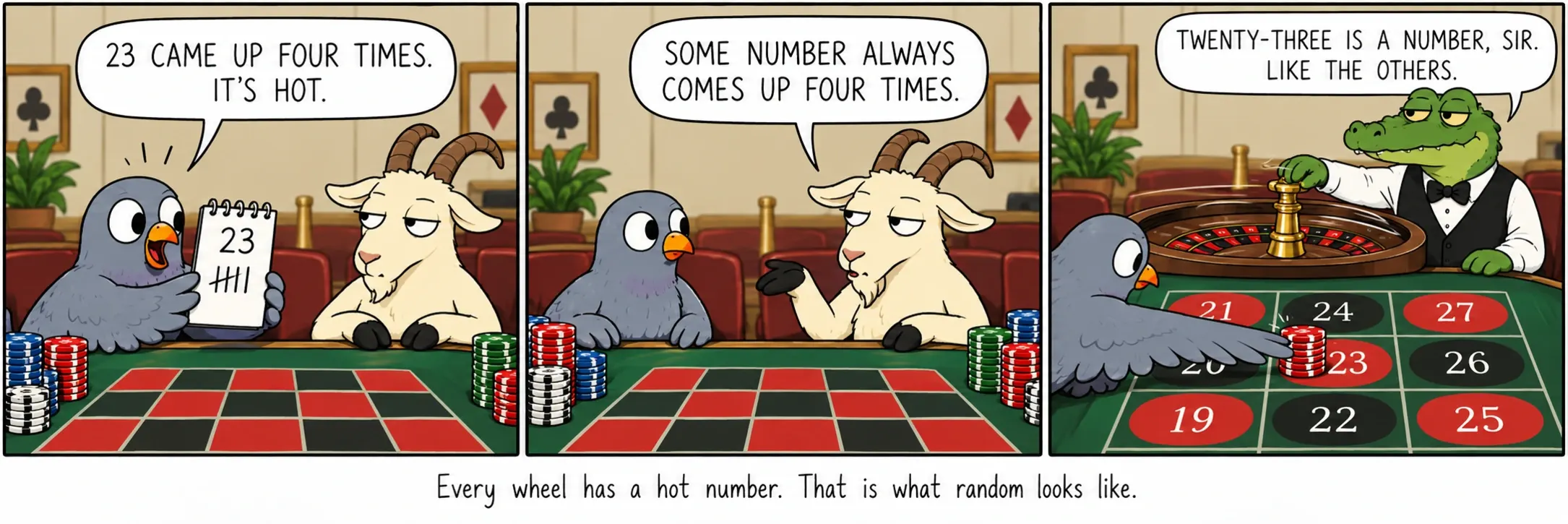
Past hits do not change the odds on an independent spin.
Sources
- RouletteDoc. Strategy description and examples.
- Roulette77. Strategy description and examples.
- Ethier, S. N. The Doctrine of Chances: Probabilistic Aspects of Gambling.
- Barnhart, R. T. Beating the Wheel.