Variance
Why a straight up and a red bet with the same expected lossmathExpected lossExpected value times total amount wagered; the average amount lost over a session or a period.Read full → feel like different games.

Variance measures how far results spread around the expected value. Per unit staked it is about 34 for a straight up and about 1 for red.
The formula for one bet
For a bet that pays W to 1 with probabilitymathProbabilityChance of an outcome, from 0 to 1 or 0% to 100%. One number: 1/37 = 2.70%.Read full → p, the result per unitmoneyUnitThe base stake a system or a player works in. Progressions are described in units so they apply at any table.Read full → is +W with probability p and −1 with probability 1 − p. The expected valuemathExpected valueThe average result per bet over the long run. −1/37 of the stake for every standard European bet.Read full → is pW − (1 − p) = −1/37. The variancemathVarianceA measure of how widely results spread around the expected value. High for straight up, low for even-money bets.Read full → is E[X²] − EV² = pW² + (1 − p) − (1/37)². For a straight upbetStraight upA single number, pays 35:1.Read full →: (1/37)(1225) + 36/37 − 0.0007 ≈ 34.08. For redbetRedEven-money bet on the 18 red numbers. French: rouge.Read full →: 18/37 + 19/37 − 0.0007 ≈ 0.999.
What it means for a session
Variances add across independent spinsmathIndependent spinsEach spin has the same probabilities regardless of history. The basis for every calculation on this site.Read full →, so over N spins at a fixed stake the variance of the total is N × stake² × σ², and the standard deviationmathStandard deviationSquare root of variance; the typical distance of a result from the expected value.Read full → is σ × stake × √N. 100 spins at $10: the standard deviation is about $584 for straight ups and $100 for red, around the same expected −$27. One player sees results swinging by hundreds; the other sees a gentle drift. Both are paying the same price.
Variance and systems
A progressionstrategyProgressionAny rule that changes the stake based on previous results. Negative progressions raise it after losses, positive after wins.Read full → does not change the EV per unit wagered but changes both the amount wagered and the shape of the distribution. MartingalestrategyMartingaleProgression that doubles the bet after each loss. See the Strategy section for what it does and does not do.Read full → lowers the variance of most sessions (many small wins) and adds a fat tail (the rare large loss); the total variance across all sessions is higher than flat bettingstrategyFlat bettingWagering the same amount every spin. The baseline every progression is compared against.Read full →’s because of that tail. ParolistrategyParoliPositive progression: double after a win, reset after a loss or after three wins in a row. Also: reverse Martingale.Read full → does the reverse. Choosing a system is choosing a variance profile; the mean is not on the menu.
- p10 −$500
- p25 −$500
- median −$500
- p75 +$40
- p90 +$1,120
Why it matters to a player
Variance is what makes short sessions unpredictable and long ones predictable. With σ = $100 and EV = −$27 over 100 spins, the edge is a quarter of the noise and a winning session is ordinary. Over 10,000 spins the EV is −$2,700 and σ is $1,000; the edge is now nearly three times the noise and a winning run is a three-sigma event. Variance is the player’s friend in the short run and the house’s in the long.
Variance of a combination
For several bets on the same spin, outcomes are correlated (a hit on 17 is also a hit on blackbetBlackEven-money bet on the 18 black numbers. French: noir.Read full → and the second dozenbetDozen1–12, 13–24 or 25–36, pays 2:1.Read full →), so the variances do not simply add. The Bet Builder tool computes the exact distribution for any set of chipsmoneyChipA token representing a fixed amount, placed on the layout to make a bet. Also: check.Read full → by enumerating all 37 outcomes, which is the only correct way to do it.
Formula
Questions
No. Every bet has the same expected value. Higher variance means wider swings around it.
Even-money betsbetEven-money betRed/black, odd/even, high/low. 18 numbers, pays 1:1.Read full →, at σ ≈ 1 per unit. Lower still with la partageruleLa partageFrench rule: when zero hits, half of an even-money stake is returned. Halves the house edge on those bets to 1.35%.Read full →, which also improves the mean.
The expected profit is the same per dollar; variance only affects how lumpy the casino’s income is, and a casino has thousands of players to smooth it.
Fun with Math
Try these yourself first. Each solution is folded; open it when you are ready.
Two players each bet $1 a spin for 100 spins on a European wheel, one always on redbetRedEven-money bet on the 18 red numbers. French: rouge.Read full →, the other always on 17. Who is more likely to be ahead at the end?
Show the solution
Answer The player on 17: 50.9%, against 35.5% for red. Both lose $2.70 on average.
Red: the player is ahead with 51 or more wins out of 100, each with probabilitymathProbabilityChance of an outcome, from 0 to 1 or 0% to 100%. One number: 1/37 = 2.70%.Read full → 18/37. The binomial distribution gives 35.5%, and exactly 50 wins, breaking even, another 7.7%.
Number 17: each win returns $36, so two wins (−$28) are not enough and three (+$8) are. The chance of three or more hits in 100 spins at 1/37 is 50.9%.
The straight-up player is ahead more often, but the results are lumpier: one hit more or less moves the result by $36, and the players who are behind are usually further behind. Bollman (2024) gives the American figures, 26.5% and 49.2%.
Comic relief
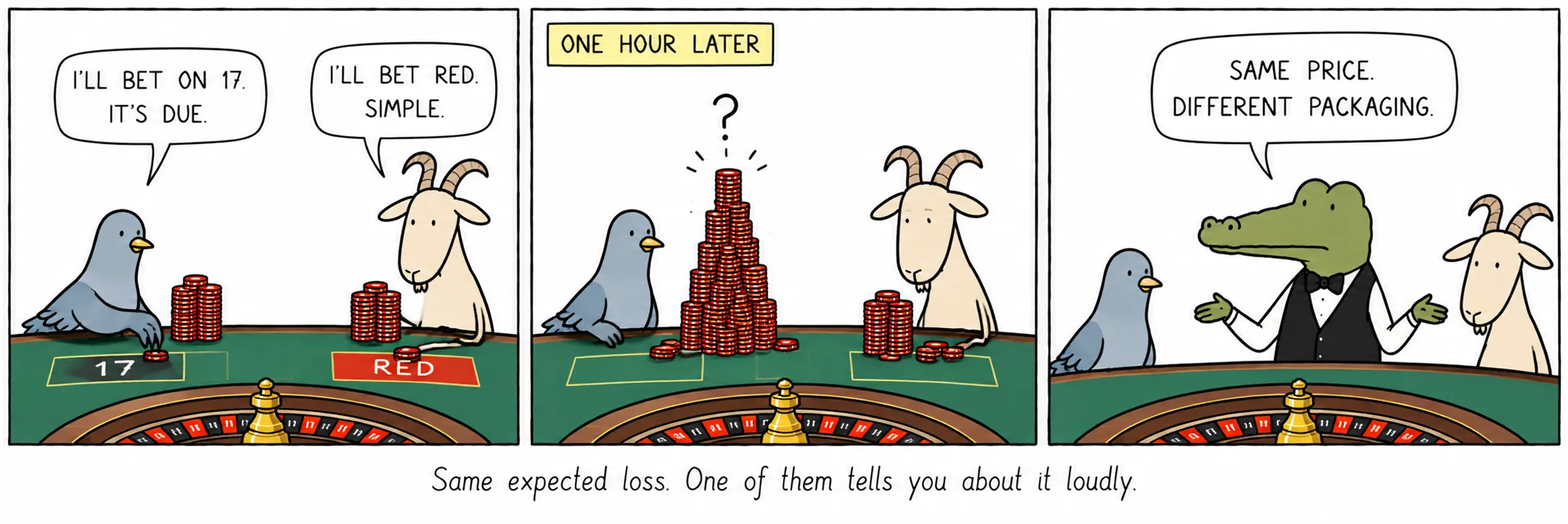
Same expected loss. One of them tells you about it loudly.
Sources
- Ethier, S. N. The Doctrine of Chances: Probabilistic Aspects of Gambling.
- Feller, W. An Introduction to Probability Theory and Its Applications, Vol. 1.