Live vs RNG Roulette
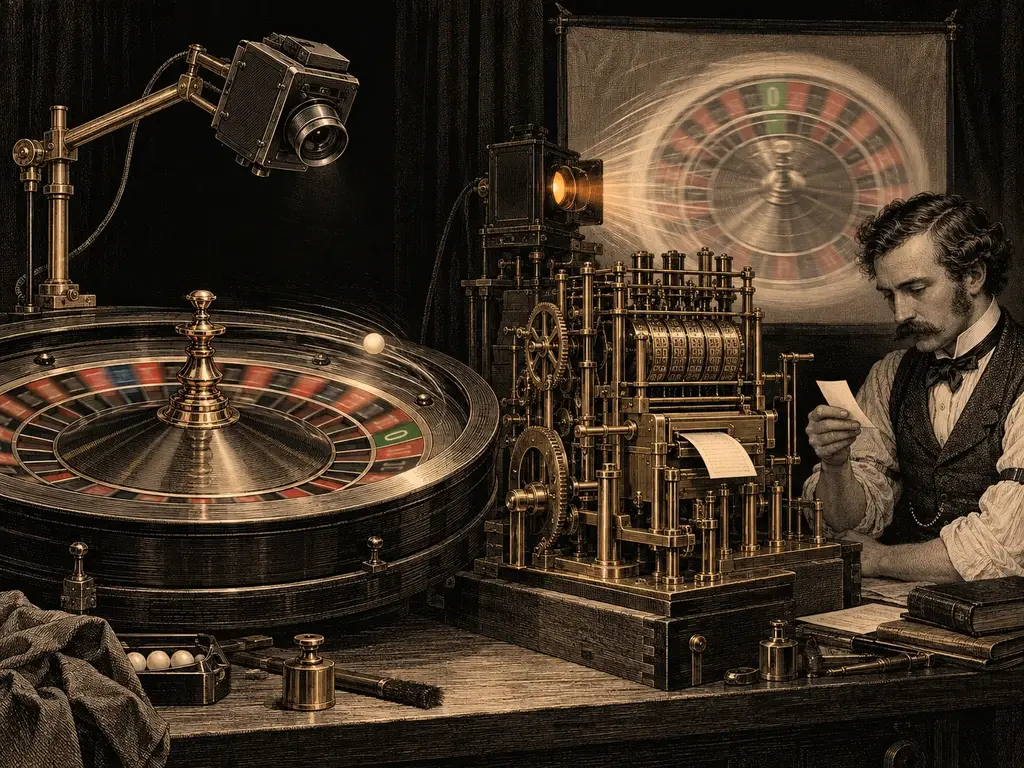
A camera on a wheel, or a number from software.
RNG roulettevariantRNG rouletteRoulette with a software random number generator instead of a physical wheel. Same odds, no wheel bias possible.Read full → draws the pocket from a certified random number generator; the wheel on screen is animation. Live roulette shows the real spin. House edgemathHouse edgeThe share of each stake the casino keeps on average: 2.70% in European roulette.Read full → is 2.70% in both.
How an RNG table works
When you press spin, the game server asks a random number generator for a value and maps it to one of 37 pocketsequipmentPocketOne of the 37 numbered compartments on the rotor. Also: slot, cup.Read full →. The result exists before the animation starts; the wheel you watch is a film of a decision already made. The RNG is a cryptographic or hardware generator certified by an independent laboratory against statistical test suites (frequency, serial correlation, runs, spectral tests) over billions of draws. The animation can be skipped on most tables, which is the honest way to think about it.
How a live table works
A real wheel in a studio, a dealer, several cameras, a stream and a game server that opens and closes betting and settles bets. The result comes from physics. The Live Roulette Technology page has the detail.
Trust
RNGs are tested far more thoroughly than any physical wheel could be. Live wheels are inspected like casino wheels, and every spin is logged for audit. Neither can be “due” and neither has memory. The difference in trust is psychological: people believe what they can see, and a filmed ballequipmentBallThe small ball launched along the track against the rotor. Modern balls are ivorine or Teflon, 18–21 mm.Read full → is more persuasive than a certificate. Mathematically the certificate is the stronger evidence.
Pace and cost
Expected lossmathExpected lossExpected value times total amount wagered; the average amount lost over a session or a period.Read full → per hour = stake × spins per hour / 37. The RNG table lets you spin four times as fast as a live table, which at the same stake costs four times as much per hour. Players who move from live to RNG and feel they are losing faster are correct about the clock and wrong about the odds.
Which to choose
RNG for low minimums, practice and speed; live for the experience, the pace control the server imposes, and la partageruleLa partageFrench rule: when zero hits, half of an even-money stake is returned. Halves the house edge on those bets to 1.35%.Read full → tables, which are more commonly offered in live studios than in RNG lobbies. The strategy editor in the Demo Game on this site is, in effect, an RNG table with a visible random seed, so you can see exactly what “the result exists before the spin” means.
Published spin histories
Live tables show the last 10 to 500 results and many operators publish full histories. These are useful for exactly one thing: the wheel-bias analysis described in the Lab, which needs thousands of spins from one identified wheel. For predicting the next spin they are decoration, like the RNG animation.
Questions
Yes, by one to three seconds. Bets close on the server before the ball slows, so the delay cannot be exploited.
Certified RNGs are sealed and audited; the operator cannot adjust the distribution without failing the audit.
Yes. The betting windowliveBetting windowThe period in a live round during which bets are accepted, timed by the game server and shown as a countdown.Read full →, the spin and the settlement take real time. The pace is a feature.
Because you see more spins per hour. The streak statistics are identical.
Comic relief
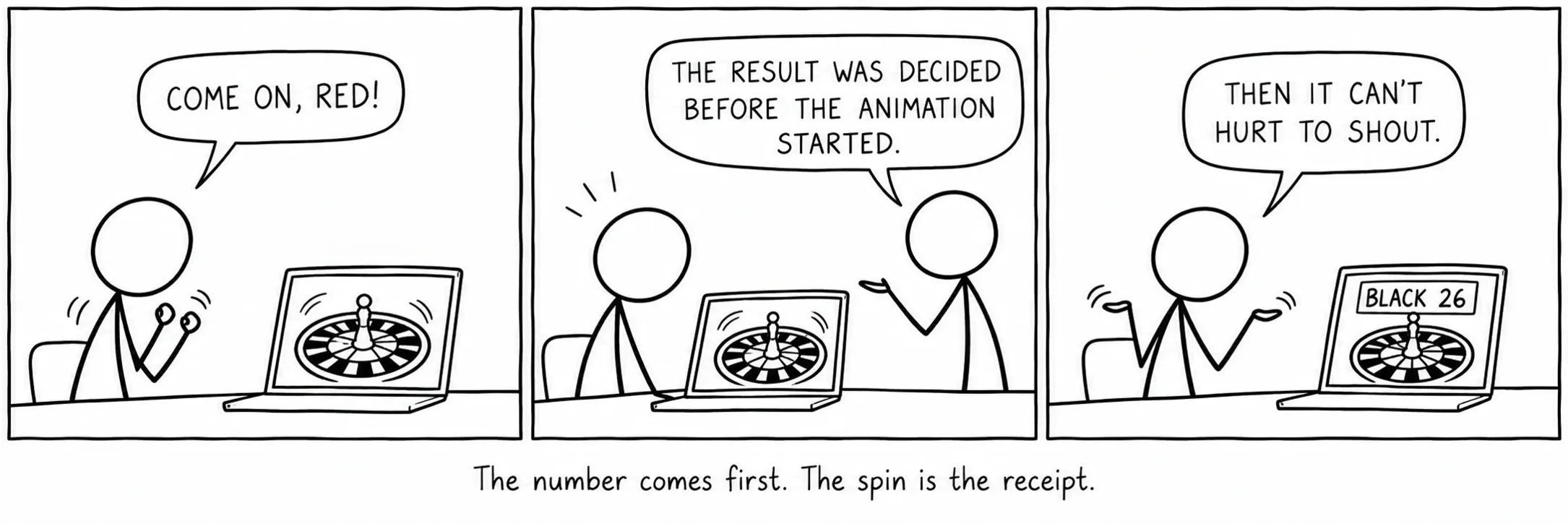
The number comes first. The spin is the receipt.
Sources
- UK Gambling Commission. Remote gambling and software technical standards.
- Malta Gaming Authority. Gaming Devices Regulations and technical directives.