Double Ball Roulette
Two balls on one wheel. Inside betsbetInside betAny bet placed on or between the numbers of the grid: straight up, split, street, corner, six line.Read full → need one ball; outside bets need both.
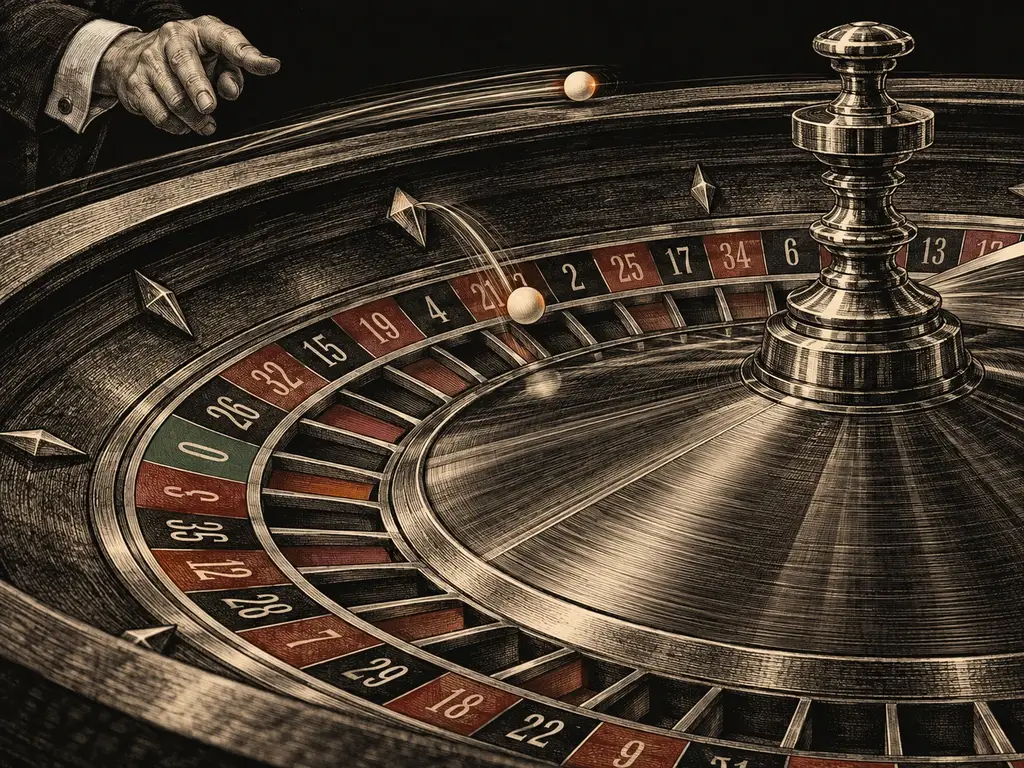
Two balls are fired together and land independently, so now and then they share a pocket. Inside bets win if either ball hits, at half the usual payout, and pay double if both do. Outside bets win only if both balls agree, which makes them twice as dear as on a one-ball table. A jackpot bet pays if both balls land on your number.
Inside bets
Your straight upbetStraight upA single number, pays 35:1.Read full → wins if either ballequipmentBallThe small ball launched along the track against the rotor. Modern balls are ivorine or Teflon, 18–21 mm.Read full → lands on it and pays 17 to 1 for each ball that does, so 34 to 1 if both do. On a single-zerowheelZeroThe single green pocket that no even-money, dozen or column bet covers; the source of the house edge. Also: single zero, 0.Read full → wheel one ball lands on your number in 72 of 1,369 equally likely pairs and both balls in 1. The bet wins 72 × 17 + 34 = 1,258 and loses 1,296, a net loss of 38 in 1,369: an edge of 2.78%, a touch above 2.70%. Paying 35 to 1 when both balls hit would bring it back to exactly 2.70%. The halved payoutsmoneyPayoutWhat a winning bet returns, quoted as “X to 1” on top of the returned stake.Read full → run down the inside table. The cornerbetCornerFour numbers sharing a corner on the layout, pays 8:1.Read full → is the trap: at 3 to 1 it costs 14.7%, where a fair price would be about 3.7 to 1.
Outside bets
RedbetRedEven-money bet on the 18 red numbers. French: rouge.Read full → needs both balls red: (18/37)² = 23.7%, paid 3 to 1. The bet returns 4 × 23.7% = 94.7% of the stake, an edge of 5.33%, twice the European figure. A dozenbetDozen1–12, 13–24 or 25–36, pays 2:1.Read full → needs both balls in it, (12/37)² = 10.5%, and pays 8 to 1: 5.33% again. So does the bet that one ball lands red and the other blackbetBlackEven-money bet on the 18 black numbers. French: noir.Read full →, at even money. All three cost 1 − (36/37)² = 5.33%, the price of a bet that has to get past the zero twice.
Where you find it
The game was shown at the Global Gaming Expo in 2013 and dealt at the Tropicana in Las Vegas from 2014 on a double-zero wheel. There red costs 10.25% and the 1,200 to 1 jackpot 16.83%. Live studios run single-zero versions and pay 1,300 to 1 on the jackpot. The balls are fired from a tube by compressed air, a moment apart; the maker’s tests found them sharing a pocketequipmentPocketOne of the 37 numbered compartments on the rotor. Also: slot, cup.Read full → about as often as chance predicts.
How to play it, if you must
Straight ups and splitsbetSplitTwo adjacent numbers, pays 17:1.Read full →, at under 3%, are the honest part. Outside betsbetOutside betA bet on the boxes surrounding the grid: dozens, columns and even-money bets.Read full → cost twice a European table. Corners at 3 to 1 cost more than any bet on an American wheel. The jackpot bet is a lottery ticket whose price depends on the table: 4.97% at 1,300 to 1, 12.27% at 1,200.
Questions
Yes. They land independently, so both in one pocket happens once in 37 spins on average, and both in a pocket you chose once in 1,369. That is what the jackpot bet pays for.
Because 3.22 to 1 is the fair payout for a 23.7% chance, and the house keeps the difference, 5.33% of the stake.
Fair would be 1,368 to 1. At 1,300 it costs 4.97%, a little less than red on the same table; at 1,200 it costs 12.27%.
Fun with Math
Try these yourself first. Each solution is folded; open it when you are ready.
In double-ballequipmentBallThe small ball launched along the track against the rotor. Modern balls are ivorine or Teflon, 18–21 mm.Read full → roulette on a single-zerowheelZeroThe single green pocket that no even-money, dozen or column bet covers; the source of the house edge. Also: single zero, 0.Read full → wheel, redbetRedEven-money bet on the 18 red numbers. French: rouge.Read full → needs both balls red and pays 3 to 1, a dozenbetDozen1–12, 13–24 or 25–36, pays 2:1.Read full → needs both balls in it and pays 8 to 1, and a bet on one red and one blackbetBlackEven-money bet on the 18 black numbers. French: noir.Read full → pays even money. Why do all three cost exactly 5.33%?
Show the solution
Answer Each returns $1,296 for every $1,369 staked: the price of getting past the zero twice.
Two balls on 37 pocketsequipmentPocketOne of the 37 numbered compartments on the rotor. Also: slot, cup.Read full → make 37 × 37 = 1,369 equally likely pairs.
Red on both balls: 18 × 18 = 324 pairs. A winning $1 at 3 to 1 brings back $4, so the bet returns 324 × 4 = 1,296.
A dozen: 12 × 12 = 144 pairs at 8 to 1, bringing back $9: 144 × 9 = 1,296.
One red and one black: 18 × 18 pairs each way round, 648 in all, at even money, bringing back $2: 648 × 2 = 1,296.
Each bet gets back $1,296 for $1,369 staked. The loss is 73/1,369 = 5.33%. And 1,296 = 36 × 36: every payoutmoneyPayoutWhat a winning bet returns, quoted as “X to 1” on top of the returned stake.Read full → is set as if both balls had to miss the zero, which is 1 − (36/37)². On a double-zero wheel the same sum gives 1 − (36/38)² = 10.25%.
A straight upbetStraight upA single number, pays 35:1.Read full → on the double-ball table pays 17 to 1 for each ball that lands on your number, so 34 to 1 if both do. What does it cost on a single-zero wheel, and what would bring it back to 2.70%?
Show the solution
Answer 2.78%. Paying 35 to 1 when both balls hit would make it exactly 2.70%.
Of the 1,369 pairs, your number is on the first ball only in 36, on the second ball only in 36, on both in 1, and on neither in 36 × 36 = 1,296.
One ball: 72 pairs at +17, so +1,224. Both balls: 1 pair at +34. Neither: 1,296 pairs at −1. Total: 1,224 + 34 − 1,296 = −38, an edge of 38/1,369 = 2.78%.
If the double hit paid 35 to 1, the total would be −37, and 37/1,369 = 1/37 = 2.70%, the European price. The house keeps one extra unitmoneyUnitThe base stake a system or a player works in. Progressions are described in units so they apply at any table.Read full → in 1,369.
Comic relief
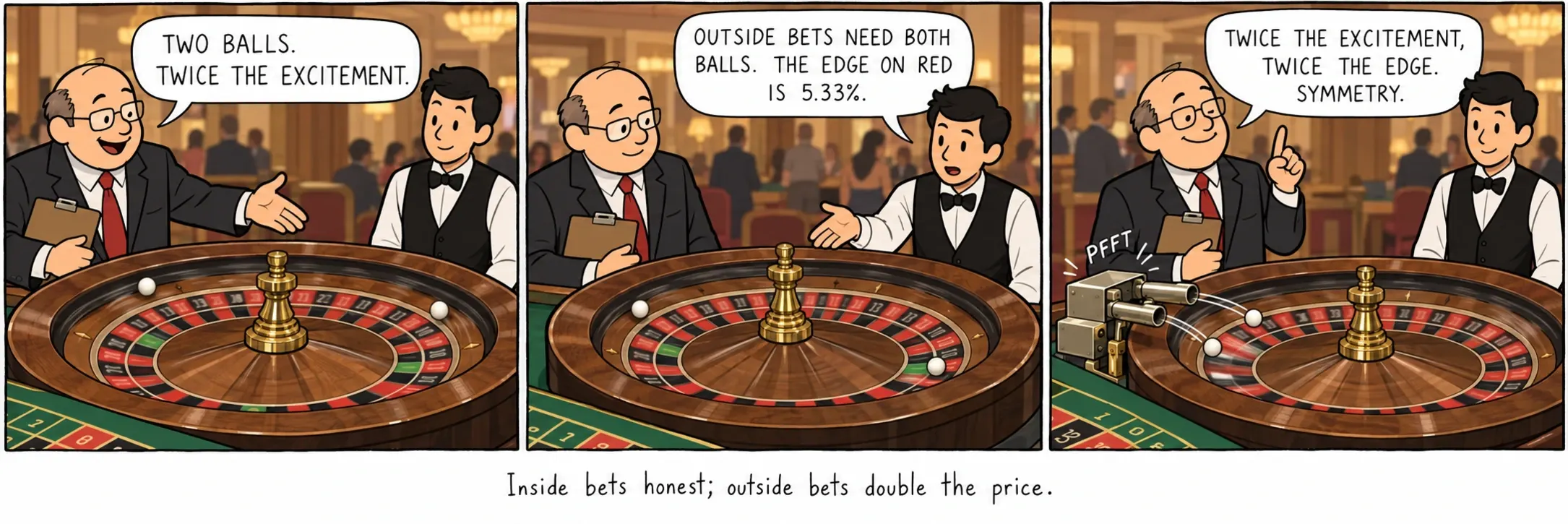
Inside bets honest; outside bets double the price.
Sources
- Wizard of Odds. “Double Ball Roulette.”
- Ethier, S. N. The Doctrine of Chances: Probabilistic Aspects of Gambling.