Finales
A bet on every number that ends in the same digit, announced to the dealer in a single call.
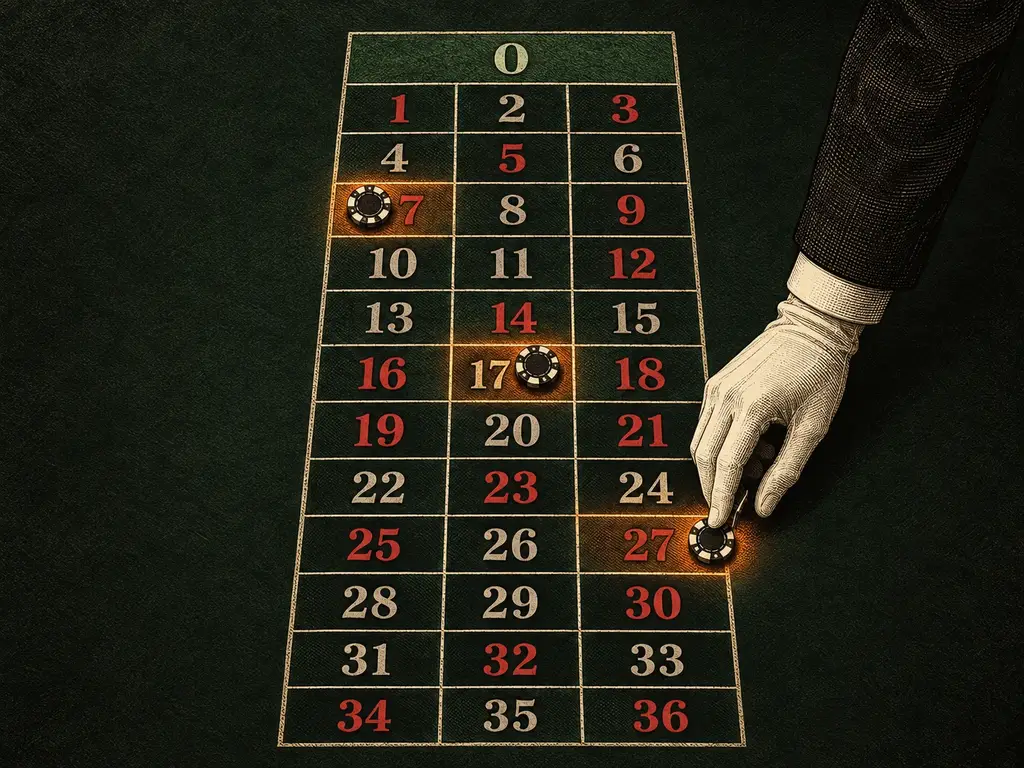
Finale 7 puts one chip on each of 7, 17 and 27. Finales 0 to 6 take four chips and 7 to 9 take three. Each chip is a straight up paying 35 to 1, so the bet costs 2.70% like every other. The split version, finale à chevalFR · splitChevalFrench for split: one chip on the line between two numbers, pays 17:1.Read full →, covers two endings at once with splits.
Placement
Call “finalebetFinaleCall bet on all numbers ending in the same digit, e.g. finale 5: 5, 15, 25, 35.Read full → 7” as you hand over the chipsmoneyChipA token representing a fixed amount, placed on the layout to make a bet. Also: check.Read full →, and the dealer puts one chip on each number ending in 7: 7, 17 and 27. Every digit from 0 to 6 ends four numbers (0, 10, 20 and 30 for finale 0; 6, 16, 26 and 36 for finale 6), so those finales take four chips; 7, 8 and 9 end only three numbers each. Some casinos also take multiples, such as two chips a number.
Payout and expectation
Each chip is an ordinary straight upbetStraight upA single number, pays 35:1.Read full →. With finale 7 on three chips, one of its numbers comes up 3 times in 37: that chip is paid 35 and the other two are lost, +33 in all. The other 34 times all three chips are lost. Average: (3 × 33 − 34 × 3)/37 = −3/37 a spin, 2.70% of the three chips. A four-chip finale wins +32 four times in 37 and loses 4 the rest of the time: −4/37, the same 2.70%.
Finales à cheval
The splitbetSplitTwo adjacent numbers, pays 17:1.Read full → version covers two endings at once. “Finale 0/3” puts a chip on each of the splits 0/3, 10/13, 20/23 and 30/33: four chips covering eight numbers, each split paying 17 to 1. Where a number has no partner beside it on the layoutequipmentLayoutThe printed betting grid on the table. Also: table, felt, cloth.Read full →, it gets a straight up instead: “finale 4/7” is the splits 4/7, 14/17 and 24/27 plus a chip on 34. Each split pays half what a straight up pays and covers twice the numbers, so the price is still 2.70%.
Why it exists
Like the other call betstableCall betA bet announced to the dealer rather than placed by hand, usually a wheel-sector bet such as voisins or tiers. Also “announced bet”.Read full → it is a shortcut: one word instead of three or four placements, which helps at a crowded table where the far end of the layout is out of reach. Numbers that share an ending are scattered round the wheel, so unlike the voisins or the tiers a finale is not a sectorwheelSectorA contiguous arc of pockets on the wheel, as distinct from a group on the layout.Read full → bet.
Variants
On a double-zerowheelZeroThe single green pocket that no even-money, dozen or column bet covers; the source of the house edge. Also: single zero, 0.Read full → wheel finale 0 can take in 00 as well: Crown Perth’s rules define it as 0, 00, 10, 20 and 30. Some online games put finales on the racetracktableRacetrackThe oval strip on live and electronic layouts showing the numbers in wheel order, used to place neighbors and sector bets in one tap.Read full → as one-click buttons, and some live tables do not take them at all. Check the table’s rules before calling one.
Questions
It is three or four straight ups: the same 2.70% and the same high variancemathVarianceA measure of how widely results spread around the expected value. High for straight up, low for even-money bets.Read full → as any straight up.
Rarely; call bets belong to European and French tables. Where one is offered, finale 0 may include 00.
Yes, as separate calls. Each is settled as its own straight ups or splits.
Fun with Math
Try these yourself first. Each solution is folded; open it when you are ready.
You call finalebetFinaleCall bet on all numbers ending in the same digit, e.g. finale 5: 5, 15, 25, 35.Read full → 4/7 for four $1 chipsmoneyChipA token representing a fixed amount, placed on the layout to make a bet. Also: check.Read full →: splitsbetSplitTwo adjacent numbers, pays 17:1.Read full → 4/7, 14/17 and 24/27, and a straight upbetStraight upA single number, pays 35:1.Read full → on 34. What do you win or lose on each kind of result, and what is the average per spin?
Show the solution
Answer A number in one of the splits: +$14. The 34: +$32. Any of the other 30 numbers: −$4. On average −$4/37, about 11¢, which is 2.70% of the $4.
Six numbers sit in the splits (4, 7, 14, 17, 24, 27). If one comes up, that split pays 17 to 1, +$17, and the other three chips are lost: +$14.
If 34 comes up, its straight up pays 35 to 1 and the three splits are lost: +$32.
The other 30 numbers, the zerowheelZeroThe single green pocket that no even-money, dozen or column bet covers; the source of the house edge. Also: single zero, 0.Read full → among them, lose all four chips: −$4.
Average: (6 × 14 + 32 − 30 × 4)/37 = (84 + 32 − 120)/37 = −4/37. Splits and straight ups carry the same 2.70%, so any mix of them does too.
Comic relief
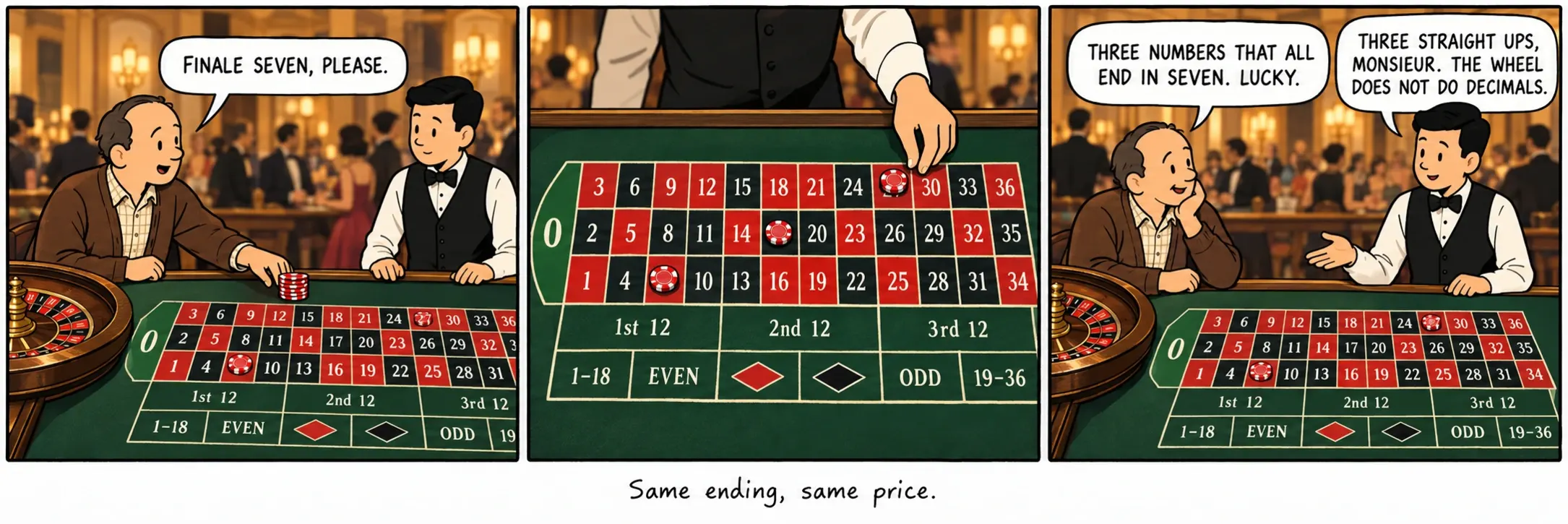
Same ending, same price.
Sources
- Ethier, S. N. The Doctrine of Chances: Probabilistic Aspects of Gambling.
- Crown Perth. Rules of the Authorised Game – Roulette.