Roulette Dealer Signature
The roulette dealer signature is the idea that a dealer’s release is consistent enough to predict the drop sectorwheelSectorA continuous arc of neighboring pockets around the wheel, rather than a group defined by the betting layout.Read full definition →.

A dealer signature is a proposed relationship between a dealer’s release and the final pocket. A recognizable habit is not enough: the relationship must predict new outcomes and beat the payoutmoneyPayoutThe amount paid on a winning wager. Check whether the quoted figure is net profit or total return including the stake.Read full definition → disadvantage.
The hypothesis
The hypothesis is that sufficiently repeatable launch conditions produce a useful distribution of final positions relative to release. Measure the actual release position against the rotorequipmentRotorThe rotating part of a physical roulette wheel, carrying the numbered pockets.Read full definition →; the previous winning number is not automatically that reference. A repeated hand motion alone does not establish a predictable pocketequipmentPocketA compartment on the rotor in which the ball can settle. The number of pockets depends on the wheel.Read full definition →.
Why it is doubtful
Rotor motion, ballequipmentBallThe small ball that settles in a numbered pocket to determine a physical roulette result.Read full definition → speed, release position and later collisions all contribute to the result. Consistency in one quantity does not fix the others. Any claimed signature needs a measured error distribution, an independently tested betting rule and a permitted time to place the bet.
| quantity | what to establish |
|---|---|
| release reference | actual rotor position at release |
| ball motion | repeatability and measurement error |
| rotor motion | speed and phase over the relevant interval |
| final scatter | distribution under comparable conditions |
| betting deadline | whether the proposed decision was possible in time |
Thorp’s objection
In The Mathematics of Gambling (1984, pp. 60–64), Thorp challenges Stephen Kimmel’s dealer-signature proposal. He says repeatability must cover rotor speed, ball travel and the rotor position at release. His roughly 16–17-pocket error threshold belongs to a normal-error model for a 38-pocket wheel, not a universal prediction rule. He reports ball-spin errors of about 20 pockets even for more consistent dealers. These are his historical observations, not measurements of today’s games. The previous winning number is not automatically the release reference; record the actual rotor position.

How to test it
Record the actual launch reference, direction, dealer, wheel identity and result. Define offset bins and the hypothesis in advance, then validate on an untouched record. If testing uniform offsets, each bin’s expected count must reflect how many pockets it contains.
Countermeasures
Closing bets before observable launch information is available prevents a strategy from using that information for the current wager. Other procedures vary. Do not infer universal rotation schedules, release instructions or online deadlines from a general description.
Treat it as a Lab exercise
Treat a signature as a hypothesis to test, not a reason to infer an edge from a dealer’s rhythm. A simulated independent uniform sequence supplies a useful null comparison, provided the analysis reproduces the same search and selection rules.
Questions
No. It explains a hypothesis and a testing approach; a claim about a particular dealer needs data.
That depends on the proposed effect and conditions. A staffing change is not proof of uniform outcomes.
No. Pocket bias concerns marginal frequencies; a signature concerns a relationship with release conditions. One can exist without the other, so a pocket-count test alone cannot settle both.
Comic relief
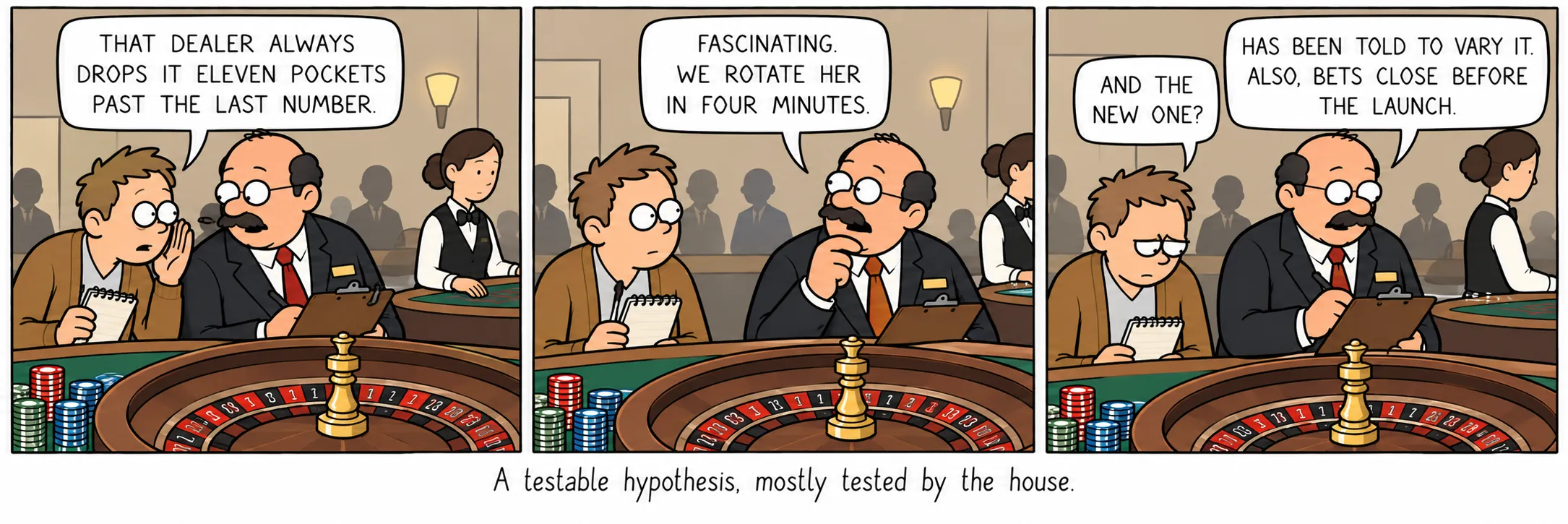
A repeatable habit is not yet a validated prediction.
Sources
- Barnhart, R. T. Beating the Wheel.
- Small, M. & Tse, C. K. “Predicting the outcome of roulette.”
- Thorp, E. O. The Mathematics of Gambling.