Roulette Table
The layout is the wheel unrolled into a grid, with group bets arranged around it.
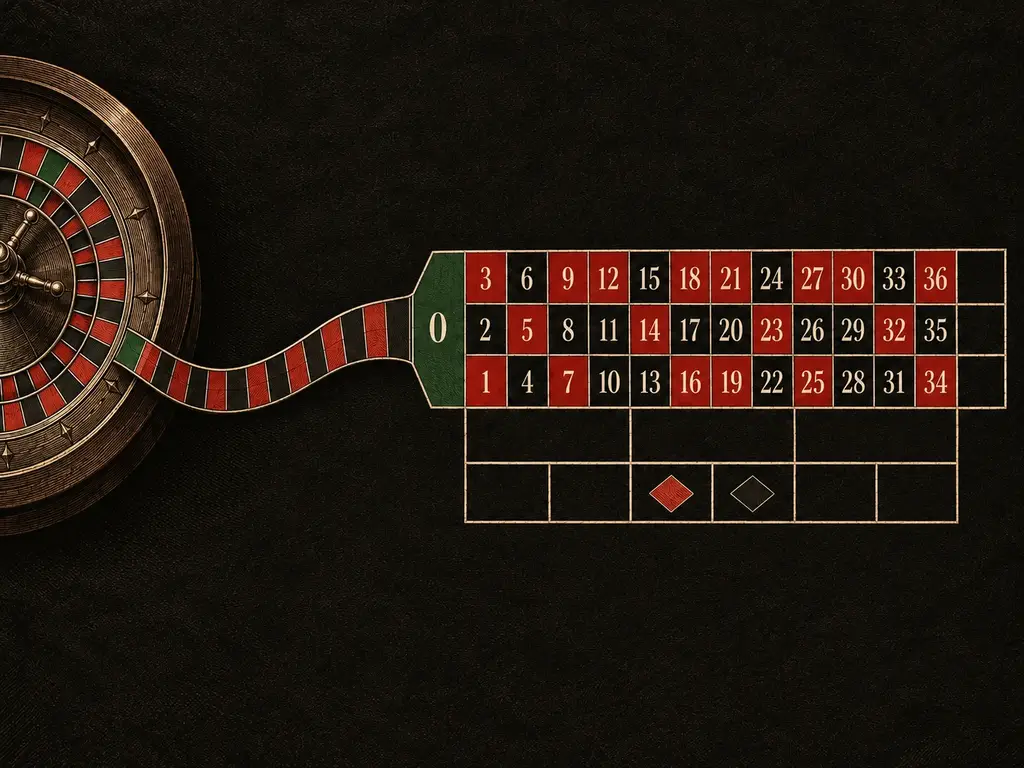
Three columns of twelve numbers with zero at the head; dozens and even-money boxes along the long side; column boxes at the foot.
Point at a sector or tap it to see its numbers.
Reading the grid
Numbers run 1-2-3 across the first row, 4-5-6 the next, and so on down to 34-35-36. ZerowheelZeroThe single green pocket that no even-money, dozen or column bet covers; the source of the house edge. Also: single zero, 0.Read full → sits across the head of the three columnsbetColumnTwelve numbers in one vertical column of the layout, pays 2:1.Read full →. Each cell is printed in the color of its pocketequipmentPocketOne of the 37 numbered compartments on the rotor. Also: slot, cup.Read full →, which is why redbetRedEven-money bet on the 18 red numbers. French: rouge.Read full → and blackbetBlackEven-money bet on the 18 black numbers. French: noir.Read full → look scattered on the layoutequipmentLayoutThe printed betting grid on the table. Also: table, felt, cloth.Read full → even though they alternate perfectly on the wheel.
Along one long side sit the three dozensbetDozen1–12, 13–24 or 25–36, pays 2:1.Read full → (1st 12, 2nd 12, 3rd 12) and, outside them, the six even-money boxes: 1–18, Even, Red, Black, Odd, 19–36. At the foot of the three columns are the three “2:1” boxes for column bets.
Where chips go
The position of a chipmoneyChipA token representing a fixed amount, placed on the layout to make a bet. Also: check.Read full →, not its color or size, defines the bet. A chip fully inside a cell is a straight upbetStraight upA single number, pays 35:1.Read full →. On the line between two cells it is a splitbetSplitTwo adjacent numbers, pays 17:1.Read full →. At the outer end of a row it is a streetbetStreetThree numbers in a row of the layout, pays 11:1. French: transversale.Read full →. On a cornerbetCornerFour numbers sharing a corner on the layout, pays 8:1.Read full → where four cells meet it is a corner. Across the outer end of two rows it is a six linebetSix lineSix numbers in two adjacent rows, pays 5:1. French: sixain.Read full →. Precision matters: dealers read placements literally, and a chip that leans into a neighboring cell will be paid as the dealer sees it.
French and American layouts
A French layout prints the outside betsbetOutside betA bet on the boxes surrounding the grid: dozens, columns and even-money bets.Read full → in French (manque, passe, pair, impair, rouge, noir) and places the dozens on both long sides so that players at either end can reach them. The dealer stands in the middle with a long rake. American layouts put all outside bets on one side, the dealer at the end nearest the wheel, and often print “1st 12” rather than “P12”. The bets and their payoutsmoneyPayoutWhat a winning bet returns, quoted as “X to 1” on top of the returned stake.Read full → are identical.
- French layout: double-ended, dealer in the middle, call betstableCall betA bet announced to the dealer rather than placed by hand, usually a wheel-sector bet such as voisins or tiers. Also “announced bet”.Read full → expected.
- American layout: single-ended, dealer at the wheel end, 00 cell beside the 0.
- Online layout: the same grid as tap targets, plus a racetracktableRacetrackThe oval strip on live and electronic layouts showing the numbers in wheel order, used to place neighbors and sector bets in one tap.Read full → strip for sectorwheelSectorA contiguous arc of pockets on the wheel, as distinct from a group on the layout.Read full → bets.
The racetrack
Live and RNG tables add a strip shaped like an oval wheel showing the numbers in wheel order. Tapping a number there places a neighborsbetNeighborsA number and the two pockets on either side of it on the wheel, five straight-up chips.Read full → bet: that number and the two on either side, five chips. Buttons on the same strip place voisins, tiers, orphelinsFR · sectorOrphelins“Orphans”: the eight numbers left over by voisins and tiers: 17, 34, 6 and 1, 20, 14, 31, 9.Read full → and jeu zéroFR · sectorJeu zéro“Zero game”: the seven numbers nearest zero (12, 35, 3, 26, 0, 32, 15), bet with four chips.Read full →. It exists because those bets are tedious to place by hand on the grid: voisins alone is nine chips on seven different positions.
Why outside bets take more space
On the printed layout the twelve outside boxes cover more felt than the 37 number cells together. That is roughly proportional to how much money sits on them: most players, most of the time, bet red or black. Outside bets are also paid first, before inside betsbetInside betAny bet placed on or between the numbers of the grid: straight up, split, street, corner, six line.Read full →, so that the dealer can clear the large area quickly and concentrate on the chips in the grid.
Chip colors
At a physical table each player buys a color of chips that has value only at that table, so that six people betting red cannot argue about whose chip won. You name the value when you buy in; a color marker on the wheel rim records it. Cash chips from the cage are allowed on outside bets and are paid in kind. Online, every player sees only their own chips, so the problem disappears.
Questions
Ask the dealer to place the bet for you and say exactly what you want: “ten on the corner sixteen, seventeen, nineteen, twenty”.
Splits 0–1, 0–2, 0–3; the streets 0-1-2 and 0-2-3; and the basketbetBasketOn a single-zero wheel: 0, 1, 2, 3 with one chip, pays 8:1. Also: first four, quatre premiers.Read full → 0-1-2-3 at the corner. All standard.
You can place three chips, one on each. You win one and lose two, or lose all three on zero. Nobody does this twice.
Comic relief
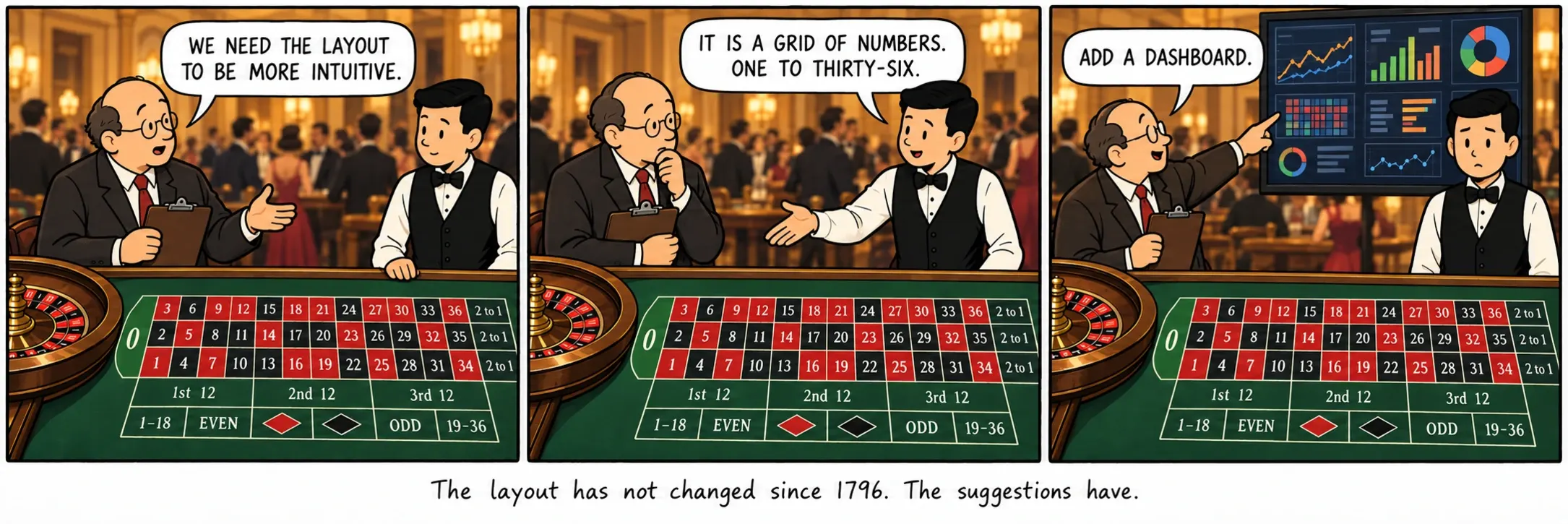
The layout has not changed since 1796. The suggestions have.
Sources
- Wykes, A. The Complete Illustrated Guide to Gambling.
- Ethier, S. N. The Doctrine of Chances: Probabilistic Aspects of Gambling.
- Lablée, J. La Roulette, ou le Jour.