Roulette Neighbors Bet
The roulette neighbors bet covers a number and the two pockets on either side of it on the wheel.
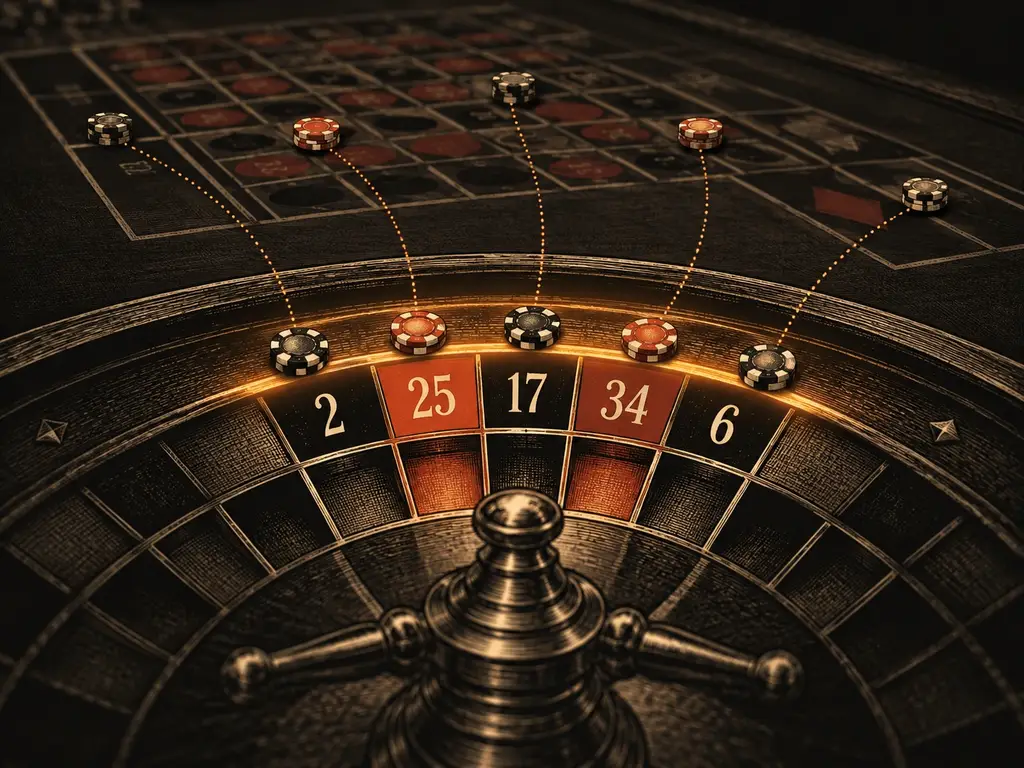
Five straight-up chips on a wheel sector of five. Probability 13.51%; a hit pays 35:1 on one chip, the other four lose, net +31 units.
Pick any number on the wheel. The bet covers it and the two pockets on each side.
Placement
Announced as “17 and the neighborsbetNeighborsPockets adjacent to a selected number around the wheel. A neighbors bet includes a chosen number of them on each side.Read full definition →” (dix-sept et les voisins). The dealer places five chipsmoneyChipA token used to place a wager, with a printed or assigned value. Also called a check in some casino terminology.Read full definition →: 17 and the two pocketsequipmentPocketA compartment on the rotor in which the ball can settle. The number of pockets depends on the wheel.Read full definition → on either side of it on the wheel, which are 25 and 2 on one side and 34 and 6 on the other. Where the interface offers a neighbors control, confirm how many pockets it selects on each side; the setting may be adjustable.
Roulette neighbors payout and expectation
Any one of the five pockets wins 35 to 1 on its chip while the other four chips lose: net +31 unitsmoneyUnitA base amount used to express stakes or results.Read full definition → on a 5-unit stake. ProbabilitymathProbabilityA measure of how likely an event is, from zero to one. Percentages express the same scale from 0% to 100%.Read full definition → 5/37 = 13.51%. Expected valuemathExpected valueThe sum of each possible net result multiplied by its probability. It can be positive, zero or negative.Read full definition → per spin: (5/37)(31) − (32/37)(5) = (155 − 160)/37 = −5/37 units, 2.70% of five units. Five straight-up bets, and five straight-up house edgesmathHouse edgeThe casino’s expected net gain expressed as a fraction of the stake, under specified probabilities and payouts.Read full definition →.
| 5 × $2 on 17 and the neighbors | outcome | probability | result |
|---|---|---|---|
| one of 2, 25, 17, 34, 6 | +$70 − $8 | 13.51% | +$62 |
| any other number | lose five chips | 83.78% | −$10 |
| zero | lose five chips | 2.70% | −$10 |
| expected per spin | −$0.27 |
Why it exists
It is a convenient way to select a wheel arc. Other sectorwheelSectorA continuous arc of neighboring pockets around the wheel, rather than a group defined by the betting layout.Read full definition → bets cover arcs too. Under uniform outcomes, five neighboring straight upsbetStraight upA wager on one number, ordinarily paying a profit of 35 to 1.Read full definition → have the same payoutmoneyPayoutThe amount paid on a winning wager. Check whether the quoted figure is net profit or total return including the stake.Read full definition → distribution as five other distinct numbers. A historical hot sector alone does not establish a predictive advantage.
Finding roulette wheel neighbors
To find anyone’s neighbors use the European sequence: 0 32 15 19 4 21 2 25 17 34 6 27 13 36 11 30 8 23 10 5 24 16 33 1 20 14 31 9 22 18 29 7 28 12 35 3 26, wrapping round from 26 to 0. The neighbors of zerowheelZeroThe 0 outcome, conventionally shown in green. Ordinary color, parity, high/low, dozen and column bets do not include it.Read full definition → are 26, 3 on one side and 32, 15 on the other. The Wheel Visualizer tool shows any pick on the rim.
| number | wheel neighbors (2 each side) |
|---|---|
| 0 | 3 26 · 32 15 |
| 17 | 2 25 · 34 6 |
| 32 | 26 0 · 15 19 |
| 5 | 23 10 · 24 16 |
| 36 | 27 13 · 11 30 |
Variants
“Neighbors by 1” places three chips; “by 3” places seven. Use the denominations the game accepts rather than assuming a chip can be divided into arbitrary fractions. Under standard single-zero payouts, each constituent straight up pays 35 to 1 against fair odds of 36 to 1.
Questions
The same idea can use the American wheel order, but the covered numbers and probabilities differ. Check whether the specific table or interface offers it.
Placing the bet does not test for bias. A possible advantage would require reliable probability estimates, an appropriate test and payouts that compensate for the covered outcomes. The sample requirement depends on the proposed effect, not a universal spin count.
Comic relief
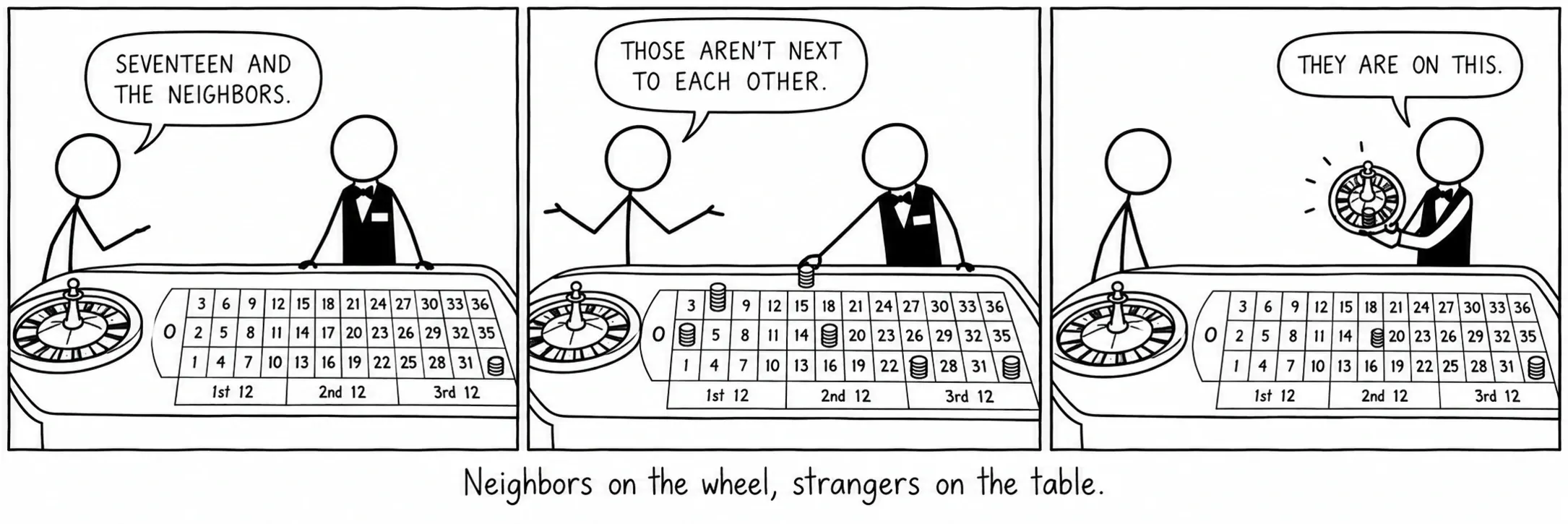
17 and two neighbors on each side: 2, 25, 17, 34 and 6 on a European wheel.
Sources
- Ethier, S. N. The Doctrine of Chances: Probabilistic Aspects of Gambling.
- Barnhart, R. T. Beating the Wheel.