Risk of Ruin
The probability of losing your whole bankroll before reaching a target.

For even-money bets, risk of ruin follows the gambler’s ruin formula. With a $500 bankroll, $10 bets and a $600 target, you reach the target about 57% of the time and bust the rest.
The question
You have a unitsmoneyUnitThe base stake a system or a player works in. Progressions are described in units so they apply at any table.Read full → of bankrollmoneyBankrollThe total amount set aside for play. Bankroll management is deciding how much of it to risk per bet and per session.Read full → and want to reach a + b units, betting one unit at a time on an even-money betbetEven-money betRed/black, odd/even, high/low. 18 numbers, pays 1:1.Read full → with win probabilitymathProbabilityChance of an outcome, from 0 to 1 or 0% to 100%. One number: 1/37 = 2.70%.Read full → p = 18/37 and loss probability q = 19/37. What is the chance you reach the target before you reach zero? The answer was worked out by Pascal, Fermat and Huygens in the 1650s and is one of the oldest results in probability.
The gambler’s ruin formula
P(reach target) = (1 − (q/p)ᵃ) / (1 − (q/p)ᵃ⁺ᵇ). Risk of ruinmathRisk of ruinProbability of losing the whole bankroll before reaching a target or spin count.Read full → is one minus that. With q/p = 19/18 ≈ 1.0556, the ratio grows exponentially in the number of units, so the formula punishes small units severely: the more bets it takes to reach the target, the more times the 2.70% toll is paid on the way.
Reading it
Smaller units hurt. Trying to double $500 with $10 bets succeeds 6% of the time; with a single $500 bet it succeeds 48.6% of the time. Bold play, fewer and larger bets, maximizes the chance of hitting a target in a negative-expectation game, because it minimizes the number of times the edge is applied. It also maximizes the variancemathVarianceA measure of how widely results spread around the expected value. High for straight up, low for even-money bets.Read full → of what happens to you, and it ends the evening fast. The theorem is called “bold play is optimal” and it was proved by Dubins and Savage in 1965.
Where the problem started
The question is older than roulette. In 1656 Pascal set Fermat a puzzle: two players throw three dice, each starting with 12 counters; a throw of 11 moves a counter one way, a throw of 14 the other. Both solved it, and Huygens, who heard of it through a letter from the mathematician Pierre de Carcavi, printed it in 1657 as the fifth problem of the first book on probability, with the answer and no proof. Eleven can be thrown 27 ways and fourteen only 15, so each counter moves the first player’s way 9 times in 14, and the formula above, with 12 counters each, makes him about 1,157 times likelier to win everything than to lose everything. A 2.70% edge is far smaller, but the same formula shows what it does over many bets.
A real bold bet
In April 2004 Ashley Revell, a young Englishman, sold nearly everything he owned, including his clothes, and took $135,300 to the Plaza in Las Vegas. After some small bets he put the whole amount on redbetRedEven-money bet on the 18 red numbers. French: rouge.Read full →, once. The ballequipmentBallThe small ball launched along the track against the rotor. Modern balls are ivorine or Teflon, 18–21 mm.Read full → landed on red 7 and he walked out with $270,600. On a double-zerowheelZeroThe single green pocket that no even-money, dozen or column bet covers; the source of the house edge. Also: single zero, 0.Read full → wheel that single spin was a 47.37% chance and cost him $7,121 on average, the 5.26% edge on one bet. Spread over $10 bets, the same target would have been close to hopeless. Bold play does not make the bet good; it makes it as short as possible.
Risk of ruin without a target
If you simply play until you bust or stop after N spins, the question becomes “what is the chance my bankroll touches zero within N spins?”. There is no closed form for general N but the simulators on this site compute it: a $500 bankroll at $10 on red almost never busts in 100 spins (under 1%), busts about 9% of the time in 500 spins, and about 95% of the time in 5,000. With no stop rule the probability tends to 100%, which is the long-run version of the house edgemathHouse edgeThe share of each stake the casino keeps on average: 2.70% in European roulette.Read full →.
- p10 −$500
- p25 −$500
- median −$500
- p75 +$0
- p90 +$350
How long, and how far ahead
Two more classical results answer questions players actually ask. With no target, flat even-money bets last on average 37 spins for every unit of bankroll on a European wheel and 19 on an American one, because each spin takes 1/37 of a unit on average (1/19 on an American wheel): 100 units last 3,700 spins on average, although half of such sessions are over within 3,134 (see Session Length and Cost). And however large the bankroll, the chance on a European wheel of ever being k units ahead is (18/19)ᵏ. That is 95% for one unit and 58% for ten, but no bankroll, however deep, gives an even chance of ever being 13 units up; on an American wheel the chance is (9/10)ᵏ and drops below one half at 7 units.
A bankroll for a fifty-fifty chance
Turn the question round: how much must you bring to have at least a fifty-fifty chance of winning a given amount before losing everything? For a small win, not much. For a larger one the bankroll needed climbs steeply, and past a point no bankroll is enough, because even an endless one gives less than a fifty-fifty chance of ever getting that far ahead. Taylor (2021) puts it another way: on an American wheel, to have a fifty-fifty chance of reaching 100 units you must start with 94, risking 94 to win 6. On a European wheel you would need 88.
The practical lesson
Decide what you are trying to do. If the goal is a specific win, bet big and few. If the goal is a long evening, bet small and accept that the edge will take its 2.70% of a large turnovermoneyTurnoverThe total amount wagered over a session or period, counting re-bet winnings. Also: handle, action.Read full →. If the goal is both, something has to give, and it is usually the target.
Formula
Questions
MartingalestrategyMartingaleProgression that doubles the bet after each loss. See the Strategy section for what it does and does not do.Read full → lowers it for short sessions and raises it dramatically for long ones. Flat bettingstrategyFlat bettingWagering the same amount every spin. The baseline every progression is compared against.Read full → at a larger unit is the honest way to lower it.
The formula above is for even money. For high-variance bets ruin is more likely at small stakes and the target is reached in a lumpier way; use the calculator.
Each step toward the target is a little less likely than each step toward ruin; the ratio compounds over the number of steps.
Fun with Math
Try these yourself first. Each solution is folded; open it when you are ready.
You have $100 and want $1,000, betting only on redbetRedEven-money bet on the 18 red numbers. French: rouge.Read full →. Plan one: bet $1 at a time. Plan two: bet everything you have until you pass $500, then just enough to reach $1,000. Which plan is better, and by how much?
Show the solution
Answer Plan two, by far. It reaches $1,000 about 9.0% of the time, close to the fair 10%. Plan one succeeds about 7 times in 10²².
In a fair gamemathFair gameA game in which neither side has an edge: every bet has an expected value of zero.Read full → you would reach $1,000 from $100 one time in ten whatever you did, because the average value of your money stays at $100.
The edge takes 2.70% of every bet, so the less you bet in total, the closer you stay to one in ten. Plan two decides the matter in a handful of bets: $100 becomes $200, $400, $800, and then $200 is enough. It succeeds about 9.0% of the time. Plan one takes thousands of bets before the walk ends, and the edge, small on each of them, adds up to near certain ruin.
This is the Dubins–Savage result in its simplest form (Epstein, 2013): in a game that favors the house, bet as much as you need, as few times as you can.
You have $500 and want $1,000, stopping as soon as you have it. You pick one kind of bet and repeat it until it wins once or the money runs out. Which kind gives the best chance?
Show the solution
Answer One $500 bet on red: 48.6%. Every plan that spreads the money over smaller bets does worse.
Choose each stake so that one win is enough: $30 on a straight upbetStraight upA single number, pays 35:1.Read full → wins $1,050, $60 on a splitbetSplitTwo adjacent numbers, pays 17:1.Read full → wins $1,020, and so on. Then count the chance that at least one bet wins before the money runs out. Sixteen $30 straight ups all miss with chance (36/37)¹⁶ = 64.5%, so they reach $1,000 35.5% of the time.
The table shows each bet. Red does best because it gets there in one bet, so the edge is paid once, on $500. The six linebetSix lineSix numbers in two adjacent rows, pays 5:1. French: sixain.Read full → comes second because it needs only three. A single dozenbetDozen1–12, 13–24 or 25–36, pays 2:1.Read full → bet is worst, a 12/37 shot; even played in $250 unitsmoneyUnitThe base stake a system or a player works in. Progressions are described in units so they apply at any table.Read full → until you have $1,000 or more, the dozen gets there only 46.4% of the time.
Bollman (2024) builds the same table for an American wheel. His dozen row has a slip: it should read 12/38 = 31.6%.
betstake × number of betschance of reaching $1,000Straight up$30 × 1635.5%Split$60 × 835.9%Street$90 × 534.5%Corner$125 × 436.7%Six line$166, $166, $16841.2%Dozen$500 × 132.4%Red$500 × 148.6%You bet one unit on red, spin after spin, with a bankrollmoneyBankrollThe total amount set aside for play. Bankroll management is deciding how much of it to risk per bet and per session.Read full → that never runs out. After the first spin you are one unit up or one unit down. What is the chance that you will ever be exactly even again?
Show the solution
Answer 36 in 37, 97.3%. On an American wheel it is 36 in 38, 94.7%.
If the first spin wins (18 times in 37), you are one unit up, and the edge drags every endless session down, so sooner or later you pass back through even: that is certain. If it loses (19 times in 37), you have to climb one unit, and the chance of ever being one unit ahead is 18/19 (see the table above).
Together: 18/37 + 19/37 × 18/19 = 18/37 + 18/37 = 36/37.
In general the chance is 1 minus the gap between the chances of winning and losing a spin: 1 − 1/37 on a European wheel, 1 − 2/38 on an American one. In a game with no zerowheelZeroThe single green pocket that no even-money, dozen or column bet covers; the source of the house edge. Also: single zero, 0.Read full → the gap is nothing and the chance is 1: the score always comes back to even. Epstein (2013) gives the general rule.
Pascal’s 1656 puzzle: two players throw three dice, each starting with 12 counters. Every 11 moves a counter to the first player, every 14 moves one to the second; other throws do not count. How likely is the first player to win all 24? And if you instead bet 1 unit on red each spin against a friend who acts as the bank, 12 units each, how likely are you to win all 24?
Show the solution
Answer The first player wins about 1,157 times in 1,158. You, on red, win all 24 units only about 34% of the time.
Three dice make 11 in 27 ways and 14 in 15 ways, so each counter that moves goes to the first player 27 times in 42, 9 times in 14. With each side starting on 12, the chance of taking everything is 1/(1 + r¹²), where r is the ratio of the other side’s chance to yours.
For the first player r = 5/9, and (5/9)¹² ≈ 0.00086, so the chance is about 0.99914: odds of 9¹² to 5¹², or 282,429,536,481 to 244,140,625, about 1,157 to 1. Huygens printed exactly those numbers in 1657.
On red, r = 19/18 because of the zero, and (19/18)¹² ≈ 1.913: your chance is 1/2.913 ≈ 34.3%. A coin would give 50%. The 2.70% edge on each bet adds up, over the many bets it takes, to a 16-point gap.
Comic relief
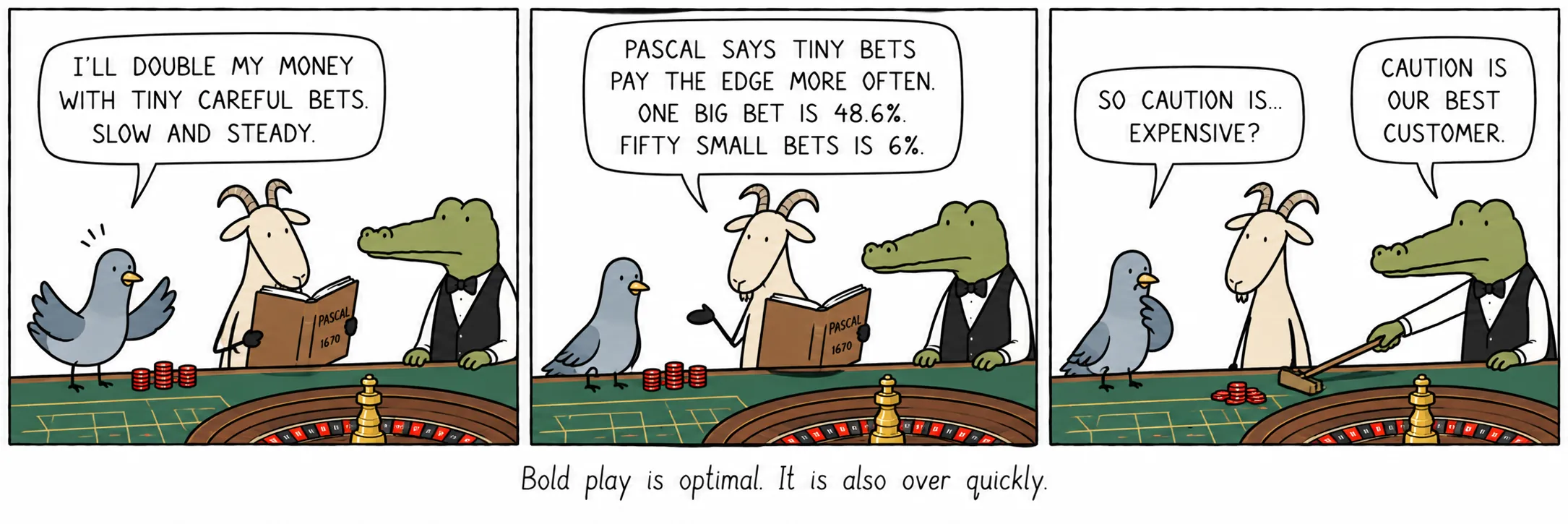
Bold play is optimal. It is also over quickly.
Sources
- Feller, W. An Introduction to Probability Theory and Its Applications, Vol. 1.
- Epstein, R. A. The Theory of Gambling and Statistical Logic, 2nd ed.
- Taylor, D. G. Games, Gambling, and Probability: An Introduction to Mathematics, 2nd ed.
- Carcavi, P. de. Letter to Huygens, 28 September 1656, on the problem Pascal posed to Fermat.
- Huygens, C. De Ratiociniis in Ludo Aleae.
- Ethier, S. N. The Doctrine of Chances: Probabilistic Aspects of Gambling.
- Reuters. “Briton bets it all on roulette spin, and wins.”
- Las Vegas Sun. “Man wagers life’s worth.”