64 Roulette Strategy
The 64% roulette system bets two dozens, then triples both bets after a miss. Its 24/37 coverage does not protect against escalating losses.

Completing a cycle wins one unit after earlier losses, but four missed levels cost 80 units and the required fifth level costs 162 units in total.
Rule as described
The 64% system places one unitmoneyUnitA base amount used to express stakes or results.Read full definition → on each of any two dozensbetDozenA bet on 1–12, 13–24 or 25–36, ordinarily paying 2 to 1.Read full definition →. A hit in either dozen resets both stakes to one; a miss in the unselected dozen or zerowheelZeroThe 0 outcome, conventionally shown in green. Ordinary color, parity, high/low, dozen and column bets do not include it.Read full definition → triples both stakes. The “64%” label is approximate: 24/37 = 64.865% on a standard single-zero wheel.
Progression table
Each row is a level before its outcome. The two same-sized dozen bets make the total stake twice the shown individual bet.
| level | each dozen | total that spin | cumulative if missed |
|---|---|---|---|
| 1 | 1 | 2 | 2 |
| 2 | 3 | 6 | 8 |
| 3 | 9 | 18 | 26 |
| 4 | 27 | 54 | 80 |
| 5 | 81 | 162 | 242 |
Worked example
Bet 1 on the first and second dozens. A 30 misses both bets, losing 2, and makes the next bets 3 and 3. If 18 then lands, the second dozen returns 9 including stake against 6 units placed: net +3 for that spin. Across the two-spin sequence, −2 + 3 = +1, then reset. The same recovery property is bought with rapid stake growth.
Cost and risk
Four consecutive misses cost 2 + 6 + 18 + 54 = 80 units. Six misses cost 728 units, and the seventh wager would require 729 on each dozen, 1,458 total. A specified six-miss run has probabilitymathProbabilityA measure of how likely an event is, from zero to one. Percentages express the same scale from 0% to 100%.Read full definition → (13/37)^6, about 0.188%, but indefinite play repeatedly encounters runs. No finite bankrollmoneyBankrollThe amount set aside for play. Bankroll management concerns stakes and limits within that amount.Read full definition → converts a loss progressionstrategyProgressionA rule that changes stakes over a sequence of bets, often using previous wins or losses.Read full definition → into certainty; expected lossmathExpected lossThe probability-weighted average net loss under a stated model. With a constant edge, it equals edge times expected total stakes.Read full definition → remains one thirty-seventh of all European stake.
Questions
One dozen wins at 2:1 while the other loses, so the net at individual stake x is +x; tripling after losses is calibrated to leave +1 across the sequence.
It is the chance either chosen dozen wins on one European spin. It says nothing about the cost of the unselected outcomes or a longer session.
Comic relief
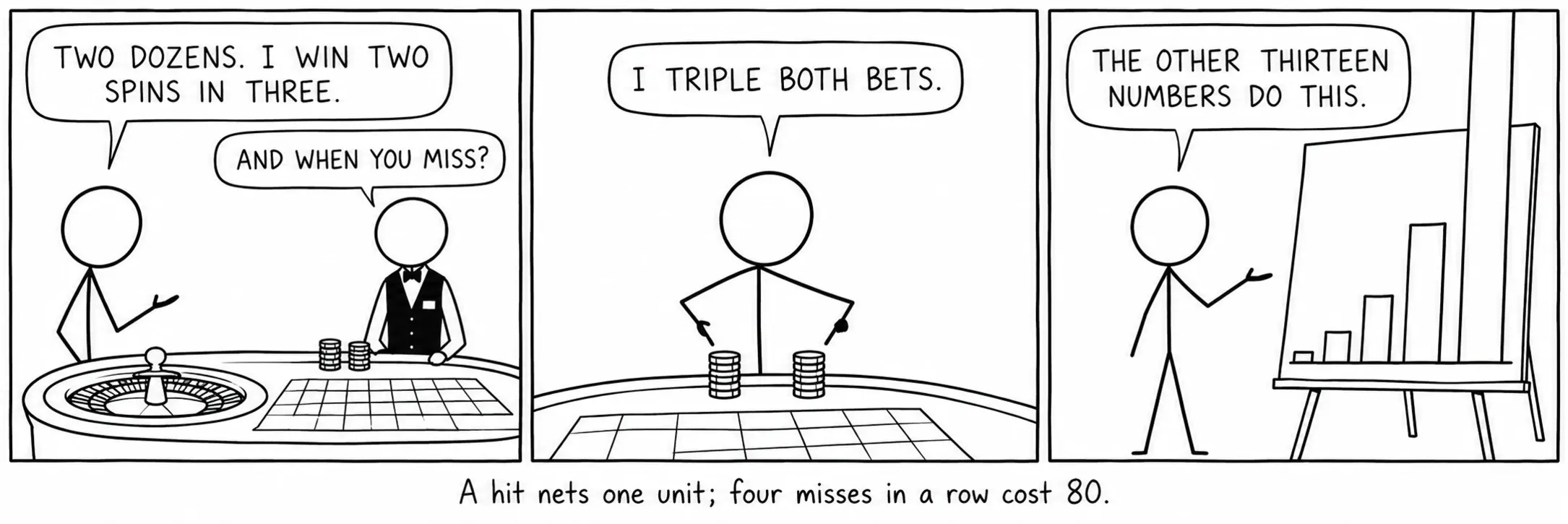
Starting at one unit per dozen, a hit completes a +1-unit cycle; four consecutive misses lose 80 units in total.
Sources
- RouletteDoc, “64% system” — two-dozen progression
- Roulette77. Strategy description and examples.
- Wizard of Odds, Roulette Basics — dozen payouts and European pocket count
- Wizard of Odds, The Truth about Betting Systems