History of Roulette Systems
Two centuries of people writing down rules for changing their stake.
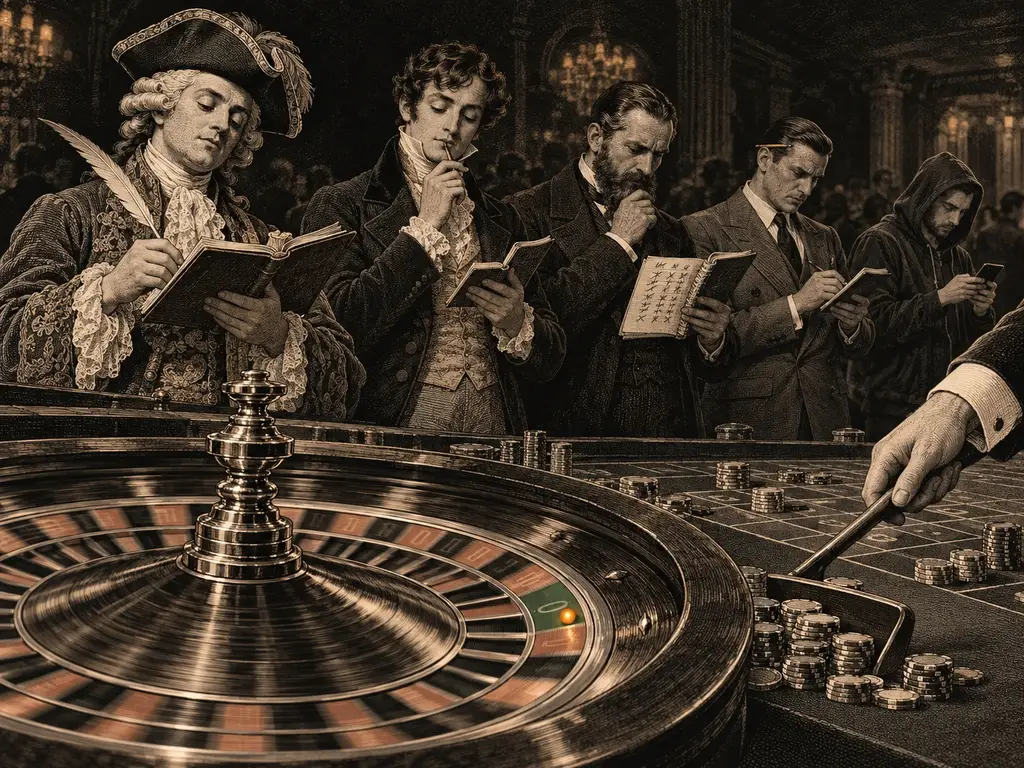
Martingale is 18th-century; D’Alembert is named for a mathematician who disliked it; Labouchère is a Victorian politician’s hobby. None of them worked then either.
Martingale
The name comes from Provençal gambling slang (à la martegalo, “in the manner of the people of Martigues”, who were proverbially reckless) for a doubling bet, recorded in French dictionaries from the 1760s. Thorp (1984), following the American Heritage Dictionary, gives a second folk explanation: the people of Martigues were mocked for odd habits, among them lacing their trousers at the back, so the phrase came to mean “in a ridiculous way”. It was already a cautionary tale in 18th-century Paris: Casanova describes losing a fortune doubling at faro in Venice in the 1750s. The mathematics of why it fails, the table limittableTable limitMinimum and maximum bet allowed. The maximum is what stops doubling progressions.Read full → and the finite bankrollmoneyBankrollThe total amount set aside for play. Bankroll management is deciding how much of it to risk per bet and per session.Read full →, was understood by the 1770s. In probabilitymathProbabilityChance of an outcome, from 0 to 1 or 0% to 100%. One number: 1/37 = 2.70%.Read full → theory “martingalestrategyMartingaleProgression that doubles the bet after each loss. See the Strategy section for what it does and does not do.Read full →” became a technical term in the 1930s for a fair gamemathFair gameA game in which neither side has an edge: every bet has an expected value of zero.Read full →, which is the one thing a roulette Martingale is not.
D’Alembert
Jean le Rond d’Alembert argued in the Encyclopédie (1754) that after a run of heads, tails became more probable, an early statement of the gambler’s fallacy by a leading mathematician. The betting system that adds a unitmoneyUnitThe base stake a system or a player works in. Progressions are described in units so they apply at any table.Read full → after a loss and removes one after a win was named for him by later gamblers who shared the belief. He did not propose it and would, on his better days, have rejected it.
Labouchère
Henry LabouchèrestrategyLabouchèreCancellation system: write a line of numbers, bet the sum of the two ends, cross them off after a win, add the lost stake after a loss.Read full → (1831–1912), journalist, theater owner and Liberal MP, popularized the cancellation system in London society in the 1870s and reportedly used it at Monte Carlo. The method, writing a line of numbers and betting the sum of the ends, predates him. His name stuck because he was famous for other things and because the system has the rare property of usually working, which made it a conversation piece at dinner.
Casanova loses doubling at faro. Martingale is already old.
D’Alembert publishes the fallacy that later bears his name as a system.
“Martingale” enters French dictionaries as gambling slang.
Labouchère popularizes cancellation in London.
Fibonacci and Paroli progressions appear in gambling manuals.
“Sector” systems based on the wheel layout sold by mail order.
Halmos, a student of Doob, proves that no betting system can turn an unfavorable game into a favorable one.
Computers simulate every system. All show −1/37 of turnover.
The same systems sold online with the same results, simulated in a browser on this site.
The 20th century
FibonaccistrategyFibonacciProgression that follows the sequence 1, 1, 2, 3, 5, 8, 13…: one step forward after a loss, two steps back after a win.Read full → and ParolistrategyParoliPositive progression: double after a win, reset after a loss or after three wins in a row. Also: reverse Martingale.Read full → entered gambling manuals around 1900. The mid-century brought mail-order systems, each with a testimonial and a money-back guarantee, and the first computer simulations, which showed what the mathematics already said. The proof that no system can work was already there: Joseph Doob (1936) and Paul Halmos (1939) showed that no rule for choosing when and how much to bet changes the expected result of a fair or unfavorable game, and Thorp’s 1969 survey set out the conditions in the form gamblers meet them. Since then the systems have not changed; the marketing has moved from pamphlets to video.
Why they survive
A system gives a player something to do and a story to tell. Most sessions under most systems end in a small win, which is a better story than the arithmetic. The losing sessions are rarer and remembered as bad luck. The marketing does not need to lie about the odds; it needs only to show a winning session, and there are plenty. The counter-argument, 2.70% of turnovermoneyTurnoverThe total amount wagered over a session or period, counting re-bet winnings. Also: handle, action.Read full →, has been available since 1796 and has never been as persuasive as a lucky night.
Systems for sale
The 20th-century trade added schemes of its own, each a new arrangement of the same negative bets. Phase One was sold for $25 plus 10% of the buyer’s winnings, with a Phase Two promised once $500 had been paid and an “Inner Circle” at $5,000. None of them changes the arithmetic: the expected valuemathExpected valueThe average result per bet over the long run. −1/37 of the stake for every standard European bet.Read full → of a series of bets is the sum of their expected values.
The one that is not a system
Stop rules: deciding in advance how much to lose or win and leaving. They are often sold as part of a system and are the only part that does anything, because they reduce turnover. They have no namesake, which is fitting.
Questions
Martingale, by a century or more. Doubling after a loss is the first idea everyone has.
D’Alembert came closest, by accident. Pascal, Fermat, Huygens, Bernoulli and Laplace all explained why they fail.
Because most sessions win, and a video of a winning session is cheap to make.
Comic relief
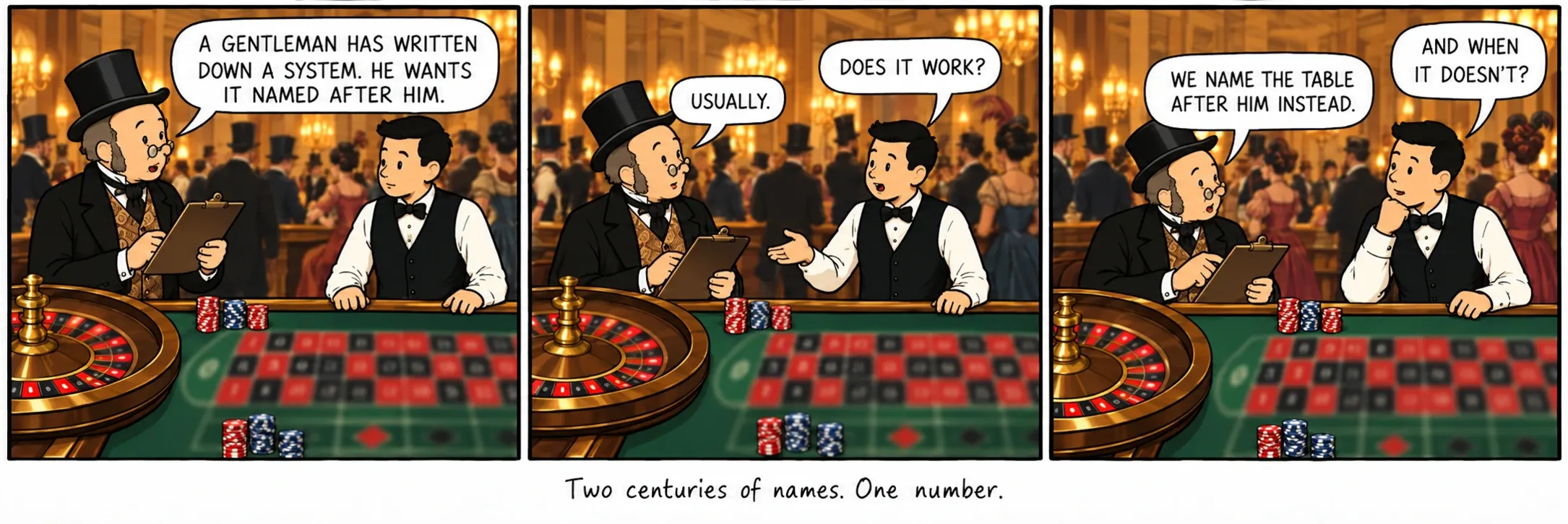
Two centuries of names. One number.
Sources
- Thorp, E. O. “Optimal gambling systems for favorable games.”
- Thorp, E. O. The Mathematics of Gambling.
- Doob, J. L. “Note on probability.”
- Halmos, P. R. “Invariants of certain stochastic transformations: the mathematical theory of gambling systems.”
- d’Alembert, J. “Croix ou pile.”
- Schwartz, D. G. Roll the Bones: The History of Gambling.
- Kavanagh, T. M. Dice, Cards, Wheels: A Different History of French Culture.
- Bollman, M. Mathematics of the Big Four Casino Table Games: Blackjack, Baccarat, Craps, & Roulette.