Roulette Advantage Play
Advantage play at roulette: what has actually been tried, and what happened.
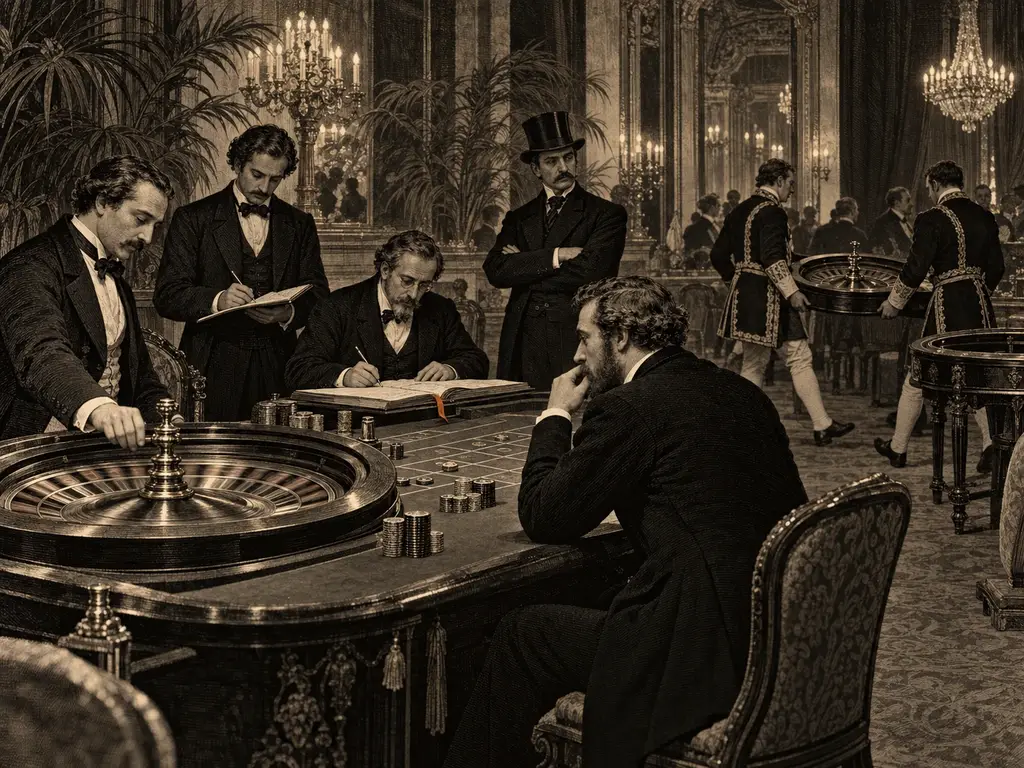
Physical prediction and persistent wheel bias are different from staking systems. Historical reports and laboratory results need their own evidence; neither establishes an available advantage at a current table.
Bias play
Bias play looks for a persistent difference between actual pocketequipmentPocketA compartment on the rotor in which the ball can settle. The number of pockets depends on the wheel.Read full definition → probabilities and the probabilities implied by the payoutsmoneyPayoutThe amount paid on a winning wager. Check whether the quoted figure is net profit or total return including the stake.Read full definition →. For a straight-up bet paying 35:1, the true hit rate must exceed 1/36 to give positive expected valuemathExpected valueThe sum of each possible net result multiplied by its probability. It can be positive, zero or negative.Read full definition →. An unusually high count in one sample does not establish that rate. Select the hypothesis, account for searches across pockets or sectorswheelSectorA continuous arc of neighboring pockets around the wheel, rather than a group defined by the betting layout.Read full definition →, and test it on fresh observations.
Historical accounts can show what people attempted, but they do not certify a present-day opportunity. The examples below distinguish retrospective reports, experiments and a specific court decision. Equipment changes may alter a pattern; neither a maintenance schedule nor a past win establishes what a wheel will do next.
Bethell’s 1910 account describes Jagger exploiting uneven pocket frequencies at Monte Carlo, followed by casino changes to the wheels. This is a later account, not an audited spin record.
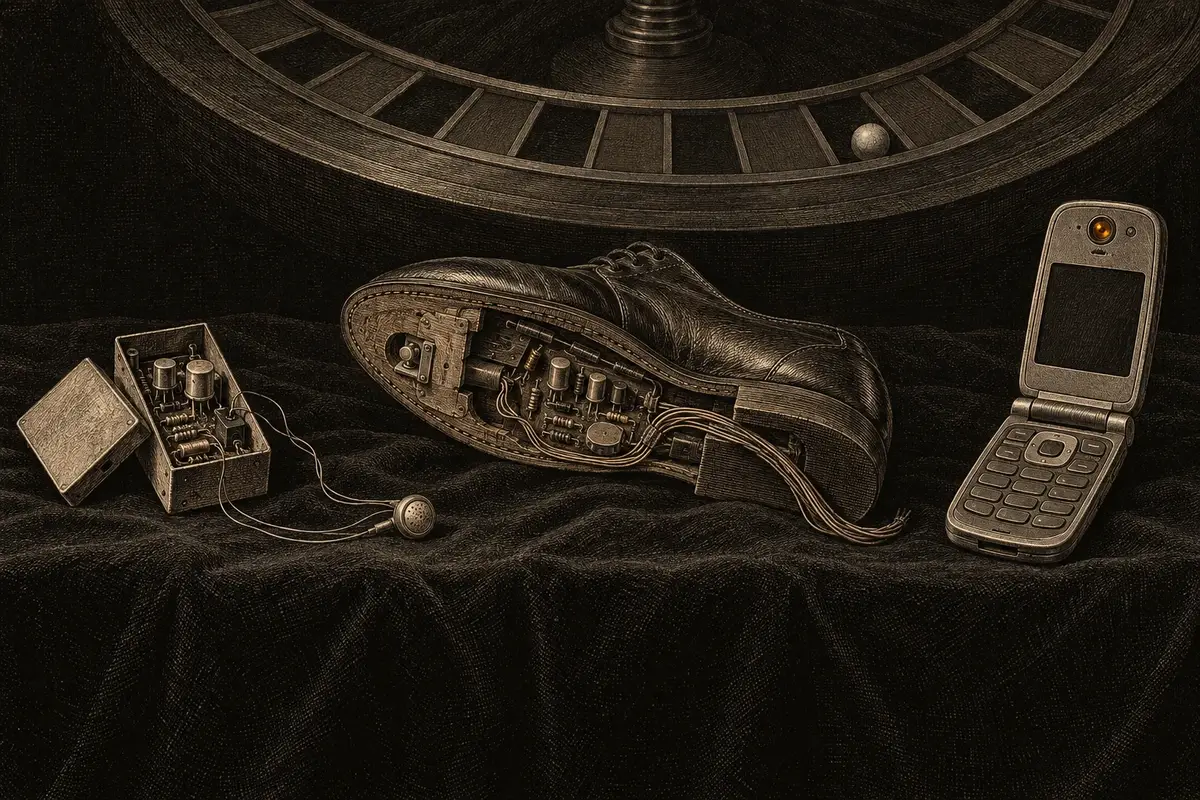
Thorp and Shannon build a wearable computer to time ball and rotor. It works in the lab; wires break on the floor.
The HNF museum dates a disrupted Eudaemons shoe-computer test to November 1981. Farmer separately recalls a 20% advantage, small stakes and persistent hardware problems; this is his estimate, not a published spin-by-spin trial.
Spain’s Supreme Court rejects Casino Gran Madrid’s appeal in an exclusion dispute involving players who analyzed wheel results. The ruling concerns their recorded conduct and that dispute, not a worldwide right to use any method.
Reports describe a £1.3 million Ritz win. The players were not prosecuted and their winnings were returned; the exact method remains disputed.
Small and Tse report a limited physical-prediction experiment; see the physics page for the sample and its limits.
Current opportunity depends on the equipment, observations, betting rules and applicable law.
Joseph Jagger: The Roulette Strategy at Monte CarloRichard Jarecki: The Roulette SystemGonzalo García-Pelayo: The Roulette System
Prediction devices
Physical prediction uses information about current motion, rather than assuming past winning numbers predict independent spinsmathIndependent spinsSpins for which learning an earlier outcome does not change the probabilities assigned to a later one.Read full definition →. Historical devices attempted to time the ballequipmentBallThe small ball that settles in a numbered pocket to determine a physical roulette result.Read full definition → and rotorequipmentRotorThe rotating part of a physical roulette wheel, carrying the numbered pockets.Read full definition →. Whether any implementation works requires validation under the actual conditions, and permission to use a device is a separate legal question.
Dealer signatures
A dealer-signature hypothesis concerns repeatable release-to-result relationships. A familiar rhythm is not evidence of an exploitable pattern. This page does not establish a demonstrated modern signature or a universal countermeasure.
What is left
Standard staking systems do not change a fixed per-unitmoneyUnitA base amount used to express stakes or results.Read full definition → negative expectation on independent spins. A physical-prediction claim needs different evidence, including predictive accuracy on fresh observations. A bias claim needs a reliable probabilitymathProbabilityA measure of how likely an event is, from zero to one. Percentages express the same scale from 0% to 100%.Read full definition → estimate and evidence of persistence.
| approach | claim to test |
|---|---|
| staking progression | does not alter fixed conditional probabilities |
| persistent bias | true selected hit rate exceeds break-even |
| motion prediction | fresh measured spins support useful predictions |
| dealer signature | release-conditioned results validate independently |
Legal position
In Nevada, NRS 465.075 prohibits specified devices, software and hardware used or possessed with intent to obtain a gaming advantage, with an exception for approved games or Commission permission. This is a Nevada rule, not a summary of the UK, EU or Australia. Observation, devices and a venue’s admission policy raise different questions; check the applicable jurisdiction.
Why a site about roulette says this
The useful distinction is between a known mathematical disadvantage and a separately demonstrated physical effect. A historical success does not validate a product sold today, while maintenance alone does not prove that prediction is impossible.
Questions
No. A current claim needs specific evidence, permissible methods and applicable rules; historical examples are not enough.
Comic relief
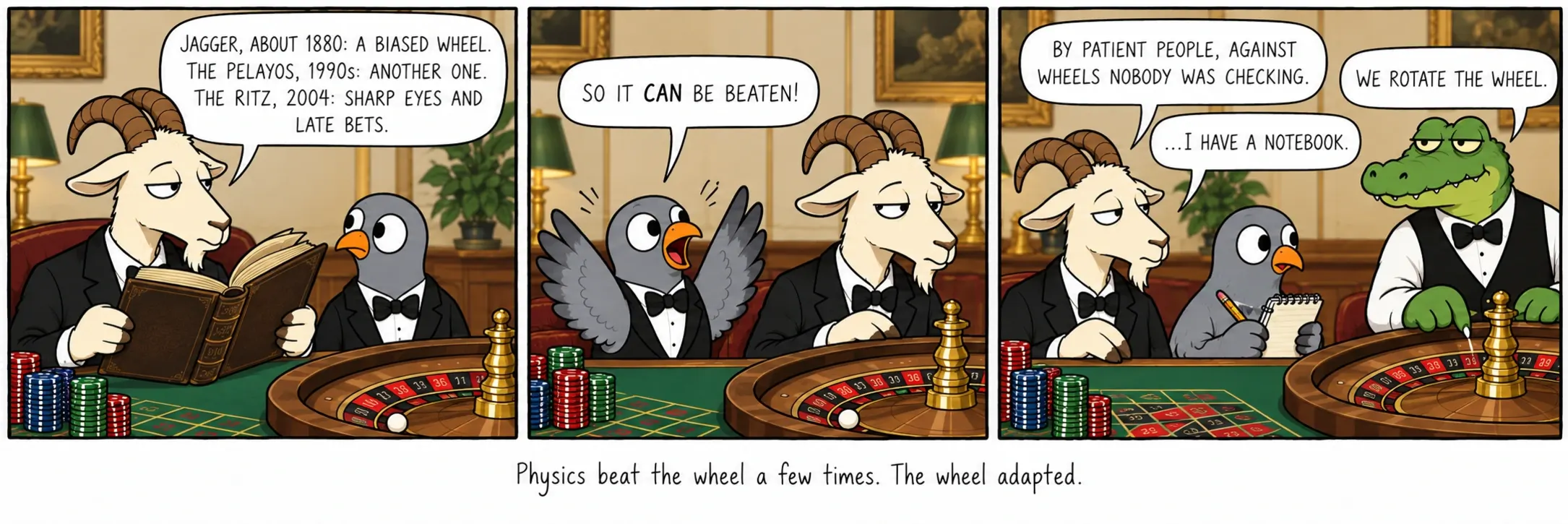
A historical success does not establish an advantage in today’s game.
Sources
- Bass, T. A. The Eudaemonic Pie.
- Thorp, E. O. “Optimal gambling systems for favorable games.”
- Thorp, E. O. The Mathematics of Gambling.
- Thorp, E. O. “The invention of the first wearable computer.”
- Small, M. & Tse, C. K. “Predicting the outcome of roulette.”
- Barnhart, R. T. Beating the Wheel.
- Bollman, M. Mathematics of the Big Four Casino Table Games: Blackjack, Baccarat, Craps, & Roulette.
- Chellel, K. “The Gambler Who Beat Roulette.”
- Goldman, N. Great Gambling Scams.
- Nevada Revised Statutes 465.075 — checked November 15, 2026
- Bethell, V. Monte Carlo Anecdotes and Systems of Play (1910), pp. 63–66.
- Farmer, J. Doyne. Roulette — participant account.
- Heinz Nixdorf MuseumsForum. Shoe computer.
- Spain, Supreme Court, appeal 4288/2000, judgment of 11 June 2004.
- Evening Standard. “Ritz coup trio keep £1.3m.” Archived report.