Roulette Books: A Reading List
Books and papers on roulette mathematics, history, physical prediction and fiction, with notes to help you choose a starting point.
This reading list includes probability textbooks, historical accounts, research papers and a novel. They serve different purposes: a memoir is not independent confirmation, and a mathematical result depends on its assumptions. Check the edition when matching dates and page references.
Mathematics
| work | edition or year | subject |
|---|---|---|
| Huygens, De Ratiociniis in Ludo Aleae | 1657 | an early printed treatment of expectation in games of chance |
| Bernoulli, Ars Conjectandi | 1713 | probability, combinations and the law of large numbers |
| Halmos, “Invariants of certain stochastic transformations: The mathematical theory of gambling systems” | 1939 | a technical paper on gambling systems; read the hypotheses with the conclusions |
| Feller, An Introduction to Probability Theory and Its Applications, volume 1 | 1968, 3rd edition | probability foundations, random walks and ruin problems |
| Thorp, “Optimal gambling systems for favorable games” | 1969 | staking when favorable opportunities exist; not a claim that ordinary roulette is favorable |
| Thorp, The Mathematics of Gambling | 1984 | analysis of several games, including roulette, and money management |
| Epstein, The Theory of Gambling and Statistical Logic | 2009, 2nd edition | mathematical analysis across a range of games |
| Ethier, The Doctrine of Chances: Probabilistic Aspects of Gambling | 2010 | a detailed mathematical reference on gambling |
| Bollman, Mathematics of the Big Four Casino Table Games | published 2021; copyright 2022 | blackjack, baccarat, craps and roulette variants, with exercises |
| Taylor, Games, Gambling, and Probability | 2021, 2nd edition | an introduction to mathematics through games |
| Bollman, Basic Gambling Mathematics | 2024, 2nd edition | probability and expected-return calculations for games of chance |
| Hunacek, Quantitative Literacy Through Games and Gambling | 2025 | an introductory treatment of discrete probability using games |
History
| work | edition or year | reading context |
|---|---|---|
| Lablée, La Roulette, ou Histoire d’un joueur | 1802 edition | an early roulette novel; the catalogue dates this edition, not the invention of the game |
| Barnhart, Beating the Wheel | 1992 | roulette and bias-play accounts; check historical claims against original evidence |
| Schwartz, Roll the Bones: The History of Gambling | 2006, first edition | a broad history of gambling rather than a roulette rulebook |
| Kavanagh, Dice, Cards, Wheels | 2005 | gambling and its representations in French culture |
| Marcus, American Roulette | 2003 | a memoir of casino cheating; treat the author’s recollections as a participant’s account |
| Goldman, Great Gambling Scams | 2007 | check individual episodes against original evidence before relying on them |
Physics and advantage play
| work | year | subject |
|---|---|---|
| Bass, The Eudaemonic Pie | 1985 | a narrative account of the Eudaemons’ roulette-computer project |
| Small and Tse, “Predicting the outcome of roulette” | 2012 | a physical model and experiments on prediction under specified conditions |
| Pearson, “On the criterion…” | 1900 | the chi-square goodness-of-fit test, including discussion of roulette data |
The novel
Dostoevsky’s The Gambler (1866) follows Alexei Ivanovich through money troubles, relationships and roulette. Read it as fiction about a gambler’s experience, not as a record of independent trials or a guide to winning. The roulette scenes are discussed on the literature pages.
The best roulette books for each purpose
Choose by the question you want to answer. Publisher descriptions position Hunacek, Taylor and Basic Gambling Mathematics as introductory texts. Feller covers broader probabilitymathProbabilityA measure of how likely an event is, from zero to one. Percentages express the same scale from 0% to 100%.Read full definition → foundations; Ethier is a detailed reference. Preview a chapter to judge the level before buying.
For history, distinguish an author’s synthesis from a participant’s recollection. For physical prediction, distinguish an experiment from a claim that a method works at a current casino. Older books cannot establish today’s laws, operator permissions or active paytables. Use current official sources for those details.
Questions
A sequence of stake changes does not turn standard negative-expectation bets into favorable ones. Books about physical bias, promotions or favorable games address different assumptions; check those assumptions carefully.
Match the title, author, edition and ISBN in a publisher or library record. Publication, copyright, paperback and digital-release dates can differ, so a year alone may not identify the copy cited.
Comic relief
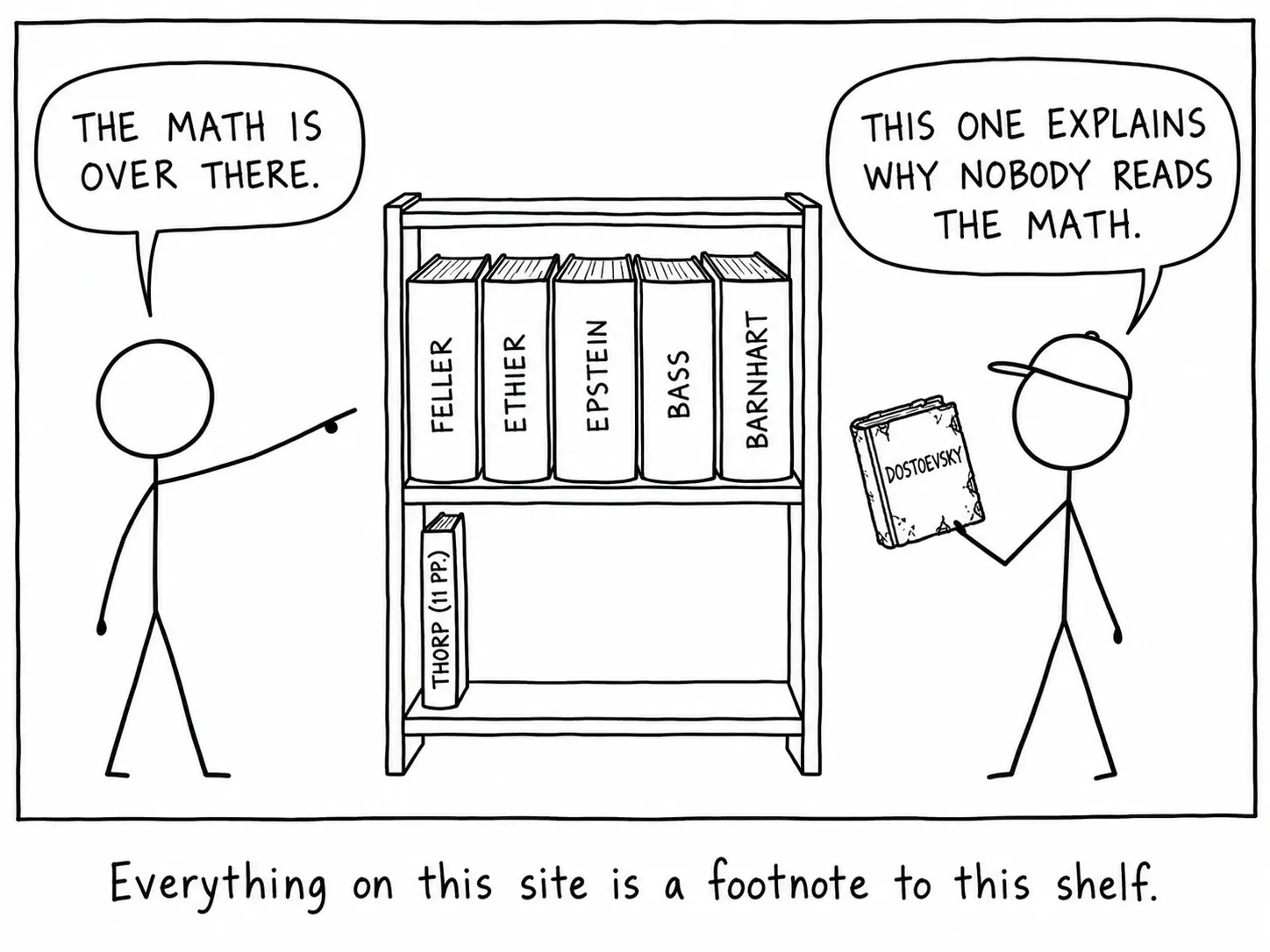
Match the source to the question.
Sources
- Ethier, author’s bibliographic record
- Wiley, Feller volume 1, third edition, contents and publication details
- Elsevier, Epstein second edition, 2009
- Bollman, Big Four publisher record; copyright 2022
- Publisher catalogue, Big Four August 2021 publication
- Taylor, second edition publisher record
- Bollman, Basic Gambling Mathematics second edition
- Hunacek, publisher record
- Lablée, CAT19 catalogue of the 1802 edition
- Kavanagh, Penn Press contents and editions
- Marcus, publisher description and excerpt
- Schwartz, author’s first-edition record
- UCI Libraries, Thorp bibliography
- Bernoulli, Smithsonian digitized edition
- Huygens, Leiden historical texts and translations
- Thorp, 1969 paper, UCI archive
- Pearson, original 1900 paper