Walkthrough: A Paroli Run
Ten dollars on black, doubled after every win, banked after three in a row. The reverse Martingale, spin by spin.
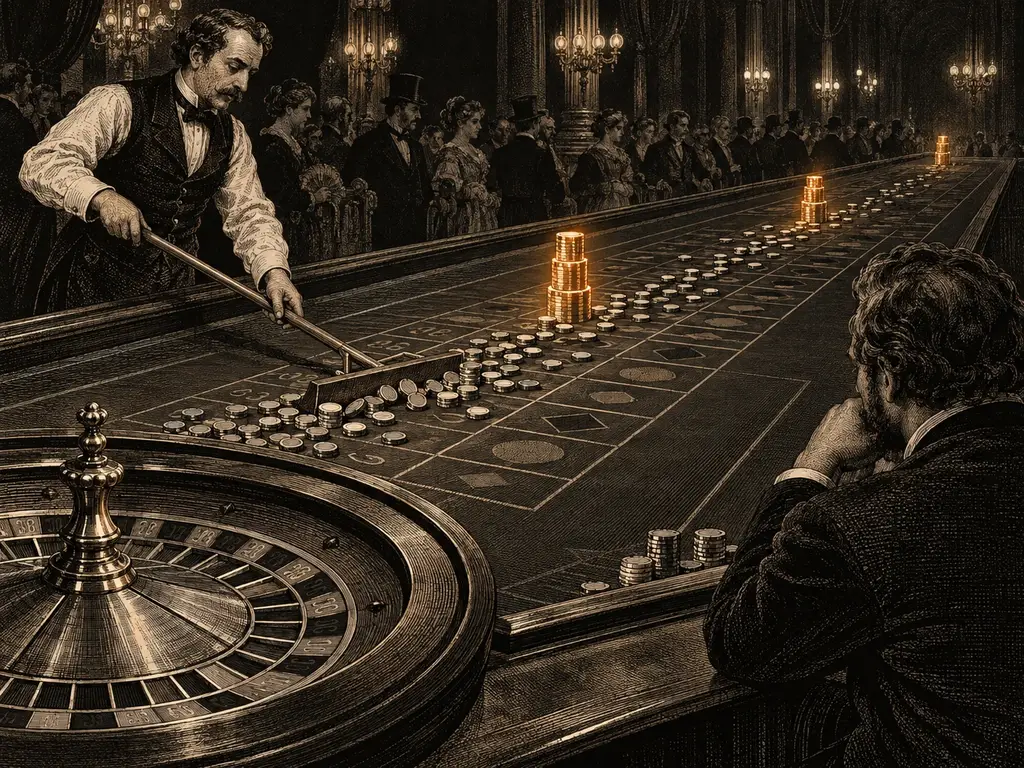
A simulated 80-spin Paroli session. Fifty-three small losses, nine broken runs and three completed triples that paid $70 each. Net −$110 after being up $90. The system that loses often and wins rarely, in the shape the arithmetic predicts.
Walk the system
A win moves one step on. A loss, or a third win, goes back to the start.
Stakes and results are in units of the base bet.
The plan
Bet $10 on blackbetBlackEven-money bet on the 18 black numbers. French: noir.Read full →. After a win, let the $20 ride. After a second win, let the $40 ride. After a third win, take the $80 down and start again with $10. A loss anywhere restarts at $10. Each attempt risks $10 of our own money and wins $70 if black comes three times running, which happens (18/37)³ = 11.5% of the time. We expect about one completed run in nine attempts.
Spins 1–25
B R R B B R R B R B B B R R R B R R R B B R B R R. Twelve attempts: eight lost at the first spin (−$10 each), three lost at the second spin (−$10 each, because the $20 was the house’s money plus ours), one completed triple at spins 10–12 (+$70). Net −$40. The completed run felt like proof. The eleven failures felt like nothing, which is the point of the design.
Spins 26–55
Two more triples, at spins 31–33 and 48–50, and a run of five blacks in the middle that we cashed after three and then lost the fresh $10 on. Net for the stretch +$90; running total +$50; peak +$90 at spin 50. Three triples in 25 attempts is above the expected 2.8; the session is running slightly hot and feels like a method.
- p10 −$780
- p25 −$510
- median −$210
- p75 +$90
- p90 +$370
Spins 56–80
Sixteen losing attempts in a row, four of them at the second or third spin where the ride ended one black short. Net −$160 for the stretch; final −$110. The streak of failures has probabilitymathProbabilityChance of an outcome, from 0 to 1 or 0% to 100%. One number: 1/37 = 2.70%.Read full → about 14%, which is to say it will happen to a ParolistrategyParoliPositive progression: double after a win, reset after a loss or after three wins in a row. Also: reverse Martingale.Read full → player roughly every seventh session of this length.
The accounts
Total wagered about $1,300 over 80 spins against $800 for a flat $10 bettor: the rides add turnovermoneyTurnoverThe total amount wagered over a session or period, counting re-bet winnings. Also: handle, action.Read full →. Expected lossmathExpected lossExpected value times total amount wagered; the average amount lost over a session or a period.Read full → on $1,300 is $35; actual −$110 is about one standard deviationmathStandard deviationSquare root of variance; the typical distance of a result from the expected value.Read full → below, unremarkable. The flat bettor beside us had the same expectation per dollar and a result with a third of the swing.
What the session shows
Paroli is MartingalestrategyMartingaleProgression that doubles the bet after each loss. See the Strategy section for what it does and does not do.Read full → upside down: it loses one unitmoneyUnitThe base stake a system or a player works in. Progressions are described in units so they apply at any table.Read full → most of the time and wins seven units occasionally, instead of winning one unit most of the time and losing sixty-three occasionally. The distribution is less dangerous because the big number is a win, not a loss, and the stake never exceeds $40 of which only $10 is ours. The expected loss per dollar is unchanged. It is the better system for a player who wants variancemathVarianceA measure of how widely results spread around the expected value. High for straight up, low for even-money bets.Read full → without a cliff, and it still costs 2.70% of turnover.
Questions
Four in a row is 5.6% and pays $150. The target is a taste; the edge is the same at every target.
No. After one win the $20 on the table is yours. Paroli feels cheap because the loss of a ride does not look like a loss of your own money. It is.
Same expectation, smaller maximum stake, no table-limit cliff. Better in every way except the one that matters, which is unchanged.
Comic relief
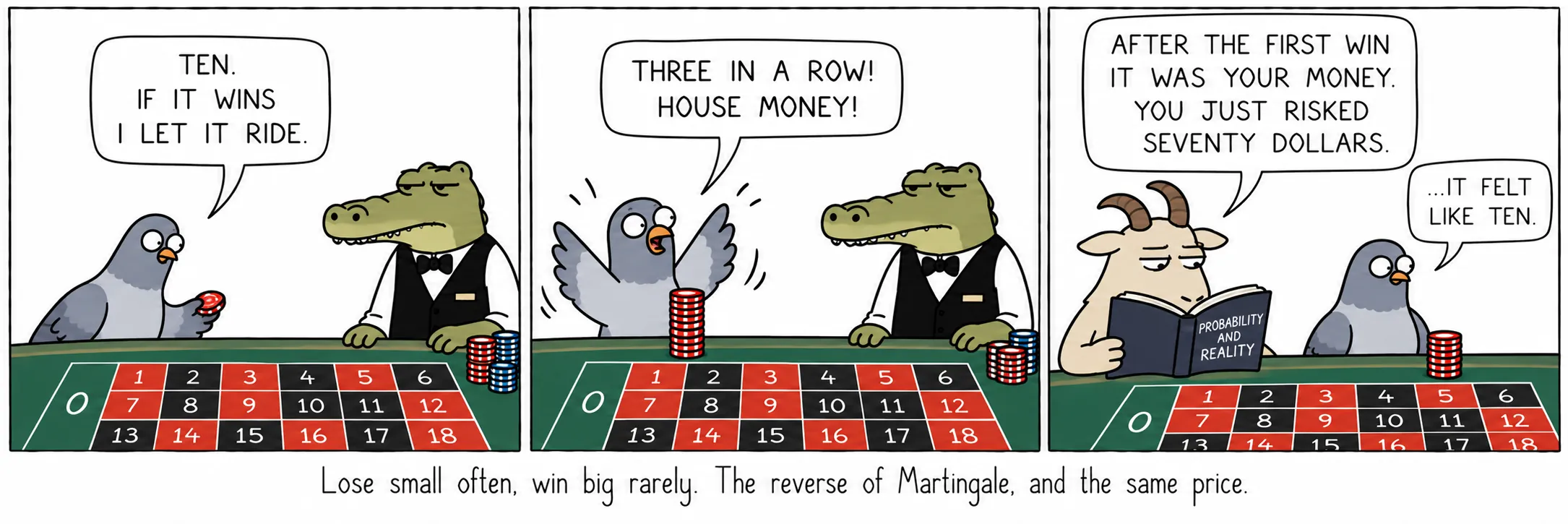
Lose small often, win big rarely. The reverse of Martingale, and the same price.
Sources
- Ethier, S. N. The Doctrine of Chances: Probabilistic Aspects of Gambling.