Flat Betting Roulette Strategy
The same stake every spin. The flat bettingstrategyFlat bettingUsing the same stake on each bet or spin, as specified by the strategy.Read full definition → roulette strategy is the baseline every progression should be compared against.
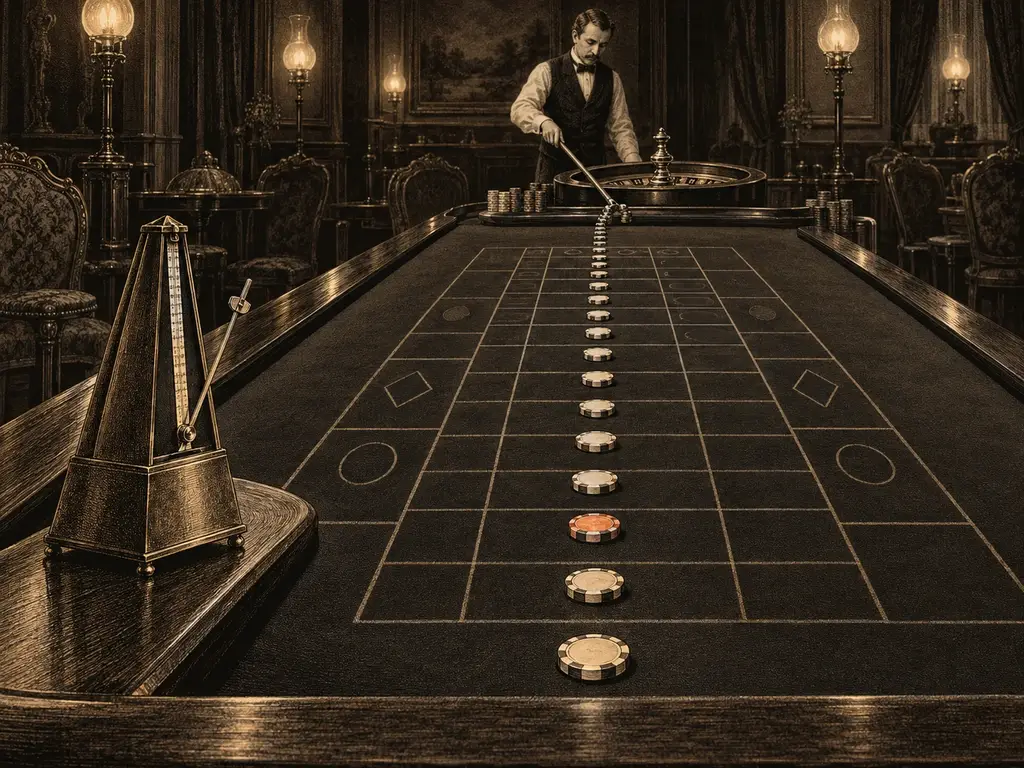
For a fixed number of fully funded standard single-zero bets, expected loss is stake × spins / 37. The chosen bet still determines the spread of outcomes.
Why it is the baseline
For a fixed stake and a fixed number of funded spins, turnovermoneyTurnoverThe sum of amounts wagered over a session or period, including money wagered again after a return. Also called handle or action.Read full definition → is known in advance: stake × spins. Under standard single-zerowheelZeroThe 0 outcome, conventionally shown in green. Ordinary color, parity, high/low, dozen and column bets do not include it.Read full definition → rules, expected lossmathExpected lossThe probability-weighted average net loss under a stated model. With a constant edge, it equals edge times expected total stakes.Read full definition → is that amount divided by 37. A progressionstrategyProgressionA rule that changes stakes over a sequence of bets, often using previous wins or losses.Read full definition → that stakes at least this same base on every one of those spins cannot have lower turnover. Early stopping, reduced stakes or different rules change the comparison.
| $10 on red | turnover | expected loss |
|---|---|---|
| 50 funded spins | $500 | $13.51 |
| 100 funded spins | $1,000 | $27.03 |
| 200 funded spins | $2,000 | $54.05 |
Shape
For 100 independent $10 redbetRedAn even-money wager on the 18 red numbers. French: rouge.Read full definition → bets, the chance of net profit is 35.53%. The exact result is a scaled binomial distribution, with mean −$27.03 and standard deviationmathStandard deviationThe square root of variance: a measure of dispersion in the same units as the result.Read full definition → about $100. The chance of ending more than $200 above or below the starting balance is about 4.19%. For 100 $10 straight-up bets, profit probabilitymathProbabilityA measure of how likely an event is, from zero to one. Percentages express the same scale from 0% to 100%.Read full definition → is 50.94% and standard deviation about $584. A larger profit probability does not imply a better expected return.
- p10 −$420
- p25 −$280
- median −$140
- p75 +$20
- p90 +$160
Choosing the stake
At a fixed pace, expected loss per hour is stake × spins per hour / 37. Reversing that formula gives a stake for a chosen expected cost, not a maximum-loss budget. At an illustrative 50 spins per hour, a $7.40 stake has expected hourly loss $10. Actual loss can be much higher, and the table may not accept that stake.
| expected hourly loss | 50 spins/h | 100 spins/h | 200 spins/h |
|---|---|---|---|
| $5 | $3.70 stake | $1.85 | $0.93 |
| $10 | $7.40 | $3.70 | $1.85 |
| $25 | $18.50 | $9.25 | $4.63 |
| $50 | $37.00 | $18.50 | $9.25 |
Flat betting with a stop rule
A precommitted loss limit can restrict spending if you stop and do not place a stake that could exceed it. A profit target does not guarantee you will reach it. With stopping, the number of bets is random, so calculate expected loss from expected turnover rather than assuming the full scheduled number of spins.
What flat betting cannot do
It cannot make standard independent spinsmathIndependent spinsSpins for which learning an earlier outcome does not change the probabilities assigned to a later one.Read full definition → positive in expectation. The 35.53% figure applies to exactly 100 equal red bets without special zero treatment; different lengths, bets and stopping rules give different profit probabilities.
Simulator · Flat
2,000 sessions of even-money bets from a $1,000 bankroll.
Base bet $10 · table limit $500 · up to 100 spins per session
Questions
Yes: it is a fixed-stake plan. It is a useful comparison because its turnover is simple to calculate for a fixed horizon.
Even-money betsbetEven-money betA bet paying a profit equal to the stake, such as red/black, odd/even or high/low.Read full definition → have smaller per-stake swings than straight upsbetStraight upA wager on one number, ordinarily paying a profit of 35 to 1.Read full definition →. With the same funded turnover and standard zero treatment, expected loss is the same; neither choice guarantees session length.
La partageruleLa partageA rule returning half of a qualifying even-money stake when zero lands. On a fair single-zero wheel it gives an edge of 1/74, about 1.35%.Read full definition → halves the edge on eligible single-zero even-money bets. Other bets are unchanged, and en prisonruleEn prisonA zero rule that holds an even-money stake for possible recovery on a later spin. The details vary by game.Read full definition → depends on its detailed rules. Check the terms rather than the name.
Comic relief
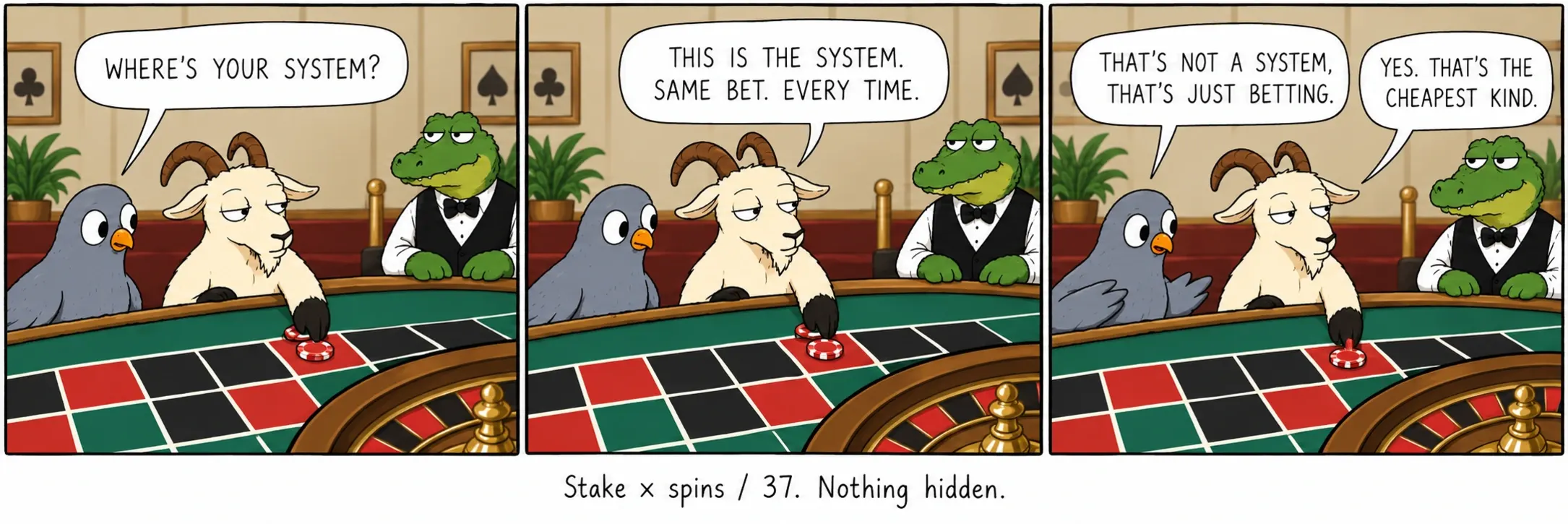
Expected loss = stake × spins / 37 (standard single-zero bets).
Sources
- RouletteDoc. Strategy description and examples.
- Roulette77. Strategy description and examples.
- Ethier, S. N. The Doctrine of Chances: Probabilistic Aspects of Gambling.