Measuring a Wheel Physically
What a casino technician actually checks, with what tools, and how often. The maintenance that made bias play extinct.

Level, rotor balance, pocket depth and width, fret height and security, ball track wear, and deflectorequipmentDeflectorOne of the metal obstacles on the apron that scatter the falling ball. Also: canoe, diamond, pin.Read full → condition. Checked on schedule with a spirit level, dial gauges, a balance rig and a logbook. Rotor heads are rotated between bowls so no defect stays with one table.
Why measure
A wheel is a machine and machines wear. A rotorequipmentRotorThe spinning part of the wheel that carries the pockets.Read full → that is a fraction of a degree off level drops the ballequipmentBallThe small ball launched along the track against the rotor. Modern balls are ivorine or Teflon, 18–21 mm.Read full → more often on the low side; a fretequipmentFretThe metal divider between two pockets on the wheel.Read full → that has worked loose changes the bounce beside it; a worn ball trackequipmentBall trackThe rim groove the ball runs along before it slows and falls. Also: upper track.Read full → creates a drop zone. Each of these was exploited historically. Modern casinos measure the wheel because the alternative is letting a player with a notebook measure it statistically first. Small tilts matter more than they look: Thorp worked out in 1969 that a tilt of only 0.2 degrees keeps the ball from leaving the track over about 30% of the circuit, on the high side, which narrows where the fall can begin (Epstein, 2013).
What is checked
How often
Level is checked every shift or every day because it is quick and because floors move. Rotor balance and spin-down time weekly to monthly. PocketequipmentPocketOne of the 37 numbered compartments on the rotor. Also: slot, cup.Read full → and fret measurement monthly to quarterly, more often on busy wheels. Everything is logged, and the log is what a regulator asks for. Live studios, with wheels running 24 hours, measure more often than floors.
Level check. Ball inspected, often swapped.
Rotor spin-down timed; bearing checked; deflectors torque-checked.
Rotor head moved to a different bowl. Frets checked for movement.
Pockets measured with gauges; frets and ball track inspected for wear; worn parts replaced.
Full strip-down or manufacturer service.
Operator’s own chi-square on logged results triggers an inspection out of cycle.
Rotating heads
The rotor (wheel headequipmentWheel headSynonym for rotor: the spinning part carrying the numbers.Read full →) lifts out of the bowlequipmentBowlThe fixed outer part of the wheel: the wooden or composite rim that holds the ball track and apron, inside which the rotor spins.Read full →. Casinos move heads between bowls on a schedule, so that any defect in a head follows it to a new table and any defect in a bowl (level, track) is paired with a new head. A bias player who has logged 10,000 spins on table six finds the wheel they measured is now at table two, with a different track, and their data describes a combination that no longer exists. This practice, the casinos’ answer to bias players from Jagger on, did more to end bias play than any statistic.
Statistical monitoring
Casinos and studios run the same chi-square testlabChi-square testStatistical test comparing observed hits per pocket with the expected n/37. Used to judge whether a wheel is biased.Read full → on their own logged results that the Lab describes, continuously, with far more data than any player could gather. A wheel that drifts is flagged and inspected before it has produced enough spins for an outsider to notice. The operator is the best-equipped bias hunter in the building and has the strongest incentive.
Questions
No. Regulators can.
No. There is no wheel.
Manufacturers specify tolerances in fractions of a millimeter for pockets and tenths of a degree for level. Anything outside is corrected.
Comic relief
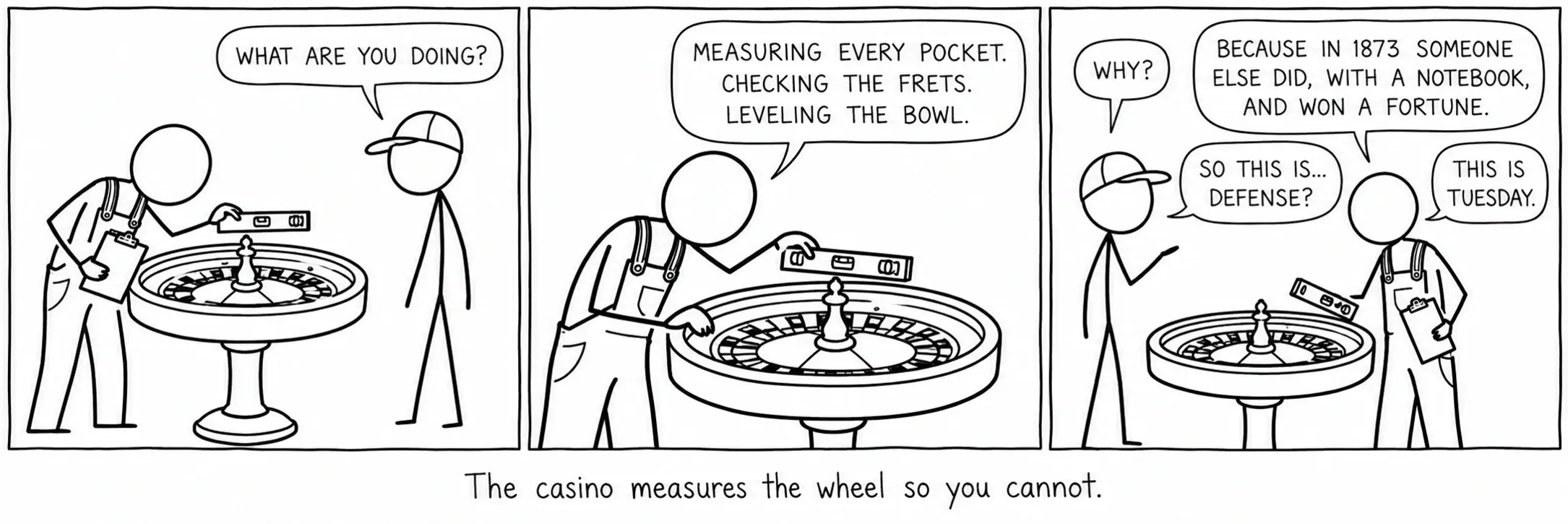
The casino measures the wheel so you cannot.
Sources
- Barnhart, R. T. Beating the Wheel.
- UK Gambling Commission. Remote gambling and software technical standards.
- Malta Gaming Authority. Gaming Devices Regulations and technical directives.
- Epstein, R. A. The Theory of Gambling and Statistical Logic, 2nd ed.