Roulette in Literature
Novelists understood the wheel long before mathematicians explained it to the public.
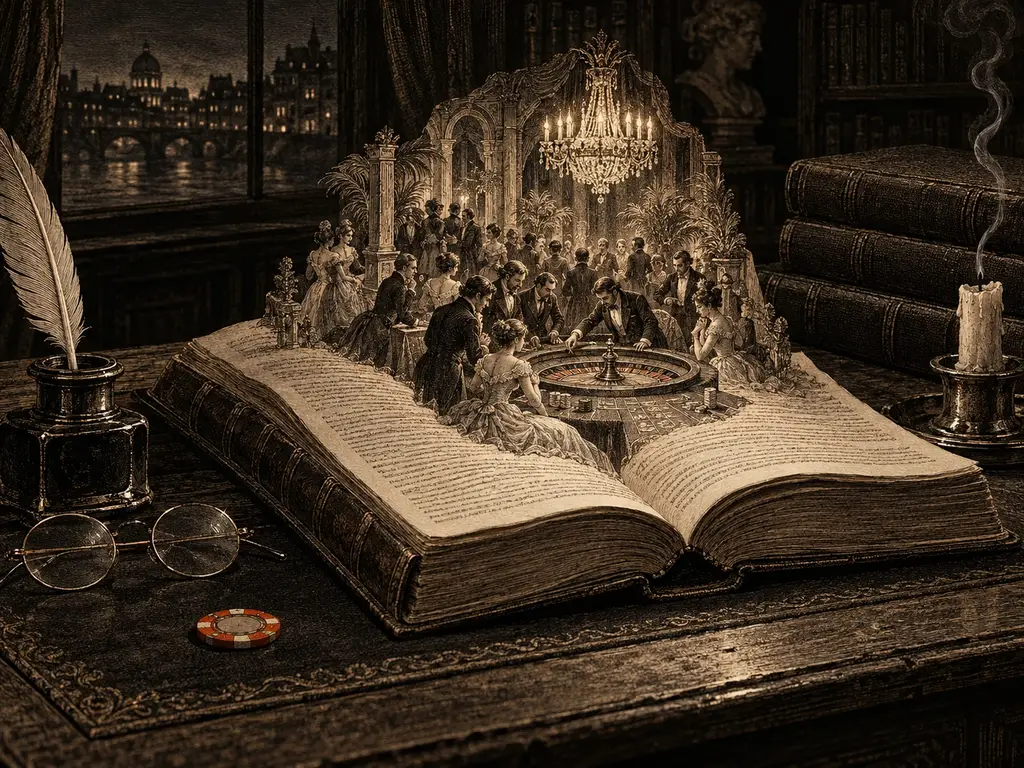
From Dostoevsky’s The Gambler to Jack London’s Klondike and Fleming’s Casino Royale, roulette in fiction is about the player, not the wheel. The best of it describes the fallacy, the compulsion and the system from the inside, with an accuracy the strategy pamphlets never managed.
Lablée, 1801
La Roulette, ou le Jour is a novel that happens to contain the first full description of the game: the Palais-Royal rooms, the two zeroswheelZeroThe single green pocket that no even-money, dozen or column bet covers; the source of the house edge. Also: single zero, 0.Read full →, the layoutequipmentLayoutThe printed betting grid on the table. Also: table, felt, cloth.Read full →, the croupierspeopleCroupierThe dealer at a roulette table.Read full →’ calls. It is the primary source for the origin of roulette and almost nobody has read it as a novel, which is probably fair.
Dostoevsky, 1866
The Gambler was dictated in 26 days to meet a contract and pay gambling debts run up at Wiesbaden and Homburg. Its narrator, Alexei, is a tutor in a Russian household at “Roulettenburg” who wins a fortune at the tables and loses it, and himself, over the course of the book. The descriptions of the tables, the systems players use, the certainty that a run must end and the way a win feels like insight are the best account of the gambler’s fallacy in any language, written nearly fifty years before the 26 blacksbetBlackEven-money bet on the 18 black numbers. French: noir.Read full → and a century before behavioral economics.
Thackeray and the spas
Vanity Fair ends with Becky Sharp at the tables of a German spa town, and the chapter is a sharp sketch of who sat around a roulette wheel in the 1840s: the ruined, the hopeful, the bored and the professional. Thackeray had seen it; Baden-Baden was on every English traveler’s route. Turgenev’s Smoke (1867) is set in the same rooms.
Jack London, 1912
“Shorty Dreams”, a story in Smoke Bellew, is the one piece of fiction that gets a winning roulette player right, because the player is not using a system. Smoke Bellew, a San Francisco man turned Klondike prospector, sits down at a roulette table in the Elkhorn saloon in Dawson and begins winning, night after night, 3,500 dollars at a time. His partner Shorty decides he must be dreaming. The gamblers of Dawson, who know from “the mathematic sharps in the colleges” that roulette itself is the only system, fill notebooks trying to decode his bets and find nothing, because Smoke varies his play on purpose, once losing forty limit bets in a row to muddy the picture.
The ten game-owners of the town pool a 10,000-dollar bank in a back room and invite him to buck it. He breaks it in an hour and a half. Faced with cutting their limits to a cent or closing the tables, they ask what he will sell the system for. Thirty thousand dollars, he says, three thousand apiece, paid in gold dust, and he will promise never to play it again in Dawson. They pay. Then he shows them: with the ballequipmentBallThe small ball launched along the track against the rotor. Modern balls are ivorine or Teflon, 18–21 mm.Read full → launched while 9 is opposite the keeper, 26 wins; 11 opposite brings double zerovariantDouble zeroThe 00 pocket of the American wheel. Its presence raises the house edge from 2.70% to 5.26%.Read full →; double zero opposite brings 32. “It doesn’t always happen, but it usually happens.” Big Burke stops the wheel, looks at it, looks at the stove beside the table, and swears. The wheel is warped by the heat. It was never a system; it was a biased wheellabBiased wheelA wheel whose physical defects make some pockets more likely than 1/37. Rare, detectable only with thousands of recorded spins.Read full → and a man who noticed.
London had wintered in the Klondike in 1897–98 and knew the saloons. The story is a complete lesson in advantage play about fifty years before Thorp: observe, record, bet the sectorwheelSectorA contiguous arc of pockets on the wheel, as distinct from a group on the layout.Read full →, vary the pattern so the house cannot see what you see, and sell before they move the table. Joseph Jagger had done the real thing at Monte Carlo around 1880; London’s version is funnier and the gamblers’ lecture on why systems cannot work is as accurate as anything on this site.
Fleming, 1953
Casino Royale is mostly baccarat. At roulette Bond backs the first two dozensbetDozen1–12, 13–24 or 25–36, pays 2:1.Read full → at the table maximum, covering two thirds of the layout, and in that scene wins six spins out of seven; Fleming has him note that each spin has no connection with the one before. The “James Bond strategy” sold online, a spread on 19–36, the six linebetSix lineSix numbers in two adjacent rows, pays 5:1. French: sixain.Read full → 13–18 and zero, is not in the novel, nor in any of the Fleming books we checked; who first gave it Bond’s name is not known. Both bets cost 2.70% on a single-zero wheel. The Strategy section has the arithmetic.
Non-fiction
Thomas Bass’s The Eudaemonic Pie (1985) tells the story of the shoe computers and is the best book on roulette physics for a general reader. Richard Epstein and Stewart Ethier wrote the serious mathematics. Russell Barnhart’s Beating the Wheel (1983) collects the bias-play history. Nobody has written a readable book on why systems fail, because it fits on one page, which this site has.
Lablée. The game described.
Pushkin. The system as madness (at faro).
Thackeray. The spa-casino crowd.
Dostoevsky. The definitive gambler.
The song: “The Man Who Broke the Bank at Monte Carlo”.
London. Smoke beats a warped wheel in Dawson and sells the “system”.
Fleming. Bond bets two dozens.
Barnhart; Bass. The non-fiction of beating the wheel.
Ethier. The mathematics, complete.
What fiction knows
That the system is a way of feeling in control. That a win feels like knowledge. That the run that cannot continue continues. That the only player who really wins is the one who found something wrong with the wheel, and that he should sell quickly. That the table is where a character shows who they are when the outcome is not up to them. The mathematics says the same things in numbers; the novelists said them first.
Questions
The Gambler. It is short and it is the whole subject.
Closely. Dostoevsky’s own losses, his stenographer (whom he married) and the spa setting are all there.
No. In Casino Royale Bond bets two dozens. The spread on 19–36, 13–18 and zero was given his name later, by someone else.
Yes. A warped or tilted wheel is exactly what Jagger exploited at Monte Carlo and the Lab section explains how to detect one. The thirty thousand dollars is the fictional part.
Comic relief
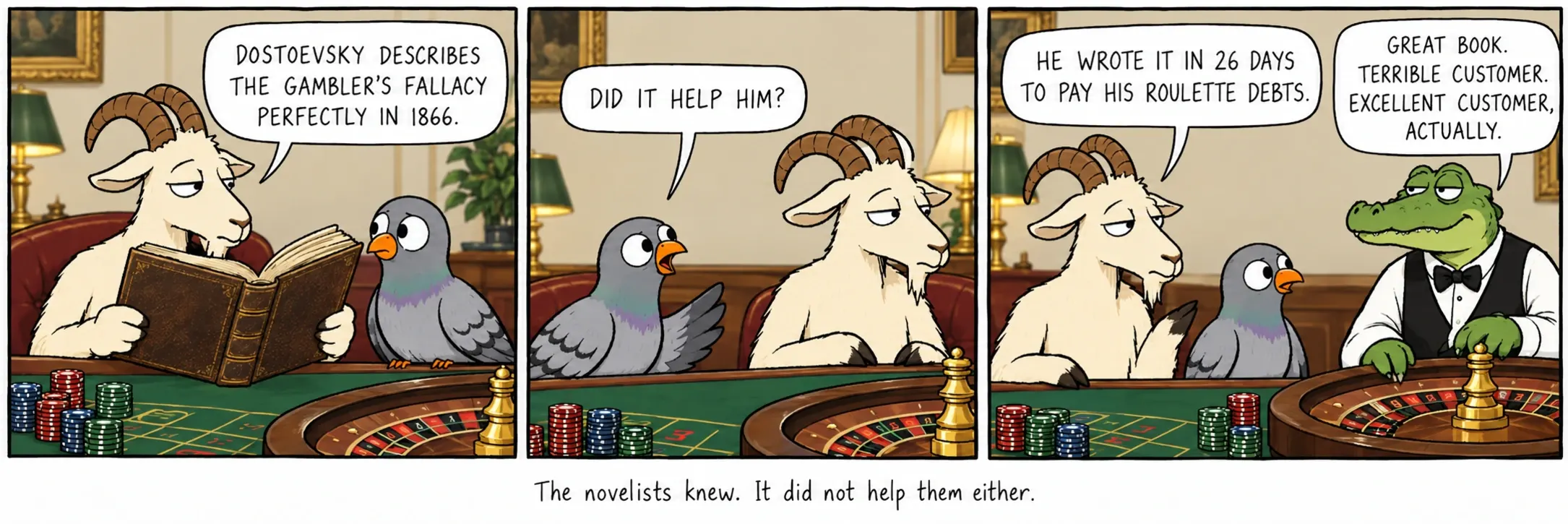
The novelists knew. It did not help them either.
Sources
- Lablée, J. La Roulette, ou le Jour.
- London, J. Smoke Bellew.
- Bass, T. A. The Eudaemonic Pie.
- Barnhart, R. T. Beating the Wheel.
- Kavanagh, T. M. Dice, Cards, Wheels: A Different History of French Culture.