Makarov-Biarritz Roulette Strategy
Makarov–Biarritz repeats any chosen straight-up number for up to 36 spins. Choosing a number does not make it due to land.
On independent single-zerowheelZeroThe 0 outcome, conventionally shown in green. Ordinary color, parity, high/low, dozen and column bets do not include it.Read full definition → spins, at least one hit in a 36-spin block is 62.7069%; a hit on spin 36 merely breaks even for the full block.
Rule as described
Makarov–Biarritz selects any straight-up number, repeats it for no more than 36 spins, chooses a new number after a hit, and restarts after 36 misses. This segments repeated straight bets; it does not make the selected number more likely to land. A separately defined observation variation watches 111 spins before selecting a number. That observation step is not part of the 36-spin rule.
Cycle payout table
A $1 straight-up hit gains $35, but earlier misses matter to the block total.
| cycle event | spins involved | net if stop at event |
|---|---|---|
| hit on spin 1 | 1 | +$35 |
| hit on spins 2–35 | k | +$(36 − k) |
| hit on spin 36 | 36 | $0 |
| no hit in 36 spins | 36 | −$36 |
Worked example
Choose 17 and stake $1 on it. If 17 lands on spin 12, that spin gains $35 and the first 11 misses cost $11, so stopping at the hit leaves +$24 for the block. If it lands only on spin 36, its +$35 exactly offsets 35 prior misses. If it misses all 36, the block loses $36. No prior appearance makes 17 more likely on a fair independent wheel.
Cost and risk
The 62.7069% figure is an at-least-one-hit block probabilitymathProbabilityA measure of how likely an event is, from zero to one. Percentages express the same scale from 0% to 100%.Read full definition →, not a per-spin probability and not strictly a profit probability because a spin-36 hit breaks even. The number of wagers is random if play stops at a hit, so do not mechanically call every cycle a $36/37 expected lossmathExpected lossThe probability-weighted average net loss under a stated model. With a constant edge, it equals edge times expected total stakes.Read full definition →; each individual $1 wager that is actually made retains an expected loss of $1/37. The system can make a hit feel persuasive without changing expected valuemathExpected valueThe sum of each possible net result multiplied by its probability. It can be positive, zero or negative.Read full definition →.
Questions
No. A first hit on spin 36 breaks even. The chance of strictly positive profit under this stop-at-first-hit rule is 61.67%, and 37.29% of cycles lose all 36 stakes.
Not on independent roulette spins. Prior results do not alter the next number’s probability.
Comic relief
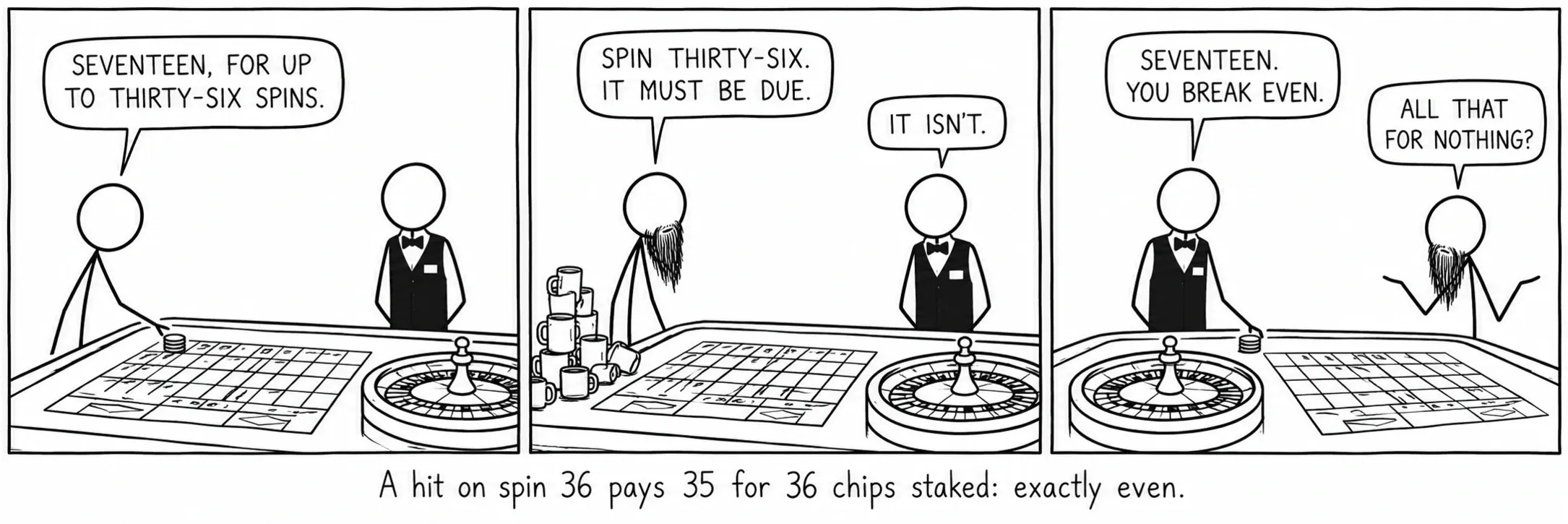
A first hit on spin 36 returns 36 chips including the winning stake, matching the 36 chips wagered.
Sources
- RouletteDoc, “Makarov–Biarritz” — any-number, 36-spin cycle
- Roulette77. Strategy description and examples.
- RouletteUK, “Makarov–Biarritz strategy” — 36-bet rule and separately discussed observation variant
- Wizard of Odds, Roulette Basics — straight-up payout and European wheel
- Wizard of Odds, The Truth about Betting Systems