Extras · FAQ · 9 min
Frequently Asked Questions
The questions this site is asked most, each answered in two sentences with a link to the long version.
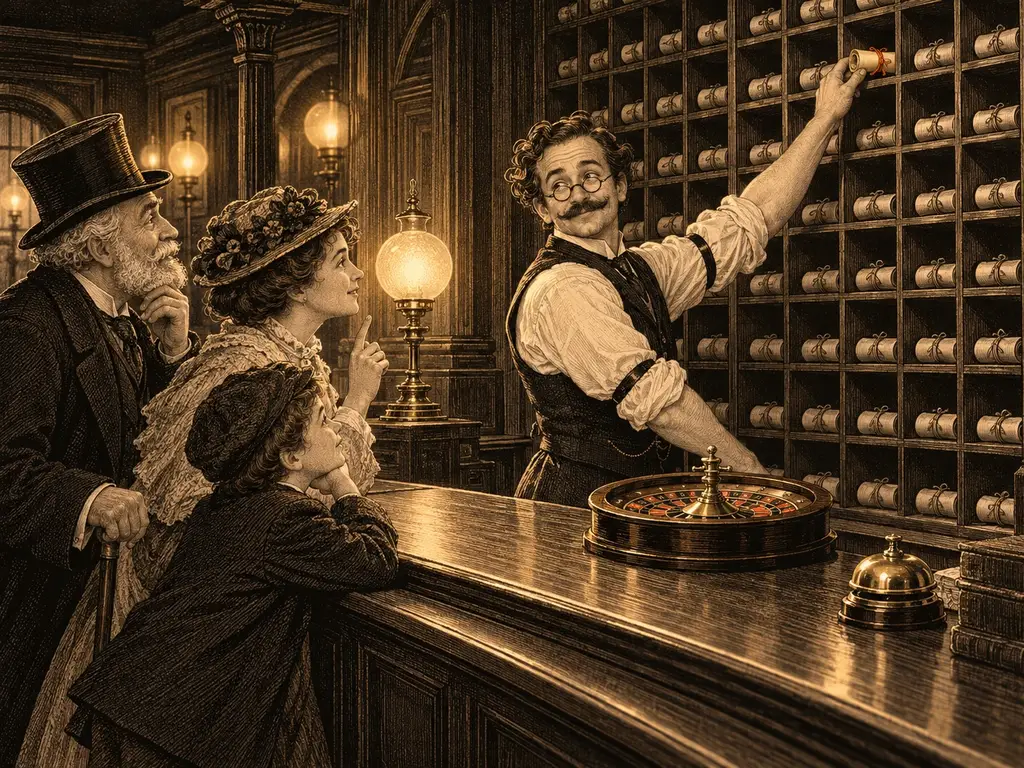
Short answer
Short answers to common questions about odds, bets, systems, wheels and online play. Every answer is a summary of a page on this site; follow the link for the arithmetic.
questions
30
house edge
2.70%
systems that work
0
best standard rules
French
Odds and payouts
What are the odds of hitting a single number?
1 in 37, 2.70%. It pays 35 to 1; fair would be 36 to 1. See Roulette ProbabilitymathProbabilityChance of an outcome, from 0 to 1 or 0% to 100%. One number: 1/37 = 2.70%.Read full →.
Why is every bet the same house edge?
Because every payoutmoneyPayoutWhat a winning bet returns, quoted as “X to 1” on top of the returned stake.Read full → is 36/n − 1 against 37 pocketsequipmentPocketOne of the 37 numbered compartments on the rotor. Also: slot, cup.Read full →. See House EdgemathHouse edgeThe share of each stake the casino keeps on average: 2.70% in European roulette.Read full →.
What does red pay?
1 to 1, and wins 48.65% of the time. ZerowheelZeroThe single green pocket that no even-money, dozen or column bet covers; the source of the house edge. Also: single zero, 0.Read full → is the difference from 50%. See RedbetRedEven-money bet on the 18 red numbers. French: rouge.Read full → / BlackbetBlackEven-money bet on the 18 black numbers. French: noir.Read full →.
Is a straight up a worse bet than red?
Same expected lossmathExpected lossExpected value times total amount wagered; the average amount lost over a session or a period.Read full →, far higher variancemathVarianceA measure of how widely results spread around the expected value. High for straight up, low for even-money bets.Read full →. See Inside vs Outside BetsbetOutside betA bet on the boxes surrounding the grid: dozens, columns and even-money bets.Read full →.
How much does green pay?
A chipmoneyChipA token representing a fixed amount, placed on the layout to make a bet. Also: check.Read full → on 0 is a straight upbetStraight upA single number, pays 35:1.Read full → and pays 35 to 1 like any number. On a double-zero wheel the splitbetSplitTwo adjacent numbers, pays 17:1.Read full → 0/00 pays 17 to 1. See Roulette Payouts.
Can I bet on red and black at the same time?
Yes. Every spin but zero is then a wash, and the zero takes both bets, or half of each with la partageruleLa partageFrench rule: when zero hits, half of an even-money stake is returned. Halves the house edge on those bets to 1.35%.Read full →. It costs 2.70% of both stakes (1.35% with la partage) and buys nothing. See Inside vs Outside Bets.
What is the best bet in roulette?
Even money on a la partage table, at 1.35%. See La Partage.
What is the worst?
The American five-number bet at 7.89%, and any bet on a triple-zero wheel. See American RoulettevariantAmerican rouletteWheel with 0 and 00, 38 pockets, house edge 5.26%. Not the default model on this site.Read full →.
Systems
Does Martingale work?
It wins most short sessions and loses more than it wins over time. Expected loss 2.70% of turnovermoneyTurnoverThe total amount wagered over a session or period, counting re-bet winnings. Also: handle, action.Read full →, like everything. See MartingalestrategyMartingaleProgression that doubles the bet after each loss. See the Strategy section for what it does and does not do.Read full →.
Is there any system that beats roulette?
No. Expected valuesmathExpected valueThe average result per bet over the long run. −1/37 of the stake for every standard European bet.Read full → add; every bet is negative. See Can You Beat Roulette.
What about quitting while ahead?
A stop rule reduces turnover and so reduces expected loss. It does not make it positive. See Stop-LossstrategyStop-lossA pre-set amount of loss at which you end the session.Read full → / Stop-WinstrategyStop-winA pre-set profit target at which you end the session.Read full →.
Which system is “safest”?
Flat bettingstrategyFlat bettingWagering the same amount every spin. The baseline every progression is compared against.Read full → at a small stake has the lowest expected loss for a given number of spins. See Flat Betting.
Why do systems seem to work?
Because most sessions win under a negative progressionstrategyProgressionAny rule that changes the stake based on previous results. Negative progressions raise it after losses, positive after wins.Read full →. The losing sessions are rarer and larger. See Myth: Systems Beat the Wheel.
Streaks and “due” numbers
After ten reds, is black due?
No. 18/37, as always. See Gambler’s Fallacy.
A number hasn’t hit in 150 spins. Should I bet it?
It is 1/37 next spin like every number. See Myth: Numbers Are Due.
How often do long streaks happen?
A run of six of one color appears in about 75% of 200-spin sessions. See Probability of Streaks.
Does the wheel remember anything?
No. See Independent SpinsmathIndependent spinsEach spin has the same probabilities regardless of history. The basis for every calculation on this site.Read full →.
Wheels and physics
Can a dealer aim the ball?
No. Scatter after the drop spans 10 to 15 pockets either side. See Myth: Dealers Can Aim the BallequipmentBallThe small ball launched along the track against the rotor. Modern balls are ivorine or Teflon, 18–21 mm.Read full →.
Are wheels biased?
Rarely, slightly, and detectably only over thousands of spins; modern maintenance removes it. See Wheel Bias.
Can you predict the ball with a device?
In principle, a few percent, with equipment that is illegal in most places and useless against studios that close bets early. See Advantage Play.
Why are there deflectors?
To scatter the ball and destroy predictability. See Roulette Wheel Physics.
Variants
European or American?
European: 2.70% against 5.26%. Same payouts, one fewer way to lose. See European RoulettevariantEuropean rouletteSingle-zero wheel, 37 pockets, house edge 2.70%. The canonical model on this site.Read full →.
What is French roulette?
European wheel plus la partage or en prisonruleEn prisonFrench rule: when zero hits, an even-money bet is held for the next spin instead of lost. Halves the house edge on those bets.Read full →: 1.35% on even money. See French RoulettevariantFrench rouletteSingle-zero wheel with la partage or en prison, lowering the even-money house edge to 1.35%.Read full →.
Is mini roulette easier?
It is 7.69%, nearly three times the European edge. See Mini Roulette.
Are game-show formats a good deal?
Outside bets usually standard; straight ups cut to 29:1 to fund multipliers. Read the RTPmoneyRTPReturn to player: the share of wagers paid back on average. European roulette: 97.30%, which is 100% minus the 2.70% house edge.Read full →. See Game-Show Roulette.
Online and live
Is online roulette rigged?
Licensed RNGs are certified and independent of bets; licensed live wheels are filmed and logged. Check the license. See Myth: Online Roulette Is Rigged.
Live or RNG?
Same odds. Live is slower and therefore cheaper per hour at the same stake. See Live vs RNG.
Why did bets close before the ball slowed?
Because the stream is delayed and the server closes early on purpose. See Live Roulette Technology.
How fast should I play?
As slowly as you can bear. Expected loss per hour is stake × spins / 37. See Roulette Speed.
Money
How much will I lose?
On average 2.70% of everything you wager; 1.35% on la partage even-money betsbetEven-money betRed/black, odd/even, high/low. 18 numbers, pays 1:1.Read full →. See Expected Loss.
How big should my stake be?
Budget ÷ 100 for even money gives a session that rarely busts in 100 spins. See BankrollmoneyBankrollThe total amount set aside for play. Bankroll management is deciding how much of it to risk per bet and per session.Read full → Management.
What is risk of ruin?
The chance of losing the whole bankroll before a target; bold play minimizes it. See Risk of RuinmathRisk of ruinProbability of losing the whole bankroll before reaching a target or spin count.Read full →.
Where can I get help?
Help lines by country are on the Responsible Gambling page and in the footer.
Questions
Why are there no questions about winning strategies?
Because there are none to answer. The strategy pages explain what systems do, and it is not that.
Can I suggest a question?
The Beginner Questions page covers the most basic ones; the glossary covers terms.
Comic relief
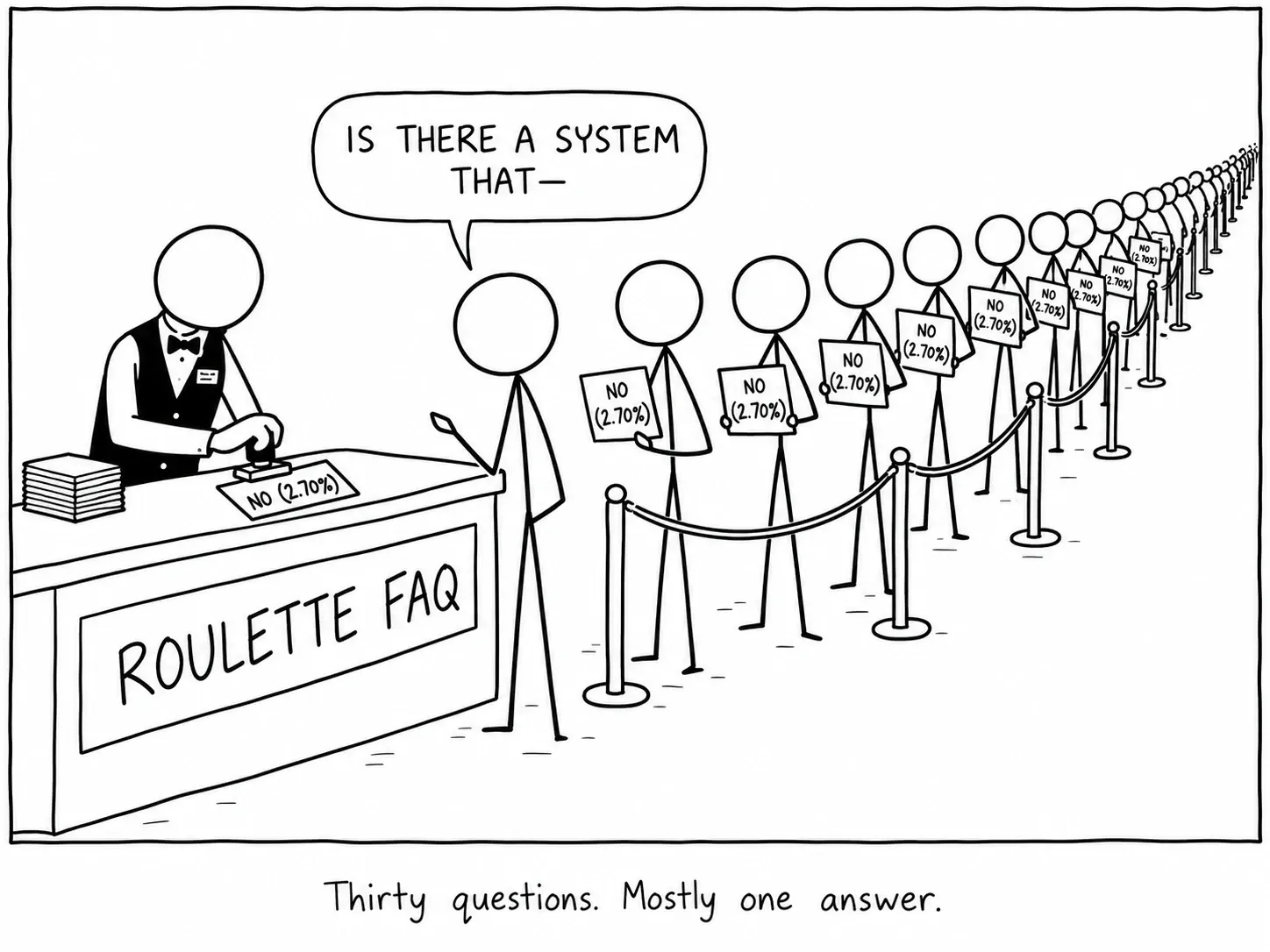
Thirty questions. Mostly one answer.
Sources
- Ethier, S. N. The Doctrine of Chances: Probabilistic Aspects of Gambling.
- Epstein, R. A. The Theory of Gambling and Statistical Logic, 2nd ed.
reviewed 2026-09-28model: European, single zeromethodology ↗sources ↗