Stop Loss / Stop Win
A stop rule is the one part of a “system” that has a real effect, because it changes how much you wager.

Stopping early reduces the total amount wagered and therefore the expected loss. It does not create an edge; a stop-win is not “locking in” anything the next spin could not have given or taken.
Stop-loss
Fix the amount you are willing to lose and leave when it is gone. It caps the worst case, ends the session before chasing starts, and makes the expected cost of the evening calculable: never more than the stop-lossstrategyStop-lossA pre-set amount of loss at which you end the session.Read full →, usually less. Of all the rules on this site it is the one that most reliably changes what happens to a player, because it is the only one that reliably ends a session.
Stop-win
Fix a target and leave when you reach it. It makes winning sessions more common and smaller. Over many sessions the average is still −2.70% of turnovermoneyTurnoverThe total amount wagered over a session or period, counting re-bet winnings. Also: handle, action.Read full →; you have redistributed when the losses arrive, not removed them. The phrase “locking in profit” describes a feeling. The next spin was always going to be 18/37 whether you played it tonight or next week.
An old argument
Whether quitting while ahead helps has been argued over for a long time. The logician John Venn held that a player who alone may choose when to stop has the advantage, provided credit is unlimited. Lord Rayleigh answered that with finite fortunes on both sides the advantage disappears, and the modern theorems agree: no rule for when to stop changes the average result per unitmoneyUnitThe base stake a system or a player works in. Progressions are described in units so they apply at any table.Read full → staked (Epstein, 2013). French has a phrase for leaving the table while ahead, faire Charlemagne. It names a habit, not an edge.
Why the mean improves
Not because the stop finds a good moment to leave. Because a session that ends after 60 spins has wagered 60 stakes instead of 100 and has paid 2.70% on fewer dollars. Any rule that reduces turnover reduces expected lossmathExpected lossExpected value times total amount wagered; the average amount lost over a session or a period.Read full → in exact proportion: a stop-loss, a stop-winstrategyStop-winA pre-set profit target at which you end the session.Read full →, a time limit, a spin count or simply a smaller stake.
Choosing the numbers
A stop-loss of 20–40% of the session budget keeps a bad night survivable without being so tight that normal variancemathVarianceA measure of how widely results spread around the expected value. High for straight up, low for even-money bets.Read full → triggers it on most nights. A stop-win of 20–50% of the budget is reachable in a typical session (even money hits +$100 from $500 at some point in about half of 100-spin sessions) without being trivial. The numbers are personal; the discipline of writing them down is not.
- p10 −$460
- p25 −$300
- median −$140
- p75 +$0
- p90 +$140
The rule about the rules
A stop rule only works if it is decided before the session and not revised during it. “Just one more spin to get back to even” is the stop-loss being renegotiated by the person it was designed to protect. If you find that happening, lower the stake rather than raise the limit.
Questions
No. It makes small wins more frequent and leaves the long-run average at −2.70% of what you wagered.
It reduces turnover the same way and is easier to keep. Use both.
Leave. That is the rule. The spins you did not play cost nothing.
Comic relief
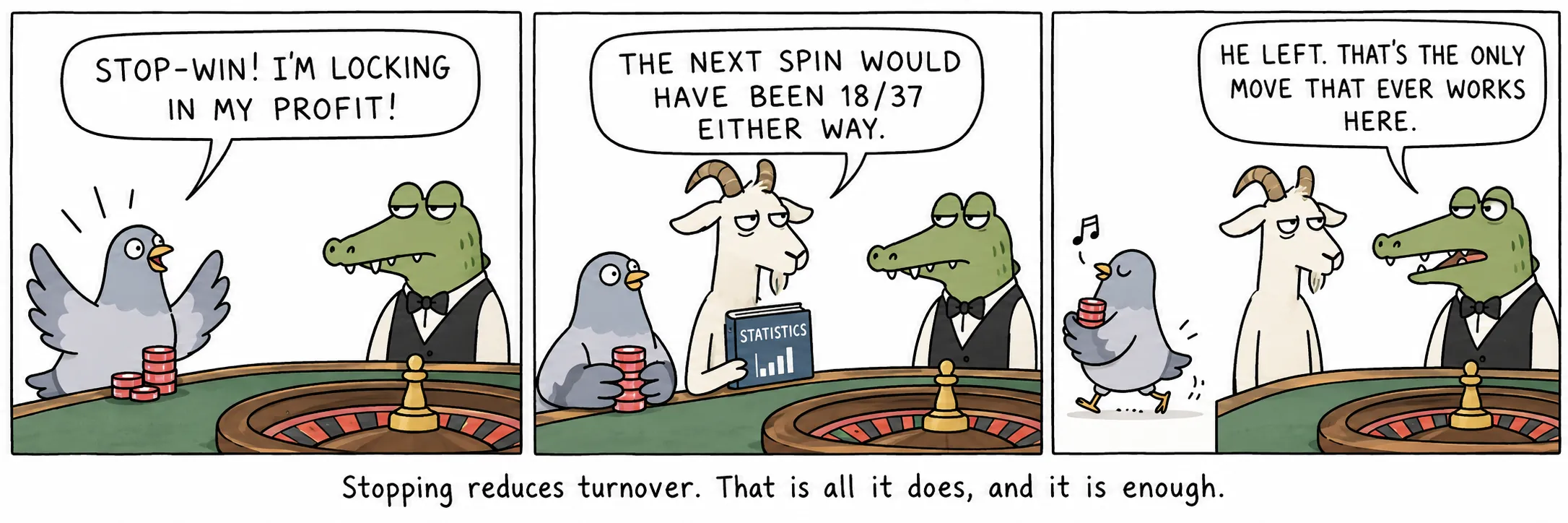
Stopping reduces turnover. That is all it does, and it is enough.
Sources
- Ethier, S. N. The Doctrine of Chances: Probabilistic Aspects of Gambling.
- Epstein, R. A. The Theory of Gambling and Statistical Logic, 2nd ed.