Walkthrough: A D’Alembert Afternoon
One unit up after a loss, one unit down after a win, red every spin for a hundred spins. The gentlest system, and what gentle costs.

A simulated 100-spin D’Alembert session at $5 a unit. The stake fell back to $5 five times, drifted up to $80 during a bad patch, and finished at $55 with the session down $40. The system that feels like balance and is not.
Walk the system
A loss moves one step up. A win moves one step back.
Stakes and results are in units of the base bet.
The plan
Start at one unitmoneyUnitThe base stake a system or a player works in. Progressions are described in units so they apply at any table.Read full →, $5, on redbetRedEven-money bet on the 18 red numbers. French: rouge.Read full →. After a loss add a unit; after a win remove one, never below one. The theory, which d’Alembert did not propose but gets blamed for, is that wins and losses balance, so for every pair of one loss and one win we are up a unit. The arithmetic says red wins 48.65% of spins, so losses outnumber wins by about one in forty, and the stake drifts up over time.
Spins 1–30
Fourteen reds, fifteen blacksbetBlackEven-money bet on the 18 black numbers. French: noir.Read full →, one zerowheelZeroThe single green pocket that no even-money, dozen or column bet covers; the source of the house edge. Also: single zero, 0.Read full →. The stake rose to $20 during a run of three losses, came back to $5 by spin 18, and rose to $25 by the end of the stretch. Net +$20. Each loss-win pair netted a unit as advertised; the extra losses ate them. It feels like a slow pump that mostly works.
Spins 31–65
The bad patch. Thirteen reds against twenty-two non-reds, including a run of seven losses. From $5 at spin 41 the stake climbed one unit at a time to $75, and each $75 loss undid fifteen of the earlier $5 wins. Net −$485 for the stretch; running −$465. Nothing dramatic happened on any single spin; the drift did it.
- p10 −$500
- p25 −$500
- median −$500
- p75 −$500
- p90 +$885
Spins 66–100
Twenty reds to fifteen non-reds, the stake unwinding from $80 toward $55 in $5 steps. Each win at a high stake recovered real money: a $75 win after a $70 loss is the pair netting +$5, but the pair is large. Net +$425 for the stretch; final −$40.
The accounts
Average stake about $37, so total wagered about $3,670 against $500 for a flat $5 bettor. Expected lossmathExpected lossExpected value times total amount wagered; the average amount lost over a session or a period.Read full → on $3,670 is $99; actual −$40, under one standard deviationmathStandard deviationSquare root of variance; the typical distance of a result from the expected value.Read full →. The drift in stake size is the system’s whole effect: more money across the table, same 2.70% off each dollar, a wider distribution of outcomes.
What the session shows
D’Alembert is the gambler’s fallacy written as a staking rule: it assumes wins and losses will even out soon enough for the stake to come back down. They even out in the long run by dilution, not correction, and the stake has no reason to return to one unit. It is a slow system with no cliff, and the slowness is why players believe in it.
Questions
Rarely. The stake grows by one unit per loss, not doubling, so it takes a very long bad run to reach the limit.
Yes, and the cap turns it into flat bettingstrategyFlat bettingWagering the same amount every spin. The baseline every progression is compared against.Read full → at the cap after a bad run. Any cap is fine; none changes the edge.
He argued in 1754 that tails becomes more likely after a run of heads. Gamblers who agreed named the system after him. He would have been embarrassed.
Comic relief
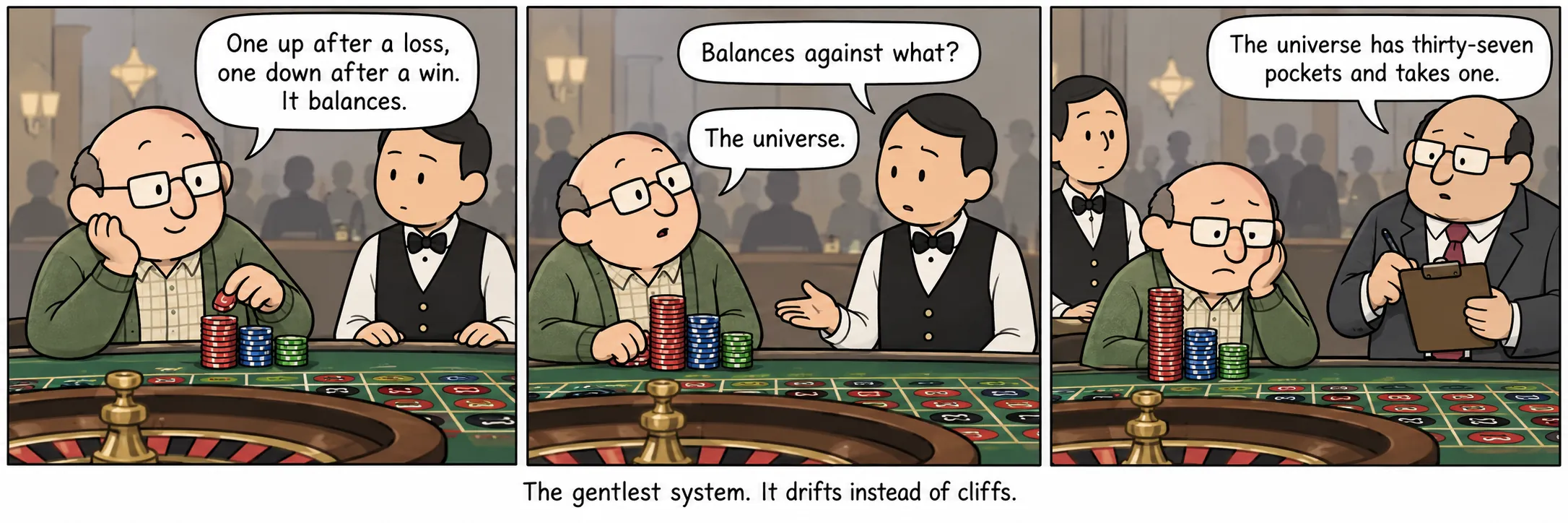
The gentlest system. It drifts instead of cliffs.
Sources
- d’Alembert, J. “Croix ou pile.”
- Ethier, S. N. The Doctrine of Chances: Probabilistic Aspects of Gambling.