Roulette Table Limits
Minimum, maximum, inside totals and why the sign on the table is really about the casino’s variance.
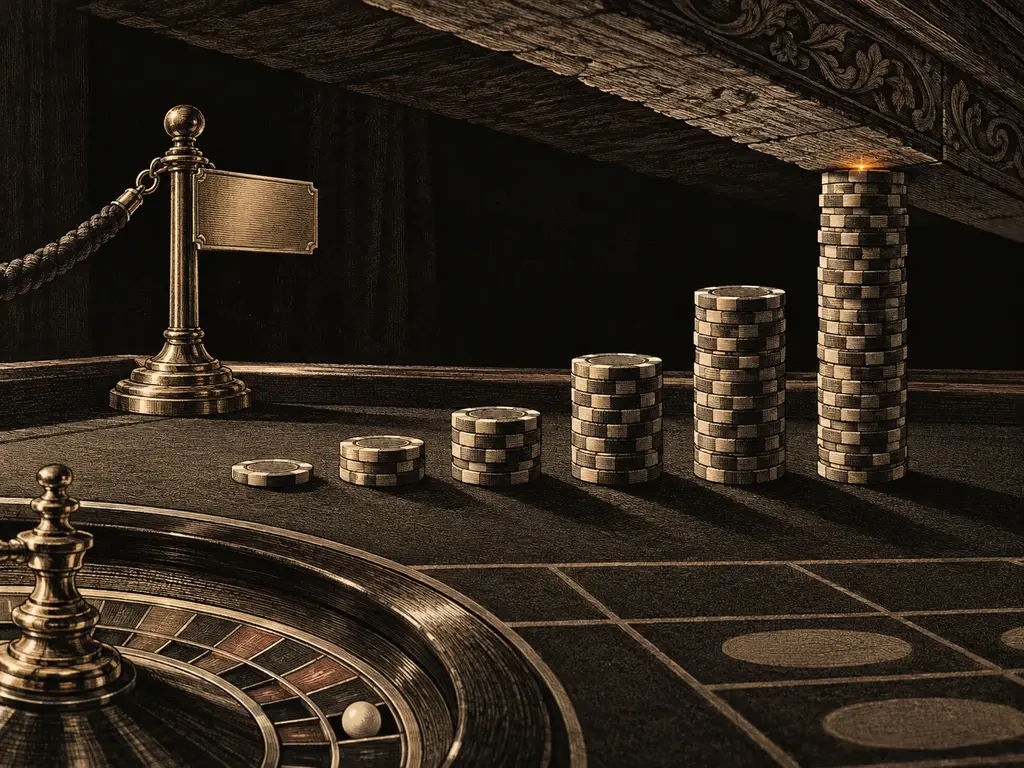
Every table posts a minimum and a maximum. The minimum applies per outside bet and to the total of inside chips; the maximum often differs by bet type. Limits cap the casino’s exposure per spin; defeating doubling systems is a side effect.
Reading the sign
A sign reads, for example: “Minimum $5. Inside $5 total. Maximum $500 outside, $100 straight upbetStraight upA single number, pays 35:1.Read full →.” The minimum must be met by each outside betbetOutside betA bet on the boxes surrounding the grid: dozens, columns and even-money bets.Read full → on its own and by the sum of your inside chipsmoneyChipA token representing a fixed amount, placed on the layout to make a bet. Also: check.Read full →. Maximums are often lower for inside betsbetInside betAny bet placed on or between the numbers of the grid: straight up, split, street, corner, six line.Read full →, because a $500 straight up would pay $17,500 and the casino caps the payoutmoneyPayoutWhat a winning bet returns, quoted as “X to 1” on top of the returned stake.Read full → per spin, not just the stake.
Why limits exist
A casino makes 2.70% of turnovermoneyTurnoverThe total amount wagered over a session or period, counting re-bet winnings. Also: handle, action.Read full → with certainty only in the long run; in any one spin it can lose a large multiple of a big stake. Limits keep each spin’s worst case within the casino’s comfort and keep one high-roller from making the day’s result a coin flip. The ratio of maximum to minimum at a table, typically 100 to 500, is set by how much variancemathVarianceA measure of how widely results spread around the expected value. High for straight up, low for even-money bets.Read full → the house wants on that table. High-limit rooms raise both.
Limits and systems
A doubling progressionstrategyProgressionAny rule that changes the stake based on previous results. Negative progressions raise it after losses, positive after wins.Read full → meets the maximum after a handful of losses: six from $10 at $500, nine at $5,000. Players often conclude that the limit is what stops MartingalestrategyMartingaleProgression that doubles the bet after each loss. See the Strategy section for what it does and does not do.Read full → working. It is not; the arithmetic is. The limit decides where the cliff is, and the math-problem page on the table limittableTable limitMinimum and maximum bet allowed. The maximum is what stops doubling progressions.Read full → shows that moving the cliff does not change the slope.
Inside totals
The inside minimum applies to the sum of your inside chips, so at a $5 table five $1 chips on five numbers is legal and one $1 chip on redbetRedEven-money bet on the 18 red numbers. French: rouge.Read full → is not. Dealers check it when the ballequipmentBallThe small ball launched along the track against the rotor. Modern balls are ivorine or Teflon, 18–21 mm.Read full → is launched; a short inside total is pointed out and the player adds a chip or removes the bet. Online interfaces refuse to confirm a round until minimums are met.
Choosing a table by its limits
The minimum sets your pace: a table where the minimum is 1–2% of your session budget gives a long evening. The maximum matters only to progression players and high rollers. If a $25 minimum forces you to bet more than you planned, a $5 table with worse odds (double zerovariantDouble zeroThe 00 pocket of the American wheel. Its presence raises the house edge from 2.70% to 5.26%.Read full →) can still be cheaper per spin: $5 × 5.26% = $0.26 against $25 × 2.70% = $0.68. Compare stake × edge, not the sign.
Questions
High-limit rooms exist for that. At a standard table, no.
Because it pays 35:1. The casino caps payout per spin.
Yes, often $0.10 to $1 per bet on RNG tables, higher on live.
Comic relief
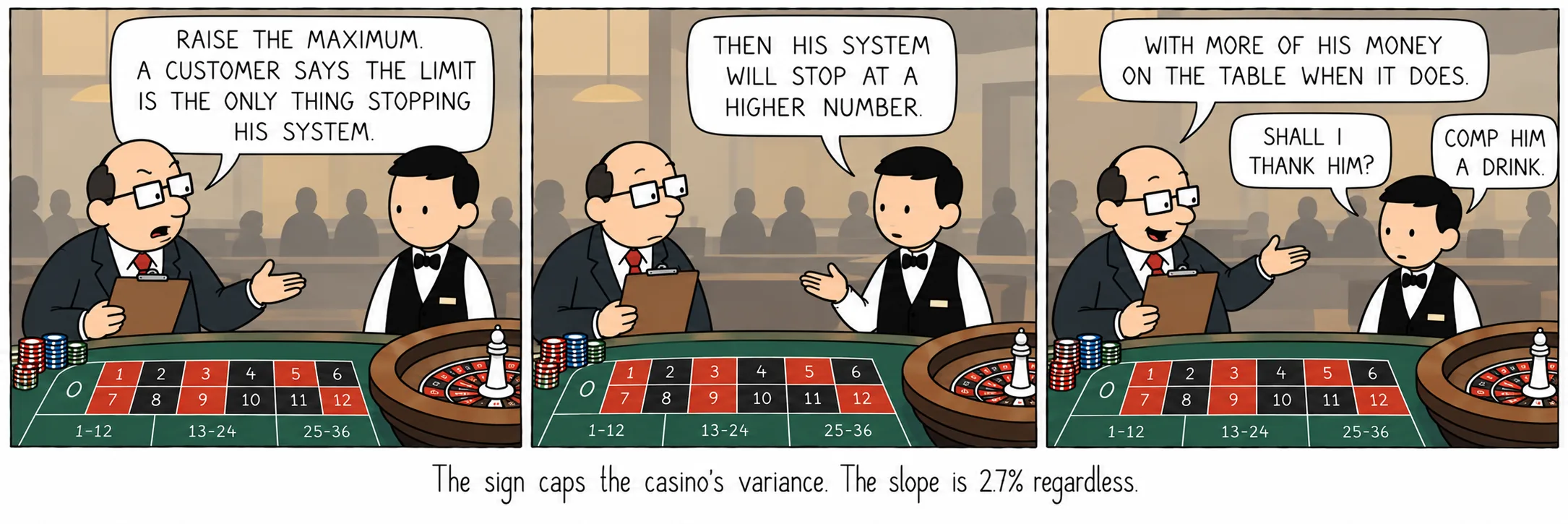
The sign caps the casino’s variance. The slope is 2.7% regardless.
Sources
- Ethier, S. N. The Doctrine of Chances: Probabilistic Aspects of Gambling.