Streak Side Bets
Side bets settled over two or more spins: a run of primes, of one color, of new colors or of greens, the same number twice, a football game. Each is priced from its own pay table.
A streak bet wins only when several spins in a row go its way, so it loses at once most of the time and needs large prizes to make up for it. Prime Time costs 7.22%, and Roulette Rage 17.00% on its minimum pay table. Touchdown Roulette costs 9.00%, Rainbow 11.37%, Back2Back 16.83%, Straights and 8’s 5.47% to 8.61%, and Caesars’ 2G’$ 22.16%, eight times what it cost when it first paid 350 to 1.
Streak bets: Prime Time and Roulette Rage
Prime Time pays by the number of prime numbersmathPrime numberA whole number above 1 that only 1 and itself divide exactly: 2, 3, 5, 7, 11, 13 and so on.Read full → spun in a row (eleven of the 36 numbers are prime): 1 to 1 for one, rising to 299 to 1 for seven. Its edge is 7.22%. Roulette Rage, approved in UK casinos and in Mississippi, pays on a run of one color, counted from the spin after the color changes. Its minimum approved pay tablemoneyPay tableThe list of what each bet or result pays. On machines and side bets, it is where the house edge is set.Read full → runs from 5 to 1 for four in a row to 2,000 to 1 for fourteen, and costs 17.00%. An approved alternative pays 6, 10, 20 and 30 to 1 for runs of four to seven and brings the edge down to 4.61%. Short runs are where the probabilitymathProbabilityChance of an outcome, from 0 to 1 or 0% to 100%. One number: 1/37 = 2.70%.Read full → is: a table that is generous on long runs and mean on short ones is a 17% bet with a 2,000-to-1 headline.
Rainbow: a run of new colors
INAG’s Rainbow bet replaced its Riverboat Roulette in 2015. Each row of three on the layoutequipmentLayoutThe printed betting grid on the table. Also: table, felt, cloth.Read full → gets a second color, shown as a ring round the number: blue 1–3, pink 4–6, purple 10–12, teal 13–15, lime 19–21, orange 22–24, yellow 28–30 and brown 31–33, with the other four rows white. The bet is that three or more different colors come up in a row before a white number, a zerowheelZeroThe single green pocket that no even-money, dozen or column bet covers; the source of the house edge. Also: single zero, 0.Read full → or a repeated color. Fourteen pocketsequipmentPocketOne of the 37 numbered compartments on the rotor. Also: slot, cup.Read full → end a run at once, and every new color leaves fewer ways to go on: by the eighth color, only 3 pockets in 38 would. Stakes are collected up front and the pay table is “for 1”.
Touchdown Roulette: a football game in four spins
Interblock installed the first Touchdown Roulette at the Borgata in Atlantic City in June 2013, as a side betbetSide betAn optional extra wager attached to the main game, usually on a streak, a bonus event or a jackpot. Almost always dearer than the standard bets.Read full → on an electronic double-zero game. The bet loses at once unless the next spin is 0 or 00, which happens 2 spins in 38. Then a football game starts. You take the redbetRedEven-money bet on the 18 red numbers. French: rouge.Read full → team or the blackbetBlackEven-money bet on the 18 black numbers. French: noir.Read full → one, and each of the next four spins moves the football from midfield toward the end of the color spun. Ordinary roulette carries on meanwhile, and no new Touchdown bets are taken until the game is over.
Where the ball stops
After four plays the payoutmoneyPayoutWhat a winning bet returns, quoted as “X to 1” on top of the returned stake.Read full → depends on where the football is. A touchdown needs 50 net yards in your color: four 15-yard plays, three 15s and a 5 or a 10, or two 15s and two 10s. That is 2,511 chances in 2,085,136, about 1 game in 830. Some spots cannot be reached at all: no four plays leave the football on a 6-yard line. A game that ends at midfield pays both teams 5 to 1, and the team that finishes behind is paid even money, so every bet that reaches the game wins something, 16.29 unitsmoneyUnitThe base stake a system or a player works in. Progressions are described in units so they apply at any table.Read full → per unit on average. It is not enough. With 36 instant losses in 38, the bet costs 9.00%. A European version starts the game on 0 or on a number that repeats the spin before, so it too loses at once about 35 spins in 37. By our count of every game on a single-zero wheel, it costs about 4.8%, half the double-zero price.
2G’$: from 2.77% to 22.16%
Caesars Entertainment sells 2G’$ as “Roulette’s Best Bet”: green on two spins in a row. It first appeared in 2020 at the Gold Coast, off the Strip, paying 350 to 1 on double-zero tables. Two greens in a row on 38 pockets is a chance of 1 in 361, so at 350 to 1 it cost 2.77%, less than any other bet on the table. In 2025, at Caesars’ Las Vegas casinos, it paid 280 to 1, which costs 22.16%, and 130 to 1 on triple-zero tables, 22.49%. The name stayed the same; the price went up eightfold.
2G’$: one bet, many prices
Nevada’s rules for 2G’$ show how a casino picks its price. The bet is settled over one or two spins: if the first is not green it loses at once, and if it is, the next spin decides. The rules approve nine pay tables for double-zero wheels, from 270 to 1 up to 350 to 1 in steps of 10, and thirteen for single-zero wheels, from 1,050 to 1 up to 1,350 to 1 in steps of 25. On a single-zero wheel two greens in a row come once in 1,369 bets, so even the best table, 1,350 to 1, keeps 1.31%, half the 2.70% of the main bets, while the worst keeps 23.23%. Each step of 25 moves the edge by 1.83 points, and each step of 10 on a double-zero wheel by 2.77. The bet looks the same on the layout at every price; only the sign at the table says which one you are playing.
Back2Back: the same number twice
Back2Back, seen at the Atlantis in Reno in 2019, is a bet that the next two spins both land on your number. It pays 1,200 to 1. On a double-zero wheel the chance is 1 in 38 × 38 = 1,444, so the bet costs 16.83%. The Wizard of Odds points out that the plain layout does better. Put $1 on the number, and if it wins let the $36 ride on the next spin. Two hits in a row then bring back $1,296, a payout of 1,295 to 1, and the whole run costs 10.25%, the price of two ordinary spins. The side bet sells the same thing for less. 2G’$, which bets on two greens in a row, works the same way.
Straights and 8’s: three spins
Straights and 8’s, from Aces Up Gaming, was dealt in Colorado casinos from 2017. It is settled over the next three spins and pays only the best result: 8, 18 and 28 in any order; three numbers in a row in any order; three numbers ending in 8 with a repeat; or, from the first two spins alone, two numbers in a row, two ending in 8, or two that are two apart. A 0 or 00 on either of the first two spins loses. There were four pay tables, for single- and double-zero wheels.
What the working shows
Each bet on this page was priced the same way: list the results, multiply each by its chance, add.
- A bet that loses at once most of the time needs very large prizes to break even. Touchdown pays something on every game it reaches and still costs 9%.
- When the top prize is the only prize, as in 2G’$, a cut to it moves the price a long way: from 350 to 280 to 1 multiplied the cost by eight.
- Before buying a run of wins as a side bet, price the one you can make yourself: letting a straight upbetStraight upA single number, pays 35:1.Read full → ride beats Back2Back.
- Check whether a pay table says “to 1” or “for 1” before you compare it with another.
Questions
Roulette Rage on its alternative pay table, at 4.61%, then Straights and 8’s on its best pay table, at 5.47%. Both still cost more than a plain bet on the same wheel.
2G’$ was offered at Caesars’ Las Vegas casinos in 2025. Touchdown and Rainbow date from the 2010s and are harder to find now. Back2Back and Straights and 8’s were seen between 2017 and 2019 at one or two casinos each.
The pay tables are from Bollman (2021), the Wizard of Odds and, for 2G’$, VitalVegas reporting in 2025. Every edge on this page is our own calculation from those tables.
Fun with Math
Try these yourself first. Each solution is folded; open it when you are ready.
Prime Time pays by how many prime numbersmathPrime numberA whole number above 1 that only 1 and itself divide exactly: 2, 3, 5, 7, 11, 13 and so on.Read full → come up in a row on a double-zerowheelZeroThe single green pocket that no even-money, dozen or column bet covers; the source of the house edge. Also: single zero, 0.Read full → wheel: 1 to 1 for one, then 3, 6, 10, 20 and 50 to 1, and 299 to 1 for seven. Its edge is 7.22%. What should the top prize be for the bet to cost 5.26%, like the rest of the layoutequipmentLayoutThe printed betting grid on the table. Also: table, felt, cloth.Read full →?
Show the solution
Answer About 414 to 1. A fair bet would need about 723 to 1.
Eleven of the 38 pocketsequipmentPocketOne of the 37 numbered compartments on the rotor. Also: slot, cup.Read full → are prime, so seven in a row has a chance of (11/38)⁷, about 1 in 5,871. Every extra unitmoneyUnitThe base stake a system or a player works in. Progressions are described in units so they apply at any table.Read full → on the top prize adds 1/5,871 of a unit to the bet’s expected valuemathExpected valueThe average result per bet over the long run. −1/37 of the stake for every standard European bet.Read full →.
To go from 7.22% to 5.26% the bet needs about 1.96 cents more per dollar: 0.0196 × 5,871 ≈ 115 units, so 299 + 115 = 414 to 1. To reach a fair gamemathFair gameA game in which neither side has an edge: every bet has an expected value of zero.Read full → it needs 7.22 cents: about 424 more, 723 to 1.
A prize this rare carries little weight. The edge of a long-shot bet sits in its frequent small prizes.
An alternative Prime Time table pays 1, 3, 6 and 10 to 1 for one to four primes, then stops at five primes with 50 to 1. Is it cheaper or dearer than the table above?
Show the solution
Answer Almost the same: 7.13% against 7.22%.
The first four prizes are unchanged, so only the top of the table matters. The usual table pays 20 to 1 for exactly five primes, 50 for exactly six and 299 for seven. Weighted by their chances, those three prizes are worth about 0.1007 units per bet.
The alternative pays 50 to 1 as soon as five primes come up, chance (11/38)⁵, about 0.20%. That is worth about 0.1016 units. The difference is under a tenth of a cent per dollar: the big prizes were never where the bet’s cost was decided.
In Touchdown Roulette each of four spins moves the football 0, 3, 5, 10 or 15 yards, toward one end or the other, starting from midfield. Why can the game never end on either 6-yard line?
Show the solution
Answer It would take a net move of 44 yards, and no four moves add up to 44.
To finish 6 yards from a goal line, the football must end 44 yards from where it started.
Three 15-yard moves make 45, one too many, and no move is worth 1 yard back. Two 15s leave 14 yards for the other two moves, and no two of 0, 3, 5 and 10 make 14. One 15 leaves 29 for three moves of at most 10, which needs 10 + 10 + 9. With no 15 the most four moves can make is 40. Moves backward only make the sums smaller.
The same reasoning rules out finishing on the 1, 3, 4, 9, 11, 16 and 21-yard lines.
Caesars’ 2G’$ bet pays 280 to 1 if green comes up on two spins in a row on a double-zero wheel. What would a fair payoutmoneyPayoutWhat a winning bet returns, quoted as “X to 1” on top of the returned stake.Read full → be, and what does 280 to 1 cost?
Show the solution
Answer Fair would be 360 to 1. At 280 to 1 the bet costs 22.16%.
Green is 2 pockets in 38, so two greens in a row has a chance of 2/38 × 2/38 = 1/361. The true oddsmathTrue oddsThe payout that would make a bet fair: losing outcomes divided by winning ones. A straight up on 37 pockets has true odds of 36 to 1.Read full → are 360 to 1.
At 280 to 1 the bet returns 281 units, stake included, once in 361 tries: 281/361 = 0.778 of what was staked, a loss of 22.16%.
On a triple-zero wheel green is 3 pockets in 39, so the chance is 1/169 and the true odds are 168 to 1. The bet pays 130 to 1 there: 131/169, a loss of 22.49%.
A Touchdown Roulette game is under way. The four spins are 36 redbetRedEven-money bet on the 18 red numbers. French: rouge.Read full →, 4 blackbetBlackEven-money bet on the 18 black numbers. French: noir.Read full →, 26 black and 23 red. Where does the football finish, and what is paid?
Show the solution
Answer Twelve yards into Black’s half, 38 yards from the goal Red attacks. Red is paid 25 to 1, and Black, finishing behind, even money.
Red 36 is in 31–36: 15 yards toward the red end. Black 4 is in 1–10: 3 yards back toward black. Black 26 is in 21–30: 10 more toward black. Red 23 is also in 21–30: 10 toward red.
Net for Red: 15 − 3 − 10 + 10 = 12 yards from midfield. The football is 50 − 12 = 38 yards from the goal Red attacks, in the 31-to-40 band, which pays 25 to 1. Black finishes behind and is paid even money, so both bets that reached the game win something.
Red would have needed 38 more yards for a touchdown, and four plays rarely make 50: about one game in 830 for each team.
Back2Back pays 1,200 to 1 if your number comes up on both of the next two spins. On a single-zero wheel, what would it cost? What does letting a straight-up win ride pay for the same two hits?
Show the solution
Answer The side betbetSide betAn optional extra wager attached to the main game, usually on a streak, a bonus event or a jackpot. Almost always dearer than the standard bets.Read full → would cost 12.27%. Letting it ride pays 1,295 to 1 and costs 5.33%.
Two spins on 37 pockets give 37 × 37 = 1,369 equally likely pairs, and one of them is your number twice. At 1,200 to 1 a winning $1 brings back $1,201, so the bet returns 1,201/1,369 = 87.73% of the stake: an edge of 12.27%.
Letting it ride: $1 on the number brings back $36 if it wins, and the $36 on the next spin brings back $1,296 if it wins again. That is 1,295 to 1 for the same two hits, and it returns 1,296/1,369 = 94.67%: an edge of 5.33%, the price of two ordinary spins.
In both cases you lose $1 unless both spins hit. The side bet simply pays less when they do.
Comic relief
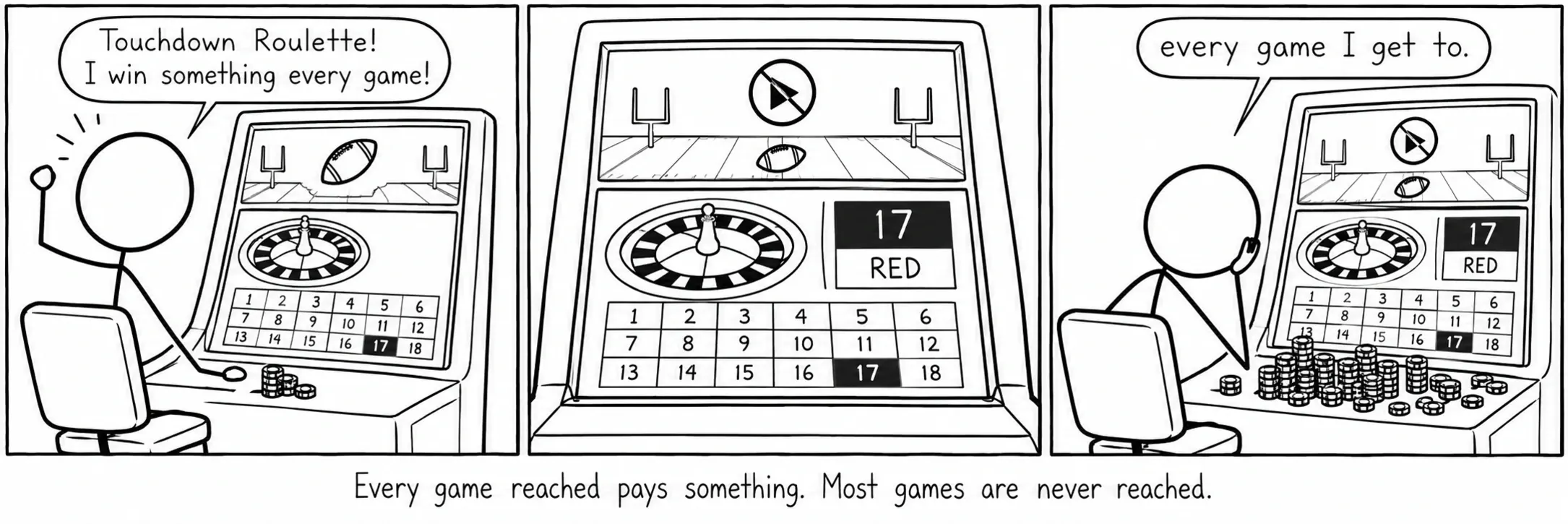
Every game reached pays something. Most games are never reached.
Sources
- Bollman, M. Mathematics of the Big Four Casino Table Games: Blackjack, Baccarat, Craps, & Roulette.
- Nevada Gaming Control Board. “2G’$ Rules and Paytable.”
- Interblock USA. “Interblock Installs First Touchdown Roulette Product at Borgata.”
- VitalVegas. “Caesars Entertainment Rolls Out ‘Roulette’s Best Bet’.” Report on the 2G’$ side bet.
- Wizard of Odds. “Touchdown Roulette.”
- Wizard of Odds. “Neighborhoods”, “Richer Spin”, “Back2Back”, “Blazing 7s”, “Straights and 8’s” and “Lucky Colour Chips”.