Unusual Roulette Wheels
Wheels with 18, 25, 26, 31, 40, 49, 50, 62, 73 or 105 pockets. One rule prices nearly all of them: the share of pockets the payouts ignore.
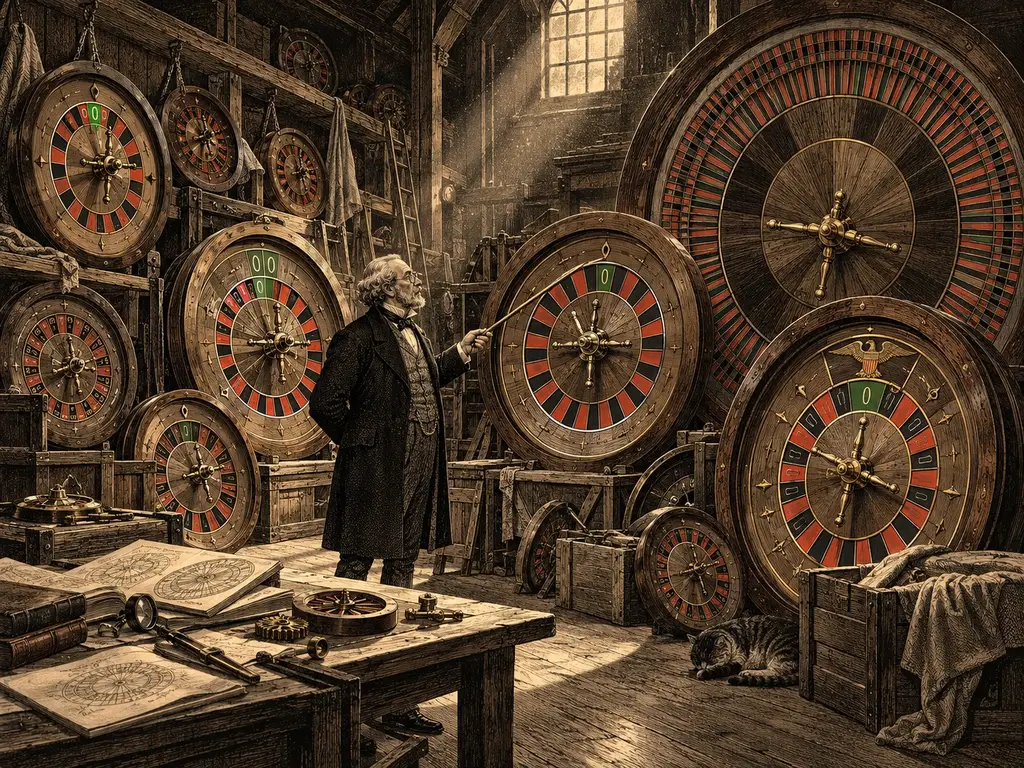
When payouts are set as if the house pockets were not there, the house edgemathHouse edgeThe casino’s expected net gain expressed as a fraction of the stake, under specified probabilities and payouts.Read full definition → is house pockets divided by total pockets, whatever the size of the wheel. Most unusual wheels follow that rule. The interesting ones break it: a rounded payout, a bonus round, or a bet that stays up for several spins.
A rule for standard proportional payouts
European roulettevariantEuropean rouletteUsually single-zero roulette: 37 pockets. Ordinary standard-payout bets have a fair-wheel edge of 1/37, about 2.70%.Read full definition → pays 35 to 1 as if the wheel had 36 pocketsequipmentPocketA compartment on the rotor in which the ball can settle. The number of pockets depends on the wheel.Read full definition →. It has 37, and the missing pocket is the 2.70% edge. The same rule works on any wheel: with N numbers and Z house pockets, a bet on n numbers that pays (N − n)/n to 1 has an edge of Z/(N + Z). Wheels of every size have been built or proposed on this rule, and the table puts them in order of price. Its rows also give the basics of how to play Royal Roulette, the Australian game: its numbers are the cards 2 to king, its two house pockets are the ace and the joker, and a single card pays 47 to 1.
| wheel | pockets | house pockets | straight up pays | edge | where |
|---|---|---|---|---|---|
| Roulette 73 | 73 | 1 | 71 to 1 | 1.37% | a published design |
| Royal Roulette, no joker | 49 | 1 (ace) | 47 to 1 | 2.04% | a published variant |
| European | 37 | 1 | 35 to 1 | 2.70% | the standard |
| Super 62 | 62 | 2 (0, 00) | 59 to 1 | 3.23% | Empire Global Gaming |
| Royal Roulette | 50 | 2 (ace, joker) | 47 to 1 | 4.00% | Australia, cards 2 to K |
| Alphabetic | 25 | 1 (YZ) | 23 to 1 | 4.00% | Fitzgerald’s, Las Vegas |
| 100 To 1 | 105 | 5 symbols | 100 to 1 | 4.76% (3.81% straight up) | online |
| American | 38 | 2 | 35 to 1 | 5.26% | the US standard |
| Super 64 | 64 | 4 | 59 to 1 | 6.25% | a published design |
| Alphabetic, Y and Z apart | 26 | 2 (Y, Z) | 23 to 1 | 7.69% | a published variant |
| Triple zero | 39 | 3 | 35 to 1 | 7.69% | Las Vegas, 2016 |
| Four zeros, no bonus | 40 | 4 | 35 to 1 | 10.00% | basis of Fast Action |
| Antique 18-pocket | 18 | 2 (0, 00) | 15 to 1 | 11.11% | our pay table |
| Eagle wheel | 31 | 3 (0, 00, eagle) | 27 for 1 | 12.90% | 19th-century America |
Bigger can be cheaper
Players read a 62-pocket wheel as a longer shot and assume a worse game. With the proportional payoutsmoneyPayoutThe amount paid on a winning wager. Check whether the quoted figure is net profit or total return including the stake.Read full definition → described here, the edge is the share of house pockets. Super 62 has two zeroswheelZeroThe 0 outcome, conventionally shown in green. Ordinary color, parity, high/low, dozen and column bets do not include it.Read full definition →, like the American wheel, but they are 2 of 62 pockets rather than 2 of 38, so it costs 3.23% against 5.26%. Roulette 73, with 72 numbers and one zero, would cost 1.37%, about the same as French even money. The rule works the other way on a small wheel. Bollman pictures an antique wheel of 18 pockets, 1 to 16 plus 0 and 00. On the rule every bet would cost 2/18, 11.11%: two house pockets are a large share of a small wheel.
Where the rule breaks: rounding
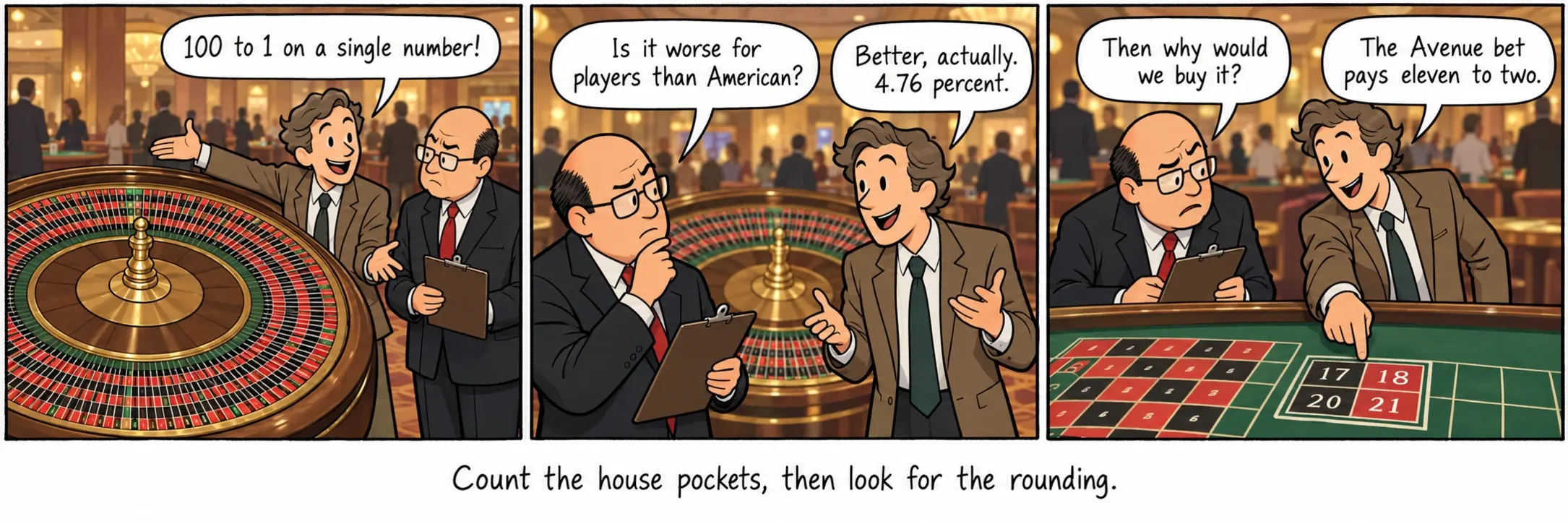
Some pay tablesmoneyPay tableThe list of payouts for specified bets or outcomes. Probabilities and charges are also needed to calculate the house edge.Read full definition → round a fractional payout down. That raises the edge; it is not a mathematical requirement. 100 To 1 Roulette’s Avenue bet covers 15 pockets and should pay 5⅔ to 1; it pays 11 to 2, which raises its edge from 4.76% to 7.14%. On Super 62, seven numbers contain the digit 6 (6, 16, 26, 36, 46, 56, 60) and the bet on that digit pays 7 to 1, which makes it 9.68%, three times the rest of the layoutequipmentLayoutThe marked betting surface, whether printed on a table or displayed on a screen.Read full definition →. Riverboat Roulette’s White bet covers 8 numbers at 7 to 2; if a table rounds a $5 winner down to $17 instead of $17.50, the edge rises from 5.26% to 7.37%. The American five-number bet, at 7.89%, is the familiar case of the same thing.
| bet | covers | rule says | pays | edge |
|---|---|---|---|---|
| 100 To 1 Avenue | 15 of 105 | 5⅔ to 1 | 11 to 2 | 7.14% (not 4.76%) |
| Super 62 digit 6 | 7 of 62 | 7⁴⁄₇ to 1 | 7 to 1 | 9.68% (not 3.23%) |
| Riverboat White, $5 | 8 of 38 | $17.50 | $17 | 7.37% (not 5.26%) |
| American five-number | 5 of 38 | 6.2 to 1 | 6 to 1 | 7.89% (not 5.26%) |
Where the rule breaks: bonuses
The historical Fast Action Roulette version described by Bollman (2021) uses a real wheel with four zeros, which on its own would cost 10%. Ten Bonus numbers light up at random on every spin. A straight upbetStraight upA wager on one number, ordinarily paying a profit of 35 to 1.Read full definition → pays 35 to 1, 40 to 1 if its number is a Bonus number, and 80 to 1 if its whole row of four is Bonus, which brings it to 6.65%. The three bonus bets in that version cost more. Later rules differ; our bonus-round page explains the distinction. IGT’s Double Bonus Spin adds a yellow Bonus pocket, one and a half pockets wide, to an American wheel; when the ballequipmentBallThe small ball that settles in a numbered pocket to determine a physical roulette result.Read full definition → lands there, every bet gets two free spins. Applying independent outcomes to Bollman’s stated bonus-payout model gives an edge between 1.94% (a straight up) and 2.73% (even money) for the usual non-basketbetBasketA name used for bets covering zero and nearby layout numbers. The covered numbers and payout depend on the game.Read full definition → bets. The five-number bet is an exception at 4.72%. Bollman (2021) prints 3% to 16% for this game; his simplified formula has an algebra slip, and for even-money betsbetEven-money betA bet paying a profit equal to the stake, such as red/black, odd/even or high/low.Read full definition → it implies that the free spins lose more than the stake, which they cannot.
| Fast Action bet | wins when | pays | edge |
|---|---|---|---|
| single number | the number hits | 35, 40 or 80 to 1 | 6.65% |
| Bonus Win | the winning number is a Bonus number (1 in 4) | 2 to 1 | 25.00% |
| Super Bonus Win | the winning number’s whole row is Bonus | 350 to 1 | 19.35% |
| Scattered Bonus | the ten Bonus numbers fall one per row | 700 to 1 | 13.28% |
Where the rule breaks: bets that stay up
Riverboat Roulette (2012) gave 32 numbers of an American wheel a second color. White marks the four pockets around each zero (1, 2, 9, 10, 13, 14, 27, 28). A bet on a color group wins if one of its numbers comes up before one of the eight White numbers. A White number is a “White Out” that clears every color bet. Every other number is a push: the bet stays up, and between spins it can be taken down or raised. Teal covers three numbers and pays 2 to 1. Per resolved bet it loses 2/11 of the stake, 18.18%. Per active spin its expected lossmathExpected lossThe probability-weighted average net loss under a stated model. With a constant edge, it equals edge times expected total stakes.Read full definition → is 2/38, or 5.26%. With independent uniform spins and the bet left up until it resolves, it stays active for an average of 38/11 spins, about 3.5.
| color group | numbers | pays | edge per resolved bet | edge per spin |
|---|---|---|---|---|
| Teal, Yellow | 3 | 2 to 1 | 18.18% | 5.26% |
| Pink, Purple | 4 | 8 to 5 | 13.33% | 4.21% |
| Orange, Blue | 5 | 7 to 5 | 7.69% | 2.63% |
A wheel Thorp could predict: Big Six
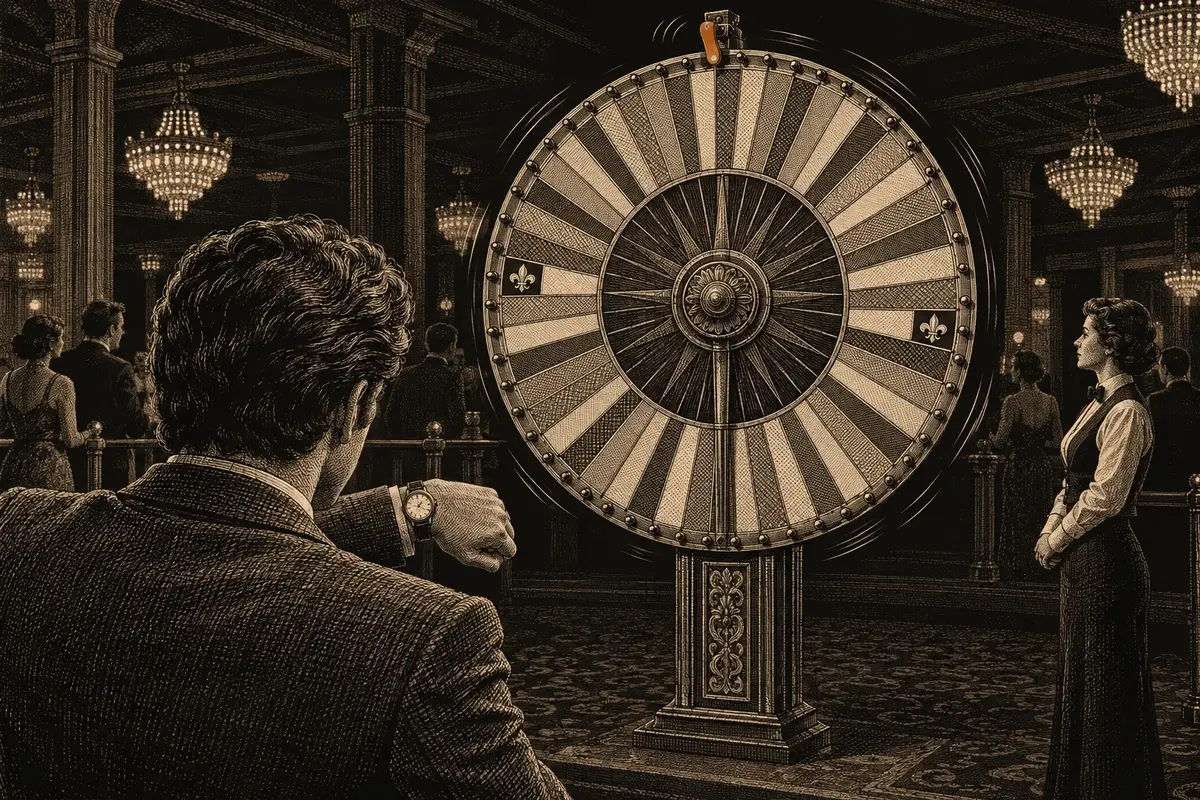
The Big Six, or wheel of fortune, is a large upright wheel with 54 slots: 24 pay 1 to 1, 15 pay 2 to 1, seven 5 to 1, four 10 to 1, two 20 to 1, and two logo slots pay 40 to 1. There is no zero; the house takes its share by paying short, and the edge runs from 11.1% on the slots that pay 1 to 1 to 24.1% on the logos. In 1961 Thorp built a matchbox-sized predictor for it, worked by a toe switch, and in October 1981 he timed a wheel at Caesars Tahoe with a wristwatch. He fitted a prediction curve to those observations, while warning that new spins would likely fit less closely. His worked example assumed errors stayed within five slots and estimated a net gain of 114 unitsmoneyUnitA base amount used to express stakes or results.Read full definition → per 54 units wagered, about +211%, if bets were accepted after the wheel started. This was a conditional estimate, not a measured casino return. In his 1998 account, Thorp said the game had too little action to conceal the late bets his method needed. That historical account does not establish today’s betting cutoff or a current advantage.
| slot | slots on the wheel | pays | house edge |
|---|---|---|---|
| 1 | 24 | 1 to 1 | 11.11% |
| 2 | 15 | 2 to 1 | 16.67% |
| 5 | 7 | 5 to 1 | 22.22% |
| 10 | 4 | 10 to 1 | 18.52% |
| 20 | 2 | 20 to 1 | 22.22% |
| each logo | 1 | 40 to 1 | 24.07% |
Why so few catch on
Changing the pocket count requires different equipment; adding a side betbetSide betAn additional wager tied to a game, such as a streak, card hand, bonus event or jackpot. It may be optional or required by the product.Read full definition → can keep an existing wheel. The examples here show both approaches. Their value depends on the probabilities and payouts, not on how unusual the equipment looks.
Questions
Not by itself. With proportional payouts and equally likely pockets, the house-pocket share gives the edge: 1 in 73 is lower than 1 in 37. Bonuses and other payout rules need separate calculations.
Among the proportional-payout models in this table, Roulette 73 has the lowest edge: 1/73, or 1.37%. This compares the stated rules, not games currently available to play. A different payout or bonus rule can change the ranking.
A bonus does not automatically increase the edge. Calculate the return from the whole rule set: base payouts, bonus probabilitymathProbabilityA measure of how likely an event is, from zero to one. Percentages express the same scale from 0% to 100%.Read full definition →, bonus prizes and any separate stake. A bonus added without another change improves the expected return.
Fun with Math
Try these yourself first. Each solution is folded; open it when you are ready.
Consider a hypothetical uniform 50-pocketequipmentPocketA compartment on the rotor in which the ball can settle. The number of pockets depends on the wheel.Read full definition → wheel with 48 ordinary card symbols, one ace and one joker. Bets covering 1, 2, 3, 4, 6, 8, 12, 16 or 24 ordinary symbols pay 47, 23, 15, 11, 7, 5, 3, 2 or 1 to 1 respectively. What payoutmoneyPayoutThe amount paid on a winning wager. Check whether the quoted figure is net profit or total return including the stake.Read full definition → pattern and house edgemathHouse edgeThe casino’s expected net gain expressed as a fraction of the stake, under specified probabilities and payouts.Read full definition → do they share?
Show the solution
Answer Each bet on n cards pays (48 − n)/n to 1, so every bet costs 2/50 = 4%.
Try the rule on a few bets: 47/1 = 47, 36/12 = 3, 32/16 = 2, 24/24 = 1. It fits all nine. The rule prices the wheel as if it had 48 pockets, so the ace and the joker are the two house pockets, exactly as 0 and 00 are on an American wheel.
Two house pockets out of 50 give an edge of 4%. If a hypothetical version removed the joker and kept those payouts, its edge would be 1/49, about 2.04%.
Design a digit bet on a fair American double-zerowheelZeroThe 0 outcome, conventionally shown in green. Ordinary color, parity, high/low, dozen and column bets do not include it.Read full definition → wheel. Count numbers from 1 to 36 containing each digit, and choose payouts that retain the standard 2/38 edge. Treat the zero pockets separately. Which payouts are whole unitsmoneyUnitA base amount used to express stakes or results.Read full definition →?
Show the solution
Answer Groups of three or four numbers give whole-unit payouts of 11:1 or 8:1. Groups of thirteen or ten need fractional payouts to preserve the same edge.
Count the numbers. Digit 1 appears in 1, 10 to 19, 21 and 31: 13 numbers. Digit 2 is also in 13 numbers and digit 3 in 10. The digits 4, 5 and 6 each occur in four numbers; for 4 these are 4, 14, 24 and 34. The digits 7, 8 and 9 each occur in three numbers.
A bet on n numbers keeps the American edge if it pays (36 − n)/n to 1. That gives 8 to 1 for four numbers and 11 to 1 for three, both whole. For 13 numbers it gives 23/13, about 1.77 to 1, and for 10 numbers 2.6 to 1. Round 1.77 down to 7 to 4 and the bet costs 5.92%; round it up to 2 to 1 and the player has a 2.63% edge. Rounding 2.6 down to 5 to 2 makes 7.89%.
The digit 0 is a choice: 10, 20 and 30 alone pay 11 to 1 at 5.26%; add 0 and 00 and it is a five-number bet, 6 to 1 at 7.89%, like the basketbetBasketA name used for bets covering zero and nearby layout numbers. The covered numbers and payout depend on the game.Read full definition →.
digit numbers rule says could pay house edge 1, 2 13 1.77 to 1 7 to 4 5.92% 3 10 2.6 to 1 5 to 2 7.89% 4, 5, 6 4 8 to 1 8 to 1 5.26% 7, 8, 9 3 11 to 1 11 to 1 5.26% Suppose a uniform wheel has 100 numbered pockets and five house symbols. Bets covering 1, 2, 3, 4, 5, 10, 15, 20 or 50 numbered pockets pay 100, 49, 32, 24, 19, 9, 11/2, 4 or 1 to 1. Besides the one-pocket and fifteen-pocket bets, which payout differs from (100−n)/n, and what is its edge?
Show the solution
Answer The three-pocket bet: the rule says 32⅓ to 1, it pays 32 to 1, and costs 5.71% instead of 4.76%.
Check each payout against the rule: 98/2 = 49, 96/4 = 24, 95/5 = 19, 90/10 = 9, 80/20 = 4 and 50/50 = 1 all fit. For three pockets the rule gives 97/3 = 32⅓, a fractional payout. The stated table instead pays 32.
The bet wins 3 times in 105 spins and then returns 33 units including the stake: 3 × 33 = 99 units back for every 105 staked, a loss of 6/105 = 5.71%.
Consider a uniform 73-pocket model with 72 ordinary numbers and zero. A bet covering n numbers pays (72−n)/n to 1. Four straight-ups and ten non-overlapping splitsbetSplitA wager on two numbers sharing an allowed layout boundary, ordinarily paying 17 to 1.Read full definition → cover 24 distinct gray numbers with 14 equal chipsmoneyChipA token used to place a wager, with a printed or assigned value. Also called a check in some casino terminology.Read full definition →. What is the spread’s edge?
Show the solution
Answer 1.37% of the 14 chips, like every other bet on that wheel.
The long way: a straight upbetStraight upA wager on one number, ordinarily paying a profit of 35 to 1.Read full definition → pays 71 to 1 and a split 35 to 1. If one of the 4 straight-up numbers comes in, you win 71 and lose the other 13 chips: +58. If one of the 20 split numbers comes in: +35 − 13 = +22. On the other 49 pockets you lose all 14. On average over 73 spins: 4 × 58 + 20 × 22 − 49 × 14 = 232 + 440 − 686 = −14 units, which is 1/73 of each chip.
The short way: expected valuesmathExpected valueThe sum of each possible net result multiplied by its probability. It can be positive, zero or negative.Read full definition → add. Each chip is an ordinary bet that loses 1/73 of itself, so 14 chips lose 14/73. Here combining bets keeps the edge per chip at 1/73, while the expected lossmathExpected lossThe probability-weighted average net loss under a stated model. With a constant edge, it equals edge times expected total stakes.Read full definition → in chips grows with the total stake.
Compare hypothetical uniform wheels whose payouts stay fixed. One family pays (60−n)/n to 1 and has 60 ordinary numbers plus one, two, three or four house pockets. Another pays (24−n)/n and has 25 or 26 total pockets. What are their house edges?
Show the solution
Answer With payout base 60 and one to four house pockets: 1.64%, 3.23%, 4.76% and 6.25%. With payout base 24: 4% on 25 pockets and 7.69% on 26.
In each model, the gross payout base stays fixed while the total pocket count changes. The edge is (total pockets − payout base) / total pockets.
One zero, 61 pockets: 1/61 = 1.64%. Two, 62 pockets: 2/62 = 3.23%. Three, 63 pockets: 3/63 = 4.76%. Four, 64 pockets: 4/64 = 6.25%. Each zero added costs about a point and a half.
For payout base 24, a 25-pocket model has edge 1/25, or 4%. A 26-pocket model has edge 2/26, about 7.69%. Keeping payouts unchanged while adding a pocket raises the edge.
wheel pockets house pockets house edge 60 numbers, one zero 61 1 1.64% Super 62 62 2 3.23% 60 numbers, three zeros 63 3 4.76% Super 64 64 4 6.25% Alphabetic 25 1 4.00% Alphabetic, Y and Z apart 26 2 7.69% Design payouts for a hypothetical uniform 18-pocket wheel: 1–16, 0 and 00. Eight ordinary numbers are redbetRedAn even-money wager on the 18 red numbers. French: rouge.Read full definition → and eight blackbetBlackAn even-money bet on the 18 black numbers. French: noir.Read full definition →. The ordinary numbers form a four-by-four layoutequipmentLayoutThe marked betting surface, whether printed on a table or displayed on a screen.Read full definition →. What standard payout pattern gives an 11.11% edge, and what happens if red also wins on 0?
Show the solution
Answer Pay (16 − n)/n to 1: 15 to 1 on one number, 7 on two, 3 on four, 1 on eight. Every bet costs 11.11%. If 0 won the red bet, red would be a fair bet.
Price the wheel as if 0 and 00 were not there. A bet on n numbers wins n times in 18 and pays (16 − n)/n to 1, so it brings back 16 units, stake included, for every 18 staked. Every bet costs 2/18, 11.11%.
The layout’s natural bets come out whole: one number 15 to 1, two side by side 7 to 1, a row or a columnbetColumnTwelve numbers in one vertical layout column, ordinarily paying 2 to 1.Read full definition → of four 3 to 1, and two rows, or the odd, even, low or high eight, 1 to 1. A three-number bet would need 4⅓ to 1; rounded down to 4 to 1, it costs 16.67%.
Red covers the eight odd numbers. If 0, being red, also won the red bet, red would cover 9 of the 18 pockets at 1 to 1: a fair gamemathFair gameIn expected-value terms, a game or wager with zero expected net profit for each side under the stated strategy and rules.Read full definition → with no edge at all. In this model, excluding zero from the eight-number even-money betbetEven-money betA bet paying a profit equal to the stake, such as red/black, odd/even or high/low.Read full definition → is what preserves its 11.11% edge. Payouts on zero itself also need to follow the specified rule.
Comic relief
Check the coverage and payout of each bet.
Sources
- Bollman, M. Mathematics of the Big Four Casino Table Games: Blackjack, Baccarat, Craps, & Roulette.
- Ethier, S. N. The Doctrine of Chances: Probabilistic Aspects of Gambling.
- Thorp, E. O. The Mathematics of Gambling.
- Thorp, E. O. “The invention of the first wearable computer.”