Roulette and Mathematics Education
Why roulette is the best classroom probability has, and how to use it without teaching anyone to gamble.
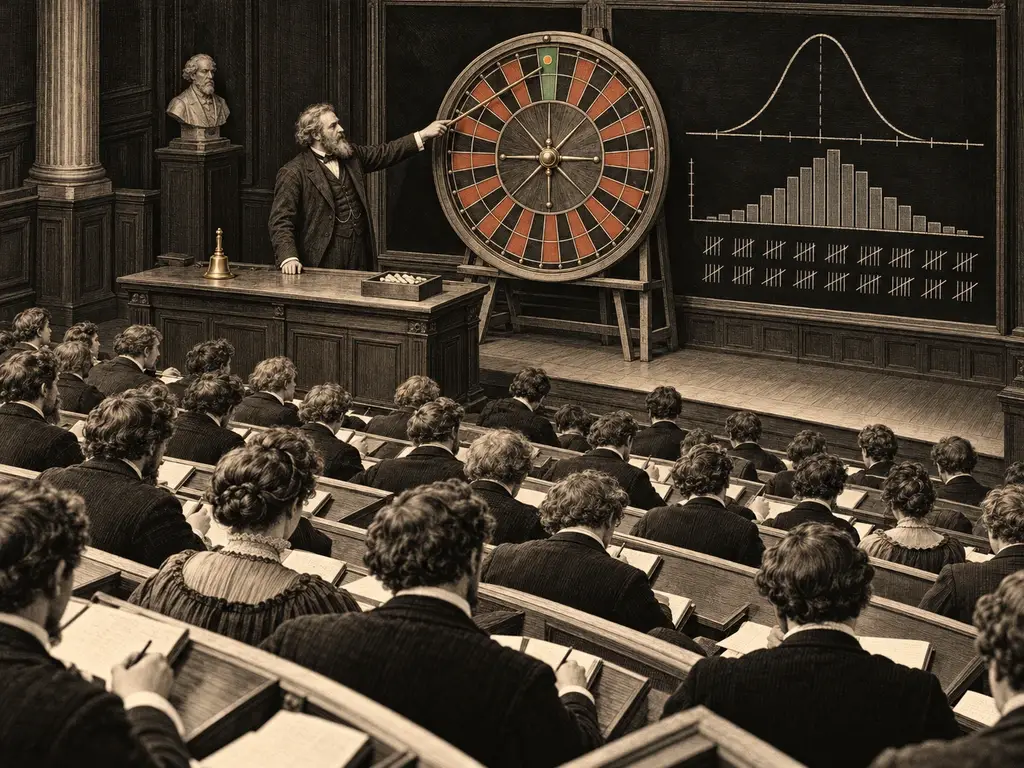
Thirty-seven equally likely outcomes, fixed payouts, independence, a known negative expectation and a long human record of getting it wrong. Roulette illustrates expectation, variancemathVarianceA measure of how widely results spread around the expected value. High for straight up, low for even-money bets.Read full →, the law of large numbersmathLaw of large numbersThe average of independent results converges to the expected value as the number of trials grows.Read full →, the gambler’s fallacy, hypothesis testing and the birthday problem better than coins or dice.
Why roulette
A coin has two outcomes and a die six; both are too small to show the birthday problemmathBirthday problemHow many people it takes before two probably share a birthday, or how many spins before a number probably repeats. On a 37-pocket wheel, 8 spins are enough for a better-than-even chance.Read full → or a chi-square testlabChi-square testStatistical test comparing observed hits per pocket with the expected n/37. Used to judge whether a wheel is biased.Read full → with any drama. A deck of cards has memory. Roulette has 37 equally likely outcomes, fixed payoutsmoneyPayoutWhat a winning bet returns, quoted as “X to 1” on top of the returned stake.Read full → that make expectation a one-line calculation, independence by physical design, and an edge small enough to hide in a session and large enough to dominate a year. It also has two centuries of documented fallacies to dissect.
A lesson sequence
Teaching without teaching gambling
Use play money and the Demo Game, which has no real stakes. Lead with the expected valuemathExpected valueThe average result per bet over the long run. −1/37 of the stake for every standard European bet.Read full → and keep returning to it: every exercise ends with “and the expected value is −1/37 of the stake”. Use the systems as counter-examples rather than methods: the exercise is to find the flaw, and the simulator makes the flaw visible in seconds. Include the history of people who lost. The lesson is that the arithmetic wins, which is the opposite of an advertisement.
Exercises that work
Have students predict how many spins until a repeat, then run the Demo Game ten times (birthday problem). Have them write a “system” in the strategy editor and run 10,000 sessions (linearity of expectation). Have them compute the probabilitymathProbabilityChance of an outcome, from 0 to 1 or 0% to 100%. One number: 1/37 = 2.70%.Read full → of the 1913 run and then of the run happening somewhere in fifty years of Monte Carlo (the difference between a specific event and some event). Have them find the “biased” pocketequipmentPocketOne of the 37 numbered compartments on the rotor. Also: slot, cup.Read full → in a fair spin history and then shuffle the data (multiple comparisons).
Why it sticks
Students remember the 26 blacksbetBlackEven-money bet on the 18 black numbers. French: noir.Read full →, Jagger’s wheel, and the moment the simulator showed their system losing. Abstract probability is forgotten by the exam; a wheel is not. The ethical line is clear: teach the arithmetic that makes the game a bad bet, using the game, and the students who gamble later will at least know the price.
Questions
With play money and the explicit framing that the house edgemathHouse edgeThe share of each stake the casino keeps on average: 2.70% in European roulette.Read full → is the lesson, many curricula already use dice and lotteries; roulette is a richer version of the same.
House Edge, then the Demo Game, then the Strategy Simulator.
It has no real money, no accounts and no links to operators.
Comic relief
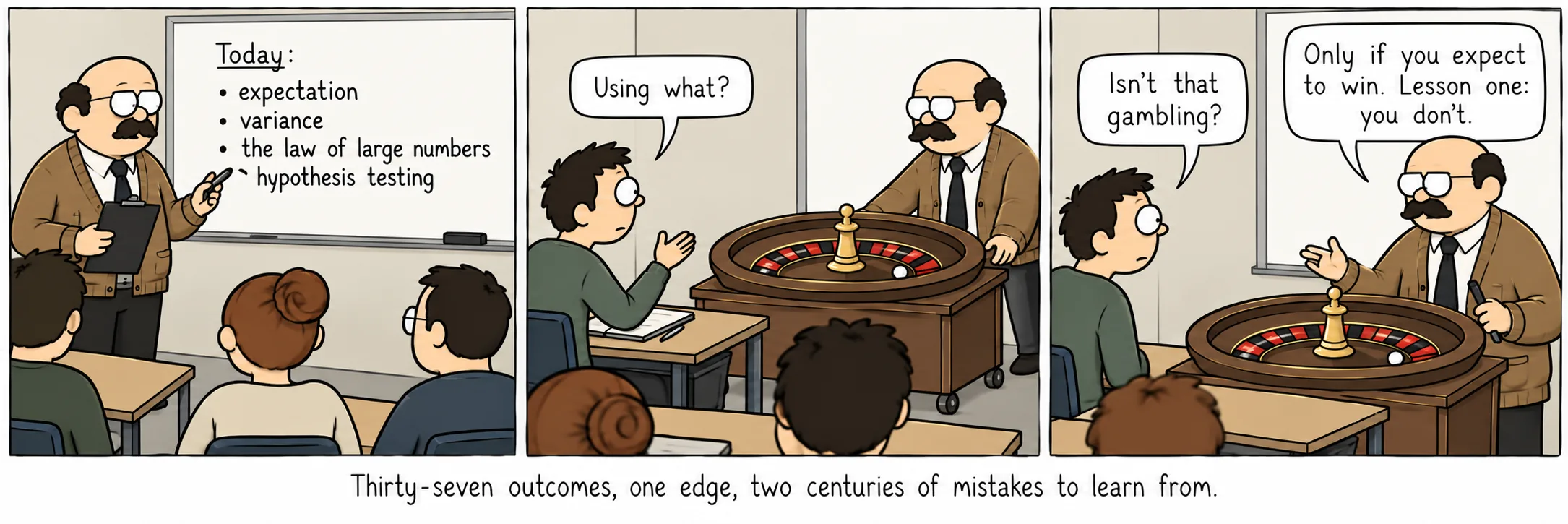
Thirty-seven outcomes, one edge, two centuries of mistakes to learn from.
Sources
- Feller, W. An Introduction to Probability Theory and Its Applications, Vol. 1.
- Ethier, S. N. The Doctrine of Chances: Probabilistic Aspects of Gambling.