Myth: Numbers Are Due
“Seventeen hasn’t come up in 150 spins. It’s due.” It is not.
A number that has not appeared for a long time is exactly as likely on the next spin as any other: 1/37. The belief that it is “due” is the gambler’s fallacy with a results board attached.
The claim
Casinos display the last 20 to 500 results and often mark “cold” numbers that have not hit for a while. Players read the board, see that 17 has been absent for 150 spins, and bet it because it must be due. The reasoning is that over the long run every number hits 1/37 of the time, so a number that is behind must catch up.
Why it is wrong
Spins are independent. The ballequipmentBallThe small ball launched along the track against the rotor. Modern balls are ivorine or Teflon, 18–21 mm.Read full → does not know 17 has been absent, and the pocketequipmentPocketOne of the 37 numbered compartments on the rotor. Also: slot, cup.Read full → is the same size it was. The long-run proportion converges by dilution, not by correction: after another 10,000 spins the 150-spin gap is a rounding error, not because 17 hit extra often but because the sample grew. The law of large numbersmathLaw of large numbersThe average of independent results converges to the expected value as the number of trials grows.Read full → does not require any number to catch up; it only requires that past fluctuations become small relative to the total.
Why it feels right
Because in every other part of life, absence predicts arrival: a bus that has not come for twenty minutes is more likely to come in the next five. That is because buses are on a schedule. Roulette has no schedule; it has a probabilitymathProbabilityChance of an outcome, from 0 to 1 or 0% to 100%. One number: 1/37 = 2.70%.Read full →, and a probability is not a quota. The intuition is sound for most of the world and wrong for the wheel.
The test
Record a hundred “cold” numbers from results boards and bet each for the next 37 spins. The hit rate will be 1/37 per spin, the same as for any number chosen at random, give or take noise. The results board is a description of the past. It has no predictive content for a fair wheel, and on a biased wheellabBiased wheelA wheel whose physical defects make some pockets more likely than 1/37. Rare, detectable only with thousands of recorded spins.Read full → (which would need thousands of spins to establish) the hot numbersmythHot numberA number that has appeared more often than expected recently. On a fair wheel it predicts nothing.Read full →, not the cold ones, would be the ones to bet.
The inverse myth
“Seventeen is hot, bet it” is the same error with the sign flipped. Both beliefs have the same expected valuemathExpected valueThe average result per bet over the long run. −1/37 of the stake for every standard European bet.Read full → as closing your eyes and pointing: −2.70% of the stake. On the Demo Game, run the history and count how often a cold numbermythCold numberA number that has not appeared for many spins. Carries no information about future spins on a fair wheel.Read full → hits in the next 37 spins; the answer is around 63.7%, exactly as for any other number.
Questions
It shows them because players ask. The board is accurate and useless.
(36/37)⁵⁰⁰ ≈ 0.0001%: rare, and still 1/37 next spin. If it keeps happening on one wheel, that is a bias question, and the answer would be to avoid the number.
No.
Comic relief
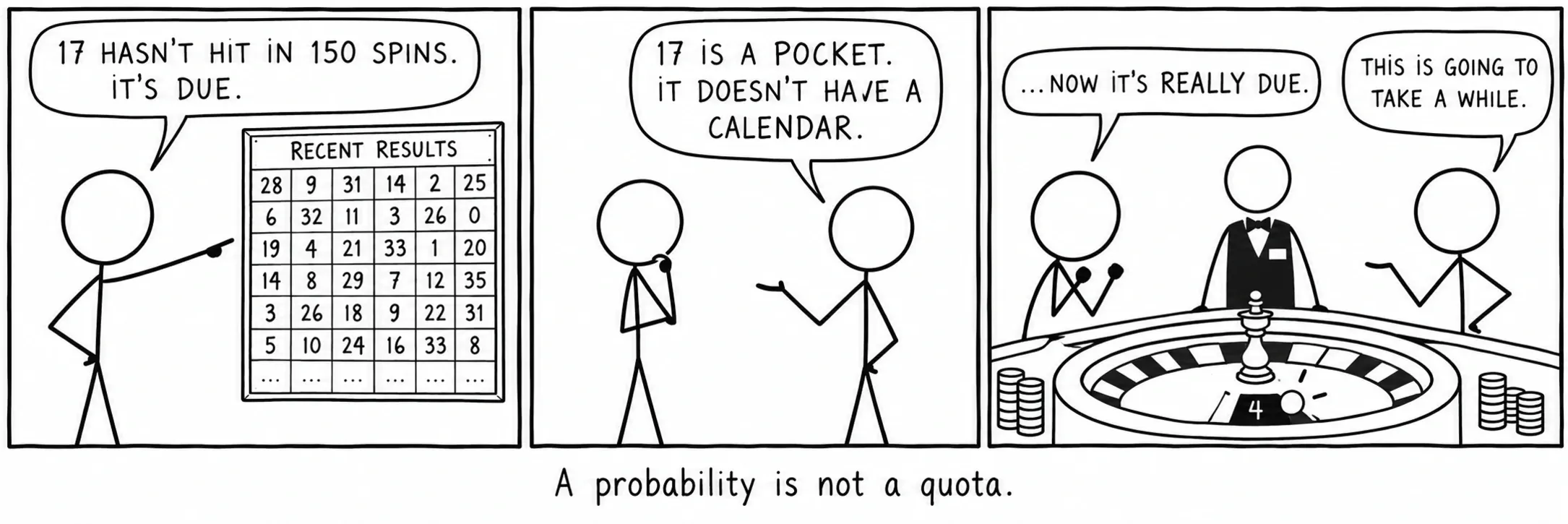
A probability is not a quota.
Sources
- Feller, W. An Introduction to Probability Theory and Its Applications, Vol. 1.
- Ethier, S. N. The Doctrine of Chances: Probabilistic Aspects of Gambling.