Hollandish Roulette Strategy
The Hollandish system uses an even-money betbetEven-money betA bet paying a profit equal to the stake, such as red/black, odd/even or high/low.Read full definition → in three-spin blocks. Because its reset instructions conflict, this version evaluates complete blocks.
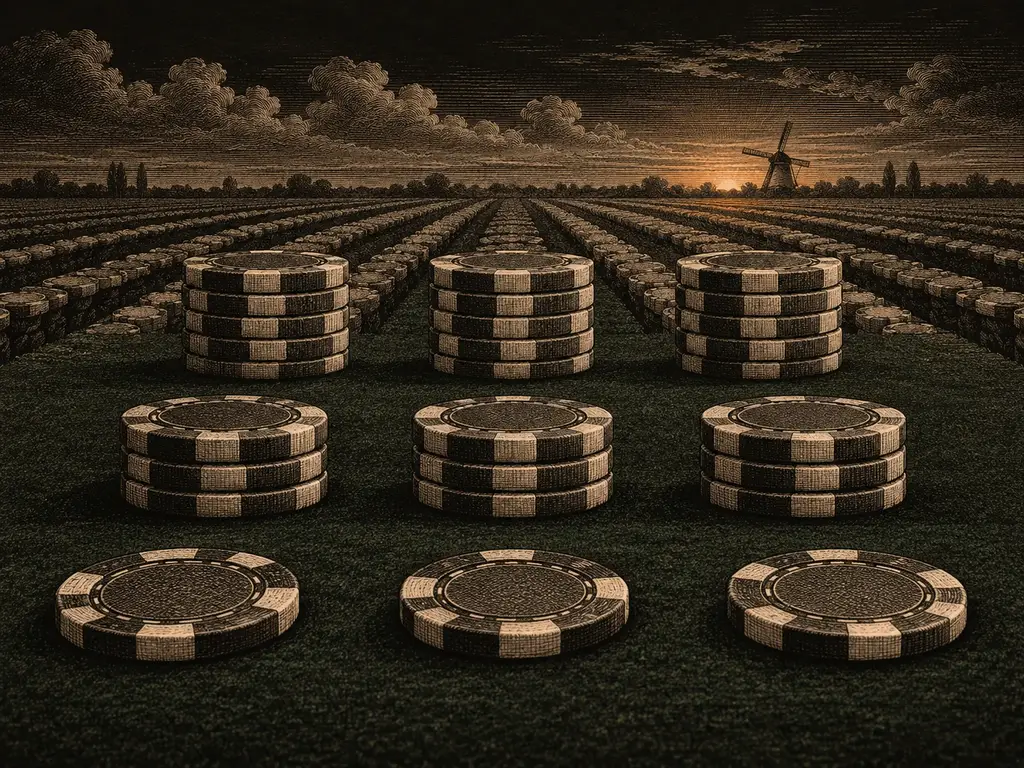
After a net-negative block, stakes move 1, 3, 5, 7…; after a profitable block, the next block returns to one. The edge is unchanged.
Three-spin block rule
Use one even-money stake for all three spins in a block. After a net-negative block, increase that stake by two; after a profitable block, reset it to one. A reset after each win would interrupt the three-spin block and therefore describes a different progressionstrategyProgressionA rule that changes stakes over a sequence of bets, often using previous wins or losses.Read full definition →.
Block progression table
Ignoring special zerowheelZeroThe 0 outcome, conventionally shown in green. Ordinary color, parity, high/low, dozen and column bets do not include it.Read full definition → rules, each three-spin block has a positive or negative net result because it contains an odd number of even-money outcomes.
| completed block result | stake in next 3-spin block | action |
|---|---|---|
| start | 1 | bet 1 on each of three spins |
| negative at 1 | 3 | increase by 2 |
| negative at 3 | 5 | increase by 2 |
| profitable at any level | 1 | reset under this article’s reading |
Worked example
Stake 1 on redbetRedAn even-money wager on the 18 red numbers. French: rouge.Read full definition → for three spins. Two losses and one win make the block −1, so the next three spins use stake 3. If that 3-unitmoneyUnitA base amount used to express stakes or results.Read full definition → block has two wins and one loss, it nets +3, so the following block returns to 1. A zero is normally a loss on a standard even-money roulette bet, so it belongs in the losing side of this accounting.
Cost and risk
A fully losing first block costs 3 units. If the second fully losing block uses 3 per spin, the total drawdownmoneyDrawdownA fall from a bankroll peak to a later value. Maximum drawdown is the largest such fall in the record.Read full definition → becomes 12; after a fully losing 5-unit block it is 27. The sequence grows linearly rather than exponentially, but it still raises the amount exposed while behind. Dividing play into blocks does not change independent spinsmathIndependent spinsSpins for which learning an earlier outcome does not change the probabilities assigned to a later one.Read full definition → or the 1/37 expected lossmathExpected lossThe probability-weighted average net loss under a stated model. With a constant edge, it equals edge times expected total stakes.Read full definition → per European unit staked.
Questions
This version resets after a profitable three-spin block. Resetting after each win would be a different progression.
The rule evaluates results in three-spin blocks. A block boundary can organize a session, but it cannot make future spins dependent on past ones.
Comic relief
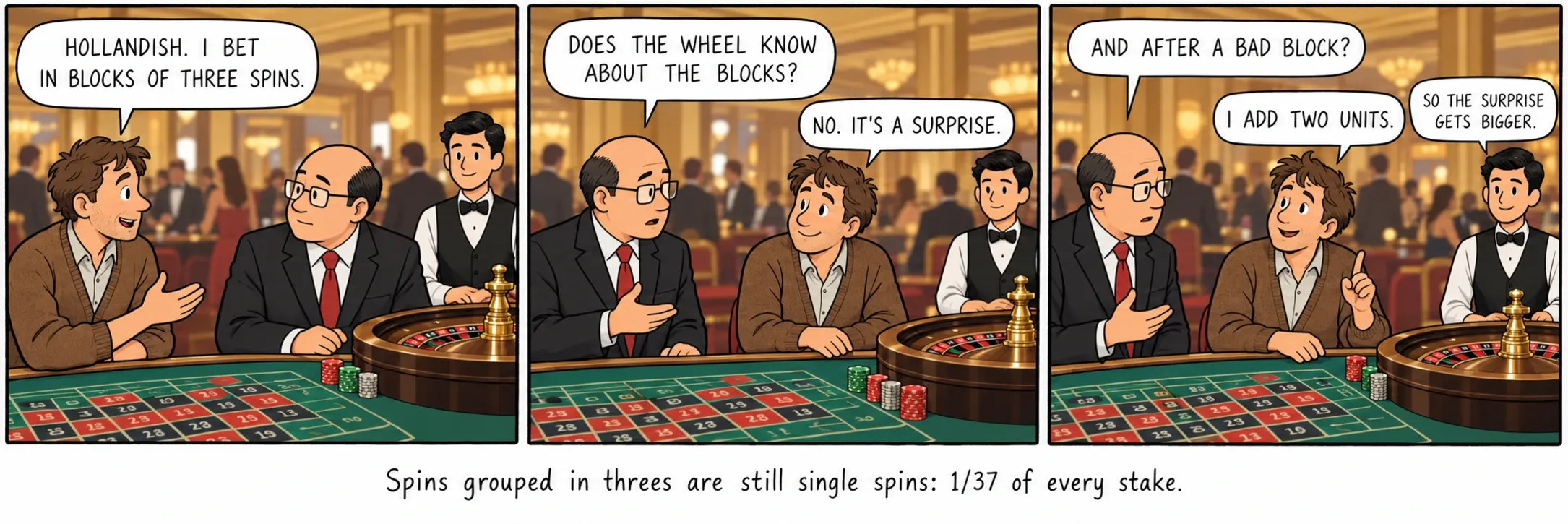
Grouping spins into blocks does not change the expected loss: 1/37 of each standard single-zero stake.
Sources
- RouletteDoc, “Hollandish system” — three-spin description and inconsistent reset wording
- Roulette77. Strategy description and examples.
- RouletteUK, “Hollandish roulette strategy” — contemporary three-spin-block rule
- Wizard of Odds, Roulette Basics — even-money bets and zero
- Wizard of Odds, The Truth about Betting Systems