Roulette Side Bets
Optional extra bets added to the wheel. Nearly all of them cost more than the game they sit beside, and some cost ten times as much.
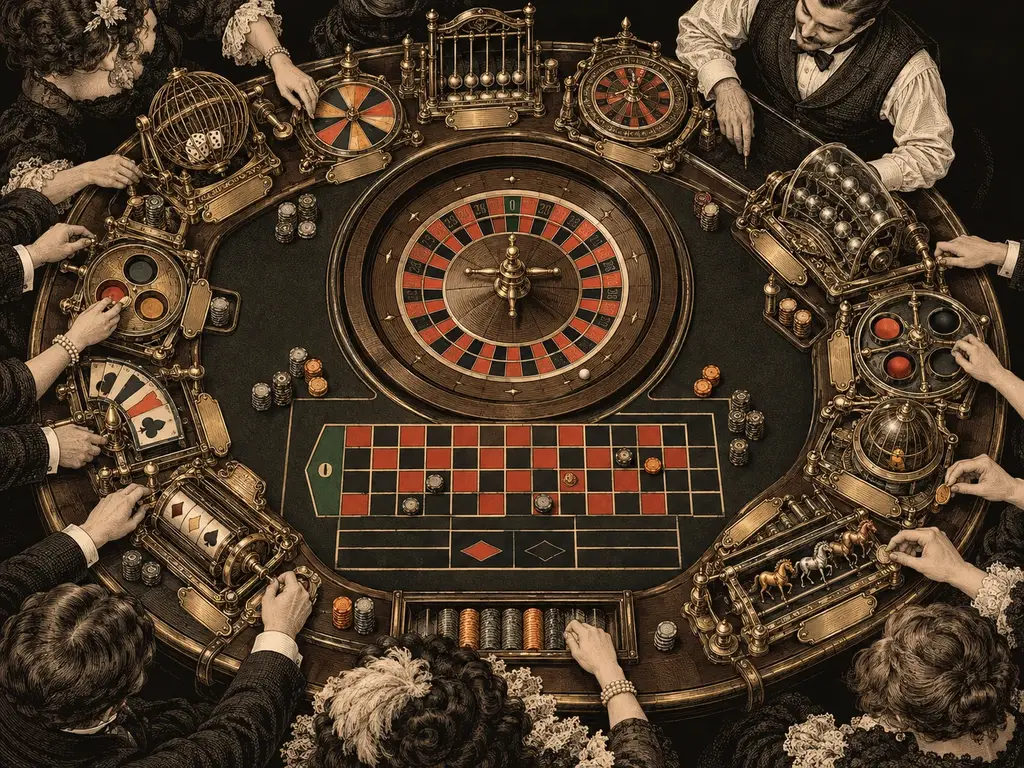
A side bet settles on the same spin, or on the next few, by its own pay table. Of the seventeen compared here, none beats the 2.70% of a plain single-zero bet and several cost more than 15%. One of them, Colors, is cheaper than the main bets on a double-zero wheel and would give the player the edge on a single-zero one, which is why no casino offers it there.
What a side bet is
A side betbetSide betAn optional extra wager attached to the main game, usually on a streak, a bonus event or a jackpot. Almost always dearer than the standard bets.Read full → is a wager the main game does not need: a streak of colors, a number plus a die, a jackpot for a repeat. Casinos add them because a new bet is easier to sell than a new game, and because a small optional stake at a high edge earns as much as a large stake at a low one: $2 at 25% earns the house the same 50 cents as $100 at 0.5%. A progressive jackpotmoneyProgressive jackpotA top prize that grows by a slice of every bet until someone wins it, then drops back to a starting amount, the seed.Read full → grows by a slice of every stake and drops back to its starting value when someone wins it.
Colors: priced for one wheel
Pick redbetRedEven-money bet on the 18 red numbers. French: rouge.Read full → or blackbetBlackEven-money bet on the 18 black numbers. French: noir.Read full →; three in a row pays 8 to 1. On a double-zerowheelZeroThe single green pocket that no even-money, dozen or column bet covers; the source of the house edge. Also: single zero, 0.Read full → wheel the chance is (18/38)³ = 10.63%, so the expected valuemathExpected valueThe average result per bet over the long run. −1/37 of the stake for every standard European bet.Read full → is 9 × 0.1063 − 1 = −4.34%: cheaper than every standard bet on the American layoutequipmentLayoutThe printed betting grid on the table. Also: table, felt, cloth.Read full →. Move the same pay tablemoneyPay tableThe list of what each bet or result pays. On machines and side bets, it is where the house edge is set.Read full → to a single-zero wheel and the chance rises to (18/37)³ = 11.51%, which makes the expected value +3.62% for the player. A pay table is set for one wheel. On another it can be a gift, or a trap.
WINGO: the value of a push
WINGO, devised by Stanley Roberts in 1990 and named after his WIN magazine, starts after an even-money betbetEven-money betRed/black, odd/even, high/low. 18 numbers, pays 1:1.Read full → wins. Instead of collecting, the player calls “WINGO!” and lets the bet ride up a ladder of five more wins, which pays 64 to 1 on the original stake. On the ladder, 0 and 00 are pushes rather than losses, so each rung is an exact 50-50. Once on the ladder the bet cannot be taken down, and part of the climb pays nothing. The chance of reaching the top is (18/38) × (½)⁵ = 1.48%, and the expected value is −3.78%, lower than the 5.26% of the even-money bet it grows out of. The lesson is general: taking the zeros out of play, even for a few spins, is worth more than any change to a payoutmoneyPayoutWhat a winning bet returns, quoted as “X to 1” on top of the returned stake.Read full →.
Progressives and the break-even jackpot
Roulette Royale, an online single-zero game, makes its jackpot bet compulsory: $1 on every spin on top of whatever else you bet. It pays $15 when a number repeats, $200 for three in a row, $3,000 for four, and the jackpot for five, a chance of 1 in 1,874,161 from any spin. With the jackpot at $40,000 the side bet returns about 65 cents of every dollar. Added to a $1 even-money bet, it raises the edge on the $2 from 2.70% to about 18 to 19%. Every progressive has a break-evenmathBreak-evenThe point where a bet’s expected value is exactly zero, so neither side has an edge. Usually a payout or a jackpot size.Read full → size, above which the side bet alone favors the player; here it is around $700,000, and higher still if several players would share the hit. Casinos reset jackpots far below that.
Neighborhoods: a number and its neighbors
Neighborhoods, which the Wizard of Odds found at the Gold Coast in Las Vegas in 2019, is a bet on one number and the two pocketsequipmentPocketOne of the 37 numbered compartments on the rotor. Also: slot, cup.Read full → beside it on the wheel. The number pays 23 to 1 and either neighbor 5 to 1. Over 38 spins at $1, the number comes once and returns $24, and each neighbor once and returns $6: $36 back for $38 staked, an edge of 5.26%, the same as any bet on the table. On a single-zero wheel it would cost 2.70%, on a triple-zero wheel 7.69%. It is a side bet only in name: it pays like three numbers sharing 11 to 1.
How to price any side bet
List the outcomes, multiply each net payout by its probabilitymathProbabilityChance of an outcome, from 0 to 1 or 0% to 100%. One number: 1/37 = 2.70%.Read full →, and add. If the pay table says “for 1”, subtract the stake from each payout first. Then compare the result with the bet beside it on the layout. Streak Side Bets and Dice and Draw Side Bets work the others through, step by step.
- Above 2.70% on a single-zero wheel, or 5.26% on a double-zero wheel, the side bet is dearer than the main game.
- A large top prize is paid for by the small, frequent prizes. Look at those first.
- A compulsory side bet raises the edge on everything else you bet.
- A side bet can cost exactly the wheel’s price, as Neighborhoods does. Most cost two to six times as much.
Questions
On these figures, none beats a plain single-zero bet. A few, such as WINGO, Flush and Colors, are cheaper than the main bets on a double-zero wheel.
Players accept them for a chance at a large payout, and a small stake at a high edge earns as much as a large stake at a low one.
Only above its break-even size, and only if you would not have to share it. Jackpots reset far below that.
Fun with Math
Try these yourself first. Each solution is folded; open it when you are ready.
The Newar bets at London’s Golden Nugget paid 3 to 1 on the eight redbetRedEven-money bet on the 18 red numbers. French: rouge.Read full → even numbers, and 2 to 1 if zerowheelZeroThe single green pocket that no even-money, dozen or column bet covers; the source of the house edge. Also: single zero, 0.Read full → came up: an edge of 5.41%. What would have happened if the casino had offered the same payoutsmoneyPayoutWhat a winning bet returns, quoted as “X to 1” on top of the returned stake.Read full → on red odd numbers instead?
Show the solution
Answer The casino would have lost money: the player would have had an edge of 16.2%.
Count them on a European layoutequipmentLayoutThe printed betting grid on the table. Also: table, felt, cloth.Read full →: 1, 3, 5, 7, 9, 19, 21, 23, 25 and 27 are red and odd. That is ten, not eight; blackbetBlackEven-money bet on the 18 black numbers. French: noir.Read full → even numbers are also ten.
Over 37 spins the bet wins 3 unitsmoneyUnitThe base stake a system or a player works in. Progressions are described in units so they apply at any table.Read full → on ten numbers and 2 on zero, and loses 1 on the other 26: 30 + 2 − 26 = +6. An edge of 6/37, 16.2%, for the player.
Red and black alternate around the wheel, but on the layout they are not spread evenly over odd and even numbers. A pay tablemoneyPay tableThe list of what each bet or result pays. On machines and side bets, it is where the house edge is set.Read full → written for one group can be a gift on its mirror image.
WINGO starts with a winning even-money betbetEven-money betRed/black, odd/even, high/low. 18 numbers, pays 1:1.Read full → left to ride up a ladder of five more wins, with 0 and 00 as pushes. Bet $1 on odd; 9 comes up and you call WINGO. The next spins are 19, 7, 19, 0 and 2. What do you collect?
Show the solution
Answer Nothing. Three rungs, a push, then a loss: the $1 stake is gone, and so is the $1 you could have collected on the 9.
The 9 wins the even-money bet, but calling WINGO means giving up that $1 win: the original $1 now rides for 64 to 1.
19, 7 and 19 are odd: three rungs. 0 is a push, and the bet stays on the third rung. 2 is even: the bet loses. WINGO pays only at the top, 64 to 1 after five rungs, and nothing for part of the climb.
From the start, the chance of reaching the top is 18/38 × (½)⁵ = 1.48%, and the bet costs 3.78%: less than the 5.26% of the even-money bet it grew from, because on the ladder the zeros cannot hurt it.
Neighborhoods pays 23 to 1 on your number and 5 to 1 on either pocketequipmentPocketOne of the 37 numbered compartments on the rotor. Also: slot, cup.Read full → next to it on the wheel. Show that on any wheel it costs the same as a plain bet on that wheel.
Show the solution
Answer It returns 36 units for every N staked, so it costs (N − 36)/N: 2.70%, 5.26% or 7.69% on 37, 38 or 39 pockets.
Spin a wheel of N pockets N times with $1 on Neighborhoods each time. On average your number comes up once and each neighbor once.
The number brings back $24, the stake and 23. Each neighbor brings back $6. Together: 24 + 6 + 6 = $36 for $N staked.
That is exactly what a straight upbetStraight upA single number, pays 35:1.Read full → returns: $36 once in N spins. So the edge is (N − 36)/N, the same as every ordinary bet on the wheel. The three numbers simply share the 33 units of winnings unevenly: 23, 5 and 5 instead of 11 each.
Comic relief
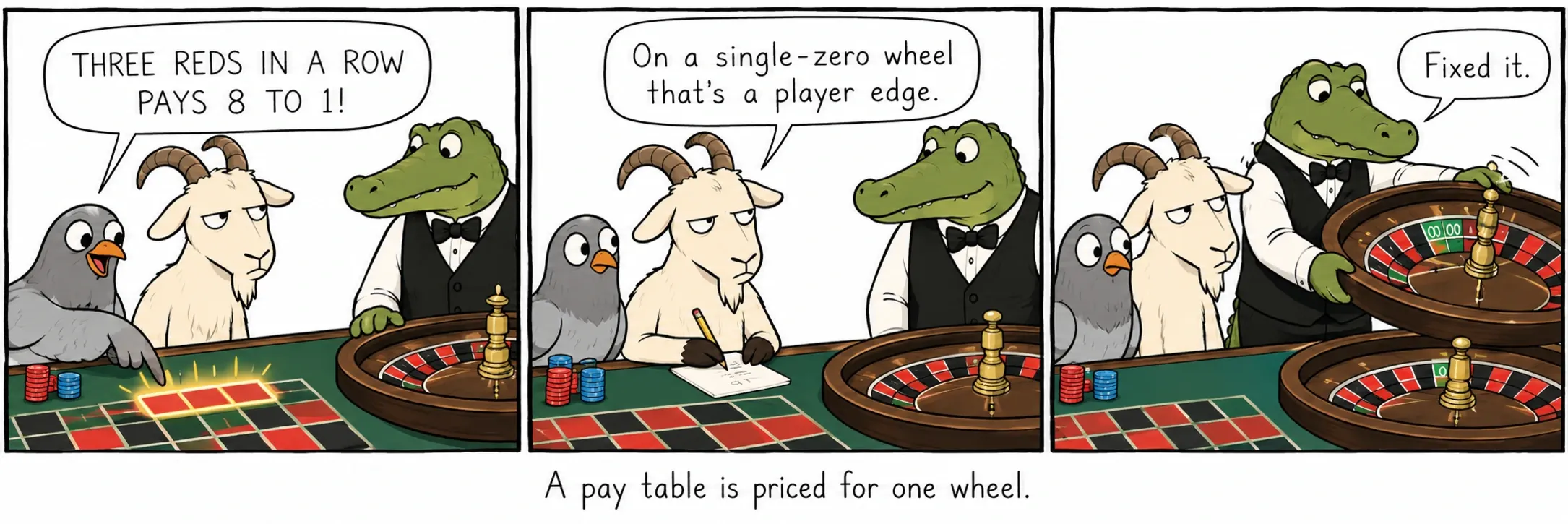
A pay table is priced for one wheel.
Sources
- Bollman, M. Mathematics of the Big Four Casino Table Games: Blackjack, Baccarat, Craps, & Roulette.
- Ethier, S. N. The Doctrine of Chances: Probabilistic Aspects of Gambling.
- VitalVegas. “Caesars Entertainment Rolls Out ‘Roulette’s Best Bet’.” Report on the 2G’$ side bet.
- Wizard of Odds. “Neighborhoods”, “Richer Spin”, “Back2Back”, “Blazing 7s”, “Straights and 8’s” and “Lucky Colour Chips”.
- Wizard of Odds. “Spread-Bet Roulette” and “Lucky Symbols Roulette”.
- New Jersey Division of Gaming Enforcement. N.J.A.C. 13:69F-5.1 to 5.4, “Spread-Bet Roulette”.