Long-Run Convergence: The Law of Large Numbers in Roulette
How the average settles toward −2.70%, and why that takes longer than intuition suggests.
For independent standard single-zero bets at a fixed one-unit stake, the average net result tends toward −1/37 per spin. Its standard deviation shrinks as 1/√N; for 1,000 red bets it is about 3.16% of the stake.
Law of large numbers
For independent, identically distributed bets with finite expectation, the running average tends toward the expected valuemathExpected valueThe sum of each possible net result multiplied by its probability. It can be positive, zero or negative.Read full definition →. After N standard single-zerowheelZeroThe 0 outcome, conventionally shown in green. Ordinary color, parity, high/low, dozen and column bets do not include it.Read full definition → even-money betsbetEven-money betA bet paying a profit equal to the stake, such as red/black, odd/even or high/low.Read full definition → at one unitmoneyUnitA base amount used to express stakes or results.Read full definition →, its expectation is −1/37 and its standard deviationmathStandard deviationThe square root of variance: a measure of dispersion in the same units as the result.Read full definition → is about 1/√N. That spread is about 10% of the stake after 100 spins, 3.16% after 1,000 and 1% after 10,000. More observations make the edge easier to distinguish from random variation; no fixed spin count guarantees a particular observation.
| spins | σ of average per spin (even money) | edge as a fraction of σ |
|---|---|---|
| 10 | 31.6% | 0.09 |
| 100 | 10.0% | 0.27 |
| 1,000 | 3.2% | 0.85 |
| 10,000 | 1.0% | 2.70 |
| 100,000 | 0.3% | 8.54 |
What converges and what does not
The average per spin converges. The total does not: it drifts further from zero as N grows, by about 2.7% of N in expectation, with a spread of √N around that. Completing 10,000 fixed $10 redbetRedAn even-money wager on the 18 red numbers. French: rouge.Read full definition → bets gives an expected net result of about −$2,703 and a standard deviation of $1,000. The standard deviation measures spread; it is not a bound on the result.
- p10 −$440
- p25 −$280
- median −$140
- p75 +$0
- p90 +$140
Why intuition fails
People expect the edge to show up quickly because 2.70% sounds like a lot, and expect long runs to “even out” because the law of large numbersmathLaw of large numbersA theorem under which sample averages converge to an expected value; independent identically distributed results with finite expectation are a standard case.Read full definition → says averages converge. Both intuitions misjudge the scale: the edge is small relative to a single spin’s variancemathVarianceThe expected squared distance of a result from its expected value. It measures dispersion in squared units.Read full definition → (σ = 1 unit against EV = 0.027), so it takes (1/0.027)² ≈ 1,400 spins to become one-sigma visible. And the convergence of the average does nothing to pull the total back; it only dilutes past fluctuations.
Convergence for other bets
For straight-up bets, σ is about 5.84 per unit, compared with about 1 for even-money bets. Using exact values, expected lossmathExpected lossThe probability-weighted average net loss under a stated model. With a constant edge, it equals edge times expected total stakes.Read full definition → equals one standard deviation of the total at 46,656 straight-up spins and 1,368 even-money spins. This compares scales of variation; one standard deviation is not a threshold that establishes an edge.
Implication for testing systems
A positive sample average does not establish that a system has positive expected value. A useful test specifies the rules, stakes, stopping rule and success criterion before examining results, and accounts for trying multiple systems. Under fixed-stake single-zero red betting, a profit after exactly 100 spins has probabilitymathProbabilityA measure of how likely an event is, from zero to one. Percentages express the same scale from 0% to 100%.Read full definition → about 35.53%. Simulation can test a stated model, but cannot prove that a real wheel behaves like that model.
Formula
Questions
Playing longer does not guarantee that you will get ahead. In the idealized fixed one-unit red-bet model with no bankrollmoneyBankrollThe amount set aside for play. Bankroll management concerns stakes and limits within that amount.Read full definition → limit, the chance of ever reaching a one-unit profit from zero is 18/19, about 94.7%. A finite bankroll lowers that chance. Continuing indefinitely with negative expectation eventually drives the total downward under this model.
No. It means past fluctuations become a smaller fraction of a bigger sample.
There is no universal number. It depends on the bet’s variance, the effect you want to detect, the error rates you will accept and how the data were collected. Decide on a test before looking for a favorable pattern.
Fun with Math
Try these yourself first. Each solution is folded; open it when you are ready.
Two friends play 20 rounds of a fair gamemathFair gameIn expected-value terms, a game or wager with zero expected net profit for each side under the stated strategy and rules.Read full definition →, a coin toss or redbetRedAn even-money wager on the 18 red numbers. French: rouge.Read full definition → against blackbetBlackAn even-money bet on the 18 black numbers. French: noir.Read full definition → with zeroswheelZeroThe 0 outcome, conventionally shown in green. Ordinary color, parity, high/low, dozen and column bets do not include it.Read full definition → returned, and keep a running score. Count the rounds during which each one is ahead (a tie counts for whoever led just before). Which is more likely: that the lead is shared 10 rounds to 10, or that one friend leads all 20?
Show the solution
Answer One friend leading all 20 rounds is far more likely: 35.2%, counting either friend, against 6.1% for an even 10 to 10.
The chance that a fair running score is level after 2k rounds is u = C(2k, k)/2²ᵏ: 0.246 after 10 rounds and 0.176 after 20. A classic result, the arc-sine law, says the chance that one named friend leads for exactly 2k of 2n rounds is u(2k) × u(2n − 2k).
Leading all 20: u(20) × u(0) = 0.176 for each friend, 35.2% for either. An even share: u(10) × u(10) = 0.246² = 6.1%, the least likely share of all.
One player leading throughout this short fair game is therefore quite plausible. The calculation uses the stated convention for ties and independent fair rounds. A long period in the lead is not, by itself, evidence of skill or a biased game.
Comic relief
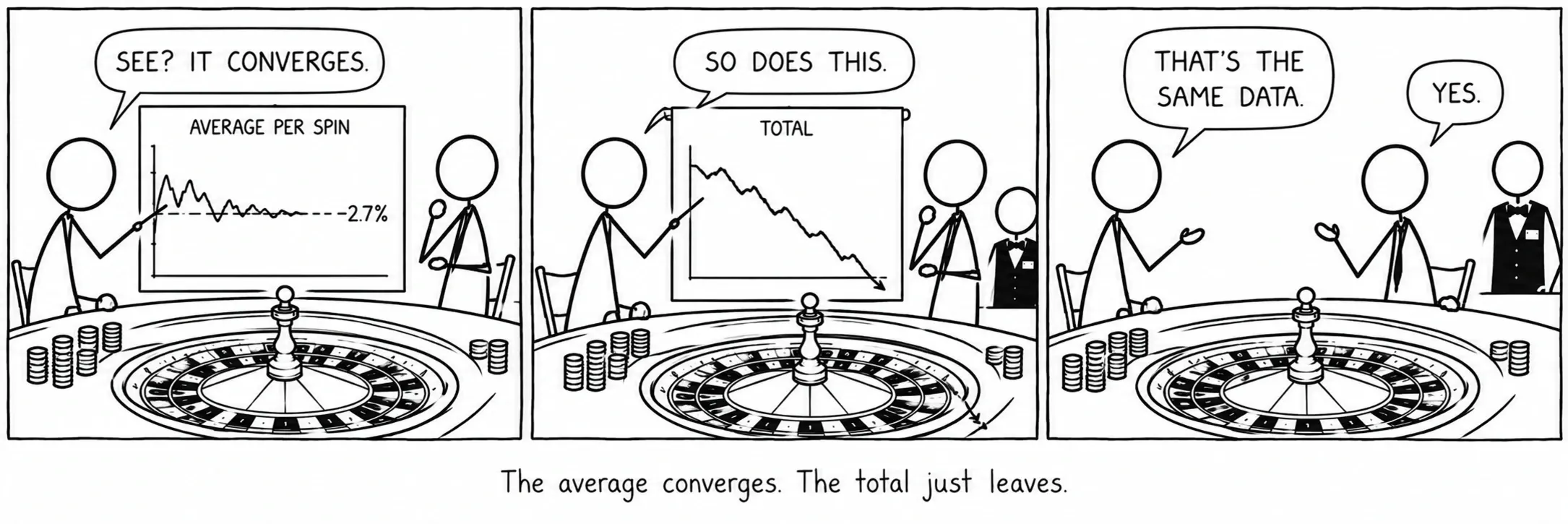
For independent standard single-zero bets, average net return per unit staked tends to −1/37.
Sources
- Bernoulli, J. Ars Conjectandi.
- Feller, W. An Introduction to Probability Theory and Its Applications, Vol. 1.