Seven Corners Roulette Strategy
Seven Corners puts one unit on seven specified corner bets. One number, 32, belongs to two listed corners, so the layout covers 27 distinct European pockets rather than 28.
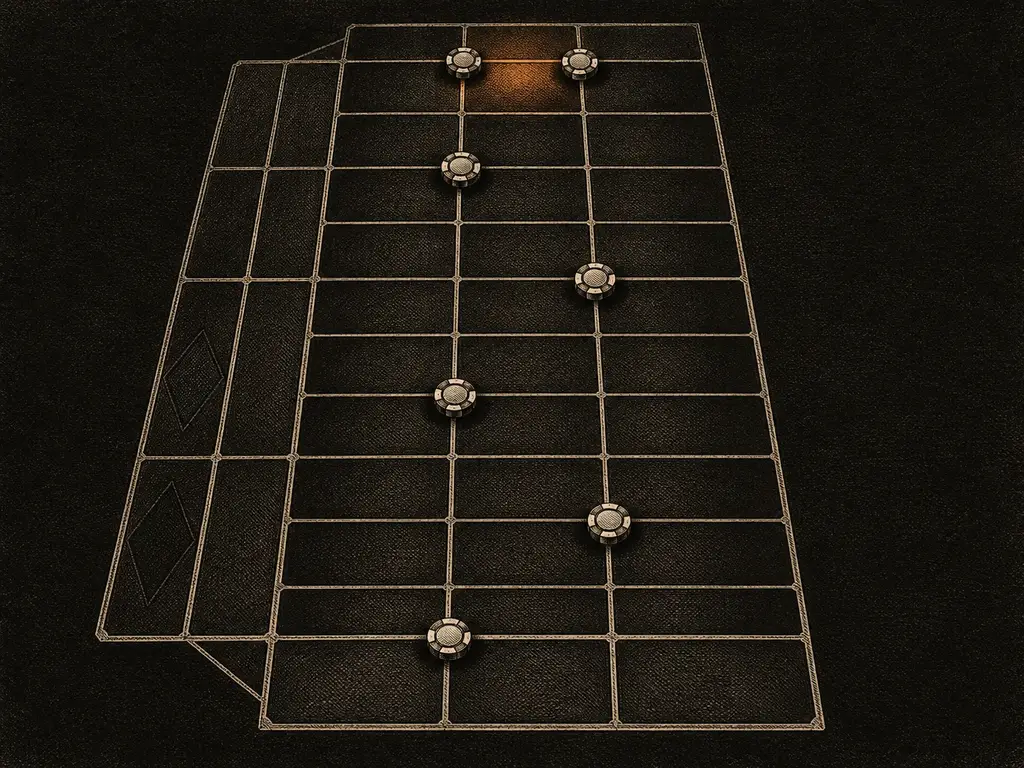
Under the clear one-unit-per-corner convention, 26 pockets net +2, 32 nets +11, and 10 pockets lose 7 units. Changing a chip’s currency value scales money but not coverage.
Defined placements
Place one unitmoneyUnitA base amount used to express stakes or results.Read full definition → on each cornerbetCornerFour numbers sharing a layout intersection, ordinarily paying 8 to 1.Read full definition →: 0/1/2/3; 4/5/7/8; 11/12/14/15; 16/17/19/20; 23/24/26/27; 28/29/31/32; and 32/33/35/36. The last two corners overlap on 32. This article normalizes the ambiguous stake wording to one unit per corner, so seven chipsmoneyChipA token used to place a wager, with a printed or assigned value. Also called a check in some casino terminology.Read full definition → are placed in total. A two-currency-unit chip would double every monetary result but would not create more covered pocketsequipmentPocketA compartment on the rotor in which the ball can settle. The number of pockets depends on the wheel.Read full definition →.
Outcome table
A corner pays 8:1 net, or nine times its chip including stake.
| European result | pockets | net with 7 units total |
|---|---|---|
| one non-overlapping listed corner | 26 | +2 |
| overlap at 32 | 1 | +11 |
| uncovered | 10 | −7 |
Worked example
If 26 lands, its one-corner chip returns nine gross. Six other chips lose, and 9 − 7 = +2 net. If 32 lands, both of its corner bets win and return 18 gross, so the net is +11. If 9 lands, none of the listed corners contains it and all seven units lose. The calculations subtract the complete original layoutequipmentLayoutThe marked betting surface, whether printed on a table or displayed on a screen.Read full definition →, not merely the chips adjacent to the landed number.
Expectation and risk
The chance of any covered pocket is 27/37 = 72.973% on a European wheel, but this layout has uneven positive outcomes because of the overlap. Its expected result is (26 × 2 + 11 − 10 × 7) / 37 = −7/37 units per spin, precisely one thirty-seventh of the total stake. A high hit rate does not cancel the size or frequency of the ten losing outcomes. The explicit normalization also matters: citing a different total stake without defining chip units cannot establish different coverage.
Questions
It is in two of the seven corner bets. Both winning corners pay, producing +11 after all seven original chips are subtracted.
Yes. Then the stake and every net outcome double, while the layout still covers the same 27 pockets.
Comic relief
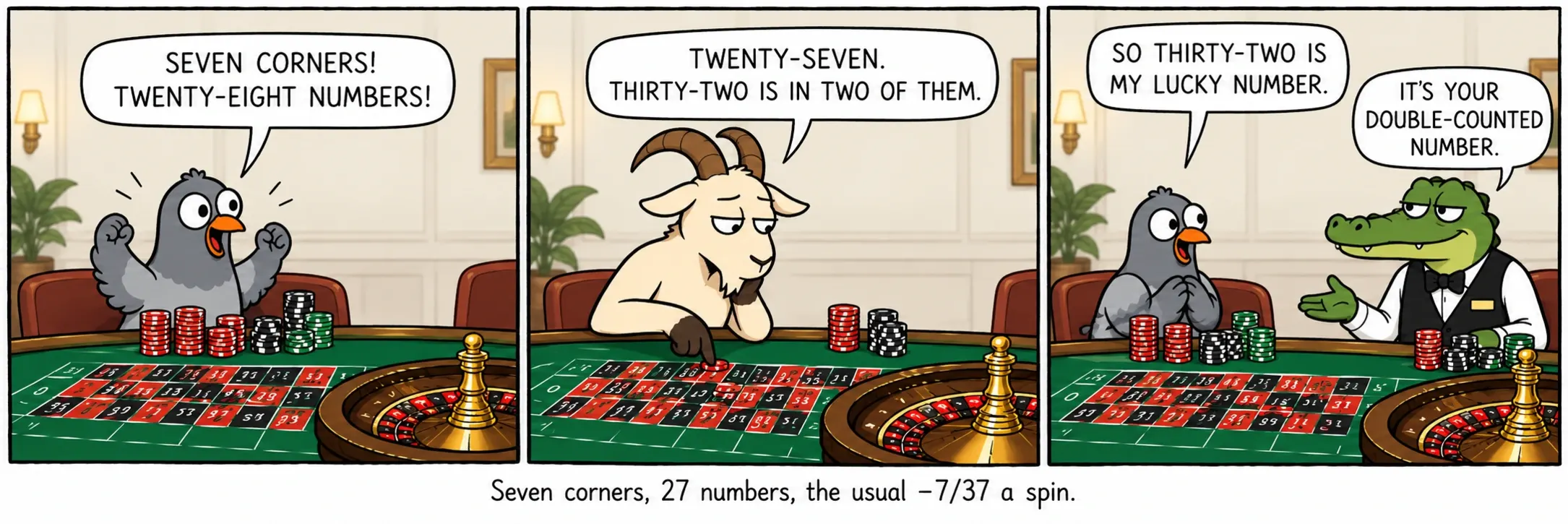
One unit on each of these seven corners covers 27 pockets. On a fair single-zero wheel with standard payouts, expected loss is 7/37 units per spin.
Sources
- RouletteDoc, Strategy overview
- Roulette77, “Seven Corners” — listed corner placements
- Wizard of Odds, Roulette Basics — corner payouts and European edge
- Wizard of Odds, The Truth about Betting Systems — coverage does not remove the edge