Roulette Snake Bet
The roulette snake bet covers twelve red numbers that zigzag down the layout from 1 to 34.
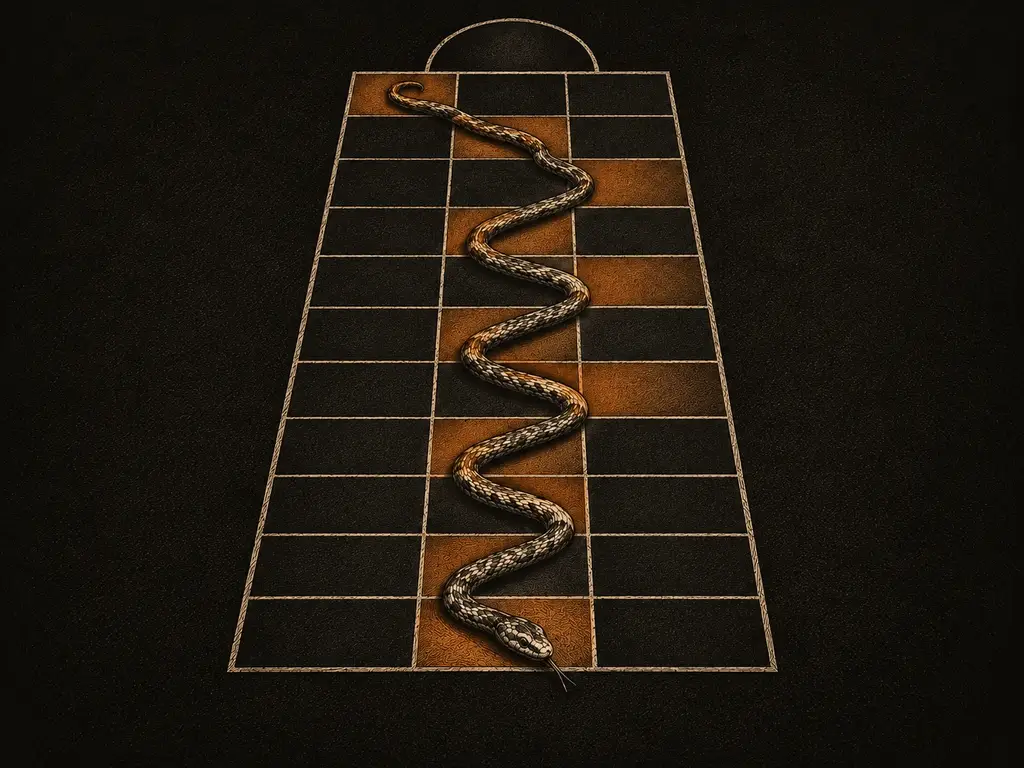
Twelve numbers, 1, 5, 9, 12, 14, 16, 19, 23, 27, 30, 32 and 34, pay 2:1 like a dozen. ProbabilitymathProbabilityA measure of how likely an event is, from zero to one. Percentages express the same scale from 0% to 100%.Read full definition → 32.43%, house edgemathHouse edgeThe casino’s expected net gain expressed as a fraction of the stake, under specified probabilities and payouts.Read full definition → 2.70%. Where the table has no snake box, twelve straight ups make exactly the same bet.
What is the snake bet in roulette?
Take one number from each streetbetStreetA bet on one row of three layout numbers, ordinarily paying 11 to 1.Read full definition → in turn, one place further along the street each time and turning back at the edge: the first of 1-2-3, the middle of 4-5-6, the last of 7-8-9, the last again of 10-11-12, then the middle and the first, and so on to 34. That gives 1, 5, 9, 12, 14, 16, 19, 23, 27, 30, 32 and 34: one number from every street, and every one of them redbetRedAn even-money wager on the 18 red numbers. French: rouge.Read full definition →. Drawn on the felt, the path bends like a snake, which is all the name means; it is also called the red snake.
Snake bet payout and odds
Where the layoutequipmentLayoutThe marked betting surface, whether printed on a table or displayed on a screen.Read full definition → marks a snake, one chipmoneyChipA token used to place a wager, with a printed or assigned value. Also called a check in some casino terminology.Read full definition → pays 2 to 1, exactly like a dozenbetDozenA bet on 1–12, 13–24 or 25–36, ordinarily paying 2 to 1.Read full definition →. Elsewhere you make it as twelve one-unitmoneyUnitA base amount used to express stakes or results.Read full definition → straight upsbetStraight upA wager on one number, ordinarily paying a profit of 35 to 1.Read full definition →: a hit pays 35 on one chip and loses the other eleven, +24 on 12 units, which is 2 to 1 again. Either way, the expected counts over 37 spins are 12 wins and 25 losses: 12 × 2 − 25 = −1 unit for every 37 staked, 2.70%.
| $10 × 100 spins | snake |
|---|---|
| probability per spin | 32.43% |
| expected wins in 100 spins | 32.4 |
| expected result | −$27.03 |
| standard deviation | $140 |
| p(no win in 100 spins) | 0.000000% |
A balanced shape
The snake takes four numbers from each dozen, four from each columnbetColumnTwelve numbers in one vertical layout column, ordinarily paying 2 to 1.Read full definition →, six odd and six even, six low and six high. The one thing it is not balanced on is color: all twelve numbers are red. Snake and blackbetBlackAn even-money bet on the 18 black numbers. French: noir.Read full definition → together cover 30 numbers with no overlap; snake and red pay twice on twelve of the eighteen reds.
| split by | snake numbers |
|---|---|
| dozen | 4 · 4 · 4 |
| column | 4 · 4 · 4 |
| odd / even | 6 · 6 |
| low / high | 6 · 6 |
| red / black | 12 · 0 |
On the wheel
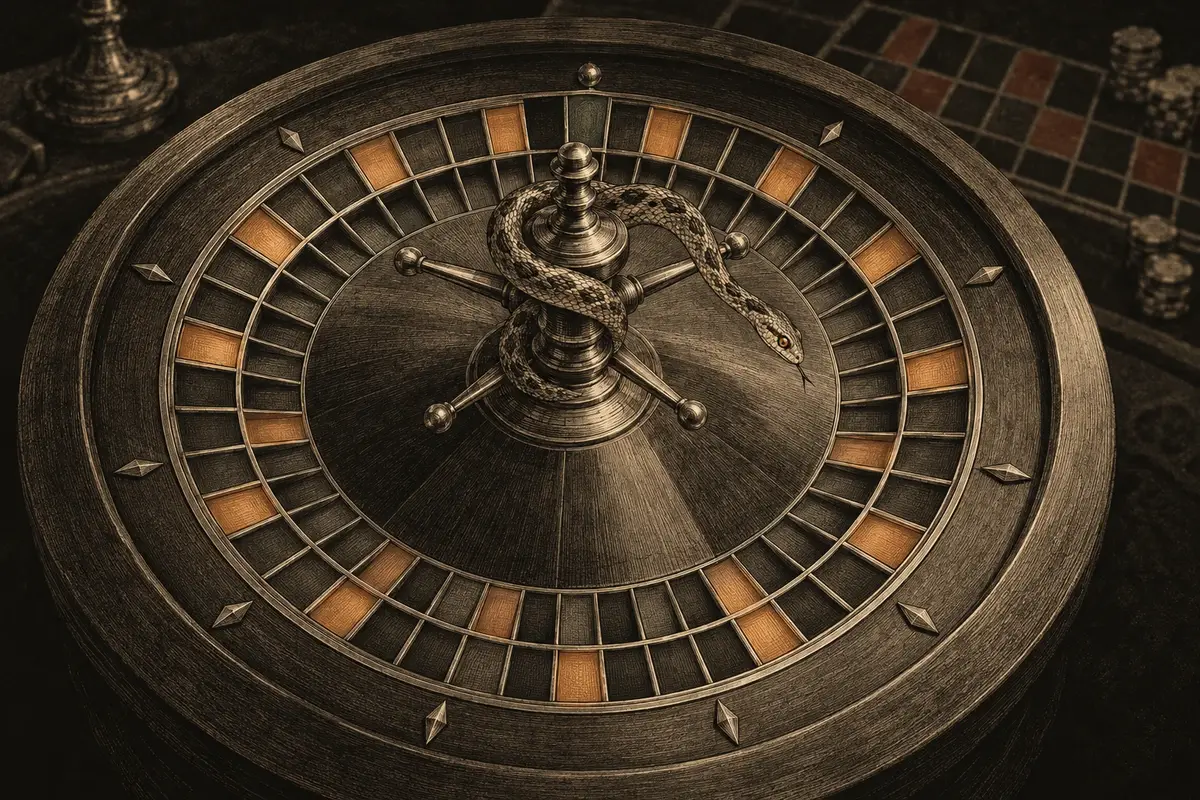
The twelve numbers are scattered: no two of them are neighborsbetNeighborsPockets adjacent to a selected number around the wheel. A neighbors bet includes a chosen number of them on each side.Read full definition → on the European wheel. Clockwise from zerowheelZeroThe 0 outcome, conventionally shown in green. Ordinary color, parity, high/low, dozen and column bets do not include it.Read full definition → they come up as 32, 19, 34, 27, 30, 23, 5, 16, 1, 14, 9, 12. The snake is a shape on the layout, not a sectorwheelSectorA continuous arc of neighboring pockets around the wheel, rather than a group defined by the betting layout.Read full definition → of the wheel.
Where you can bet it
Check whether the layout offers a snake betbetSnake betA grouping of 12 red numbers: 1, 5, 9, 12, 14, 16, 19, 23, 27, 30, 32 and 34. Where offered as one bet, its usual profit payout is 2 to 1.Read full definition → at 2:1. Otherwise, twelve equal straight ups reproduce its payoutmoneyPayoutThe amount paid on a winning wager. Check whether the quoted figure is net profit or total return including the stake.Read full definition → distribution for the same total stake. Minimums may apply per position or to the combined stake; twelve chips do not necessarily require twelve times the headline inside minimum. On an American wheel the same twelve numbers cover 12 of 38 pocketsequipmentPocketA compartment on the rotor in which the ball can settle. The number of pockets depends on the wheel.Read full definition → and cost 5.26%, like every other bet there except the five-number bet.
Questions
It is a dozen in another shape: 32.43% to win, 2 to 1, 2.70% house edge. Its expected lossmathExpected lossThe probability-weighted average net loss under a stated model. With a constant edge, it equals edge times expected total stakes.Read full definition → matches other standard single-zero bets without special zero treatment, although its distribution differs.
No. Twelve one-unit straight ups make +24 on a hit, the same 2 to 1 on the 12 units staked.
The zigzag is traced through red cells: every street holds at least one red, and the snake takes a red from each. That is the whole design, and it gives the bet no advantage.
Comic relief
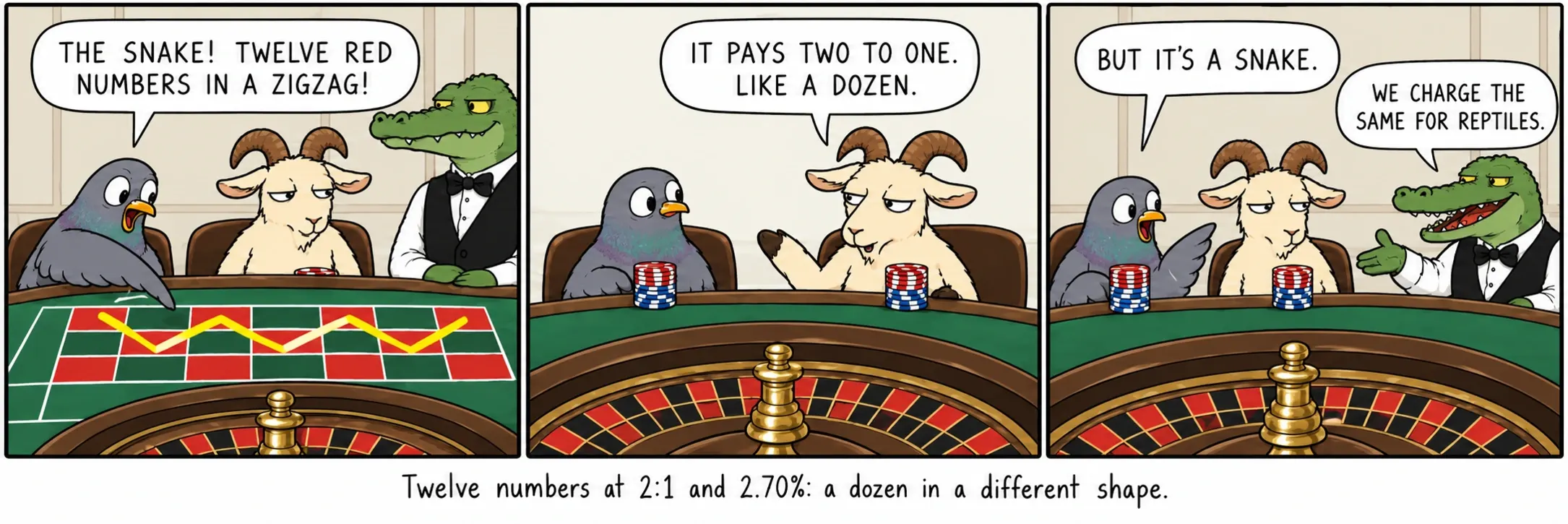
The snake covers twelve red numbers. At 2:1, its house edge is 2.70% on a fair single-zero wheel.
Sources
- Ethier, S. N. The Doctrine of Chances: Probabilistic Aspects of Gambling.
- Bollman, M. Mathematics of the Big Four Casino Table Games: Blackjack, Baccarat, Craps, & Roulette.