Gambler's Fallacy
The belief that a result is “due” because it has not appeared for a while.
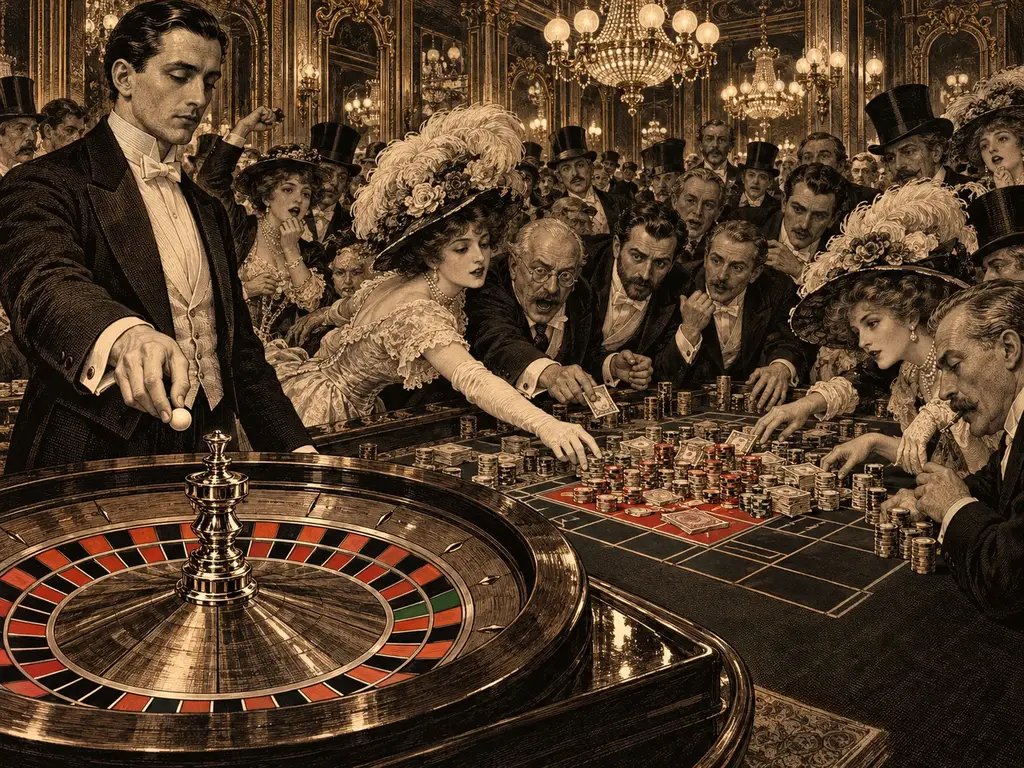
After ten reds the probability of black is still 18/37. The wheel keeps no record and owes nothing.
The fallacy
If redbetRedEven-money bet on the 18 red numbers. French: rouge.Read full → has come up ten times, many players feel that blackbetBlackEven-money bet on the 18 black numbers. French: noir.Read full → is “due” and bet accordingly. Others feel red is “hot” and bet that. Both are reasoning from a sequence that is already over to a spin that has not happened. The ballequipmentBallThe small ball launched along the track against the rotor. Modern balls are ivorine or Teflon, 18–21 mm.Read full → does not know what the last ten spins were; the pocketsequipmentPocketOne of the 37 numbered compartments on the rotor. Also: slot, cup.Read full → are the same size they were an hour ago; the probabilitymathProbabilityChance of an outcome, from 0 to 1 or 0% to 100%. One number: 1/37 = 2.70%.Read full → of black is 18/37 as it always was.
Why it feels true
In the long run the proportions of red and black do converge to 18/37 each. The law of large numbersmathLaw of large numbersThe average of independent results converges to the expected value as the number of trials grows.Read full → guarantees it. But convergence happens by dilution, not by correction: after 1,000 more spins the ten extra reds are a rounding error in the proportion, not because black caught up but because the sample grew. There is no mechanism that makes black more likely, and the law of large numbers does not require one.
Monte Carlo, 18 August 1913
Black came up 26 times in a row at a table in the Casino de Monte-Carlo. From about the fifteenth black, players piled onto red, doubling and redoubling, each spin “more certain” than the last. The casino won millions of francs. The run had probability 1 in 137 million from the first black, and the probability that it would eventually happen somewhere in the world’s casinos was essentially one. It is the reason the gambler’s fallacy is also called the Monte Carlo fallacy.
Unremarkable. Happens one time in 44.
Players begin to notice. Red is “due”.
The table is crowded. Stakes on red are doubled after each loss.
Fortunes lost. Each new black makes red feel more certain.
The run ends. The casino has won millions of francs from people betting against a run that could not “know” it was a run.
The hot hand
Backing a color because it is on a run is the same mistake turned around: the run is expected to go on instead of to end. Psychologists call it the hot handmythHot handThe belief that a run of wins, or of one result, makes another more likely. At the wheel it is the gambler’s fallacy turned around.Read full →, after a 1985 study by Gilovich, Vallone and Tversky that looked for streaks in basketball shooting and found none beyond chance. In 2018 Miller and Sanjurjo showed that the test itself had been tilted: in a short record, the share of hits right after a hit comes out below the shooter’s overall rate on average, so a player with no hot hand at all looks slightly cold. Corrected, the same data show a modest hot hand. A person can warm up; a wheel has no form to be in. Some players hold both beliefs at once, that a run goes on until it is “too long” and then ends. On a fair wheel every version has the same expected valuemathExpected valueThe average result per bet over the long run. −1/37 of the stake for every standard European bet.Read full → as choosing a color by tossing a coin: −2.70% of the stake.
At a real table
Croson and Sundali (2005) watched 18 hours of security video from one double-zerowheelZeroThe single green pocket that no even-money, dozen or column bet covers; the source of the house edge. Also: single zero, 0.Read full → table at a large casino in Reno: 139 players placing 24,131 bets. On the even-money betsbetEven-money betRed/black, odd/even, high/low. 18 numbers, pays 1:1.Read full →, players were about evenly divided between following short runs and opposing them. After five of a kind in a row they leaned against the run, and after six or more, 85% of their bets were on the other side. The same players showed the hot hand about themselves: after a win on the numbers they covered 13.6 numbers on the next spin on average, against 9.2 after a loss. Their wheel showed no sign of bias, so none of this changed what any of them could expect.
Outside the casino
The same pull shows up where real decisions are made. Clotfelter and Cook (1993) followed Maryland’s daily numbers game: the money staked on a number dropped sharply as soon as it was drawn and took months to recover, although the draw has no memory. Chen, Moskowitz and Shue (2016) found it among professionals. United States asylum judges were up to 3.3 percentage points more likely to refuse a case if they had granted the one before. Baseball umpires were 1.5 points less likely to call a strike after calling one, and more than twice that on close pitches. In a field experiment with loan officers paid a flat fee, up to 9% of decisions were reversed this way. The cases came in random order, so the last decision said nothing about the next, just as the last spin says nothing about the next one.
The inverse gambler’s fallacy
The philosopher Ian Hacking (1987) named a third version. Someone walks into a room, sees a pair of dice land double six and concludes that they must have been rolled many times already. Every roll is equally likely to be double six, the first of the evening or the thousandth, so the sight says nothing about how long the game has been going. At roulette it is the player who arrives at a board showing eight reds and decides the table must have been spinning for hours to produce them. The ordinary fallacy reads the past into the next spin; this one reads a rare sight into a past nobody saw.
A psychologist who believed it
The fallacy has had learned defenders. The German psychologist Karl Marbe went through four registers of 49,152 births each, found that the longest run of boys or of girls in a row was 17, and concluded that long runs are rarer than chance allows, so that a run makes the other outcome likelier. Chance alone says otherwise: in 196,608 births a run of 17 or more turns up about four times in five. Marbe had found exactly what a random sequence looks like. Epstein (2013) retells the case; Probability of Streaks gives the roulette version.
Where the fallacy does not apply
If the wheel were physically biased, past spins would be informative, because they would be evidence about the pockets rather than about luck. That is the Lab’s subject, and it requires thousands of spins from one identified wheel to say anything. For a run of ten reds on an unknown wheel, the bias explanation is far less likely than the chance one.
Questions
No. It applies to any independent repeated event: dice, coins, lottery numbers.
The proportions will get close. Your result will still be about −2.70% of what you wagered.
There is no law of averages. There is a law of large numbers, and it works by dilution.
Fun with Math
Try these yourself first. Each solution is folded; open it when you are ready.
After 10 tosses a coin shows 7 heads and 3 tails. After 1,000 tosses it shows 517 heads and 483 tails. Did the tails catch up?
Show the solution
Answer No. The gap grew from 4 to 34. Only the ratio came closer to even.
The ratio of heads to tails fell from 7/3, about 2.33, to 517/483, about 1.07. That is the law of large numbersmathLaw of large numbersThe average of independent results converges to the expected value as the number of trials grows.Read full → at work.
The gap between them grew, from 4 to 34. With a fair coin a gap of around 30 after 1,000 tosses is ordinary: the typical gap grows roughly with the square root of the number of tosses, while the ratio settles toward 1.
Nothing pulled the tails back. The early surplus of heads was diluted by the next 990 tosses, not corrected.
Toss a coin four times and look only at the tosses that come right after a head. What share of those are heads? Work it out for each of the 16 possible sequences and take the average of the shares. Is it 50%?
Show the solution
Answer No. It is 17/42, about 40.5%. Looked at this way, a fair coin seems to go cold after a head.
List the 16 sequences. Two of them, TTTT and TTTH, have no head among the first three tosses, so nothing follows a head; that leaves 14.
In each, take the tosses that follow a head and find the share that are heads. HHHH gives 3 out of 3. HHHT gives 2 out of 3. HTHT gives 0 out of 2. Going through all 14: six sequences give 0, four give 1/2, one gives 2/3 and three give 1 (HHHH, THHH and TTHH).
Add the shares: 4 × 1/2 + 2/3 + 3 = 17/3. Divide by 14: 17/42 ≈ 40.5%.
No toss favors tails; each is 50–50. The tilt comes from averaging sequence by sequence: a sequence full of heads has many tosses to look at but counts once, the same as a sequence with a single one. Miller and Sanjurjo (2018) showed that the 1985 hot-hand study had measured its basketball players this way, so players who seemed no streakier than chance had in fact been somewhat streakier.
Comic relief
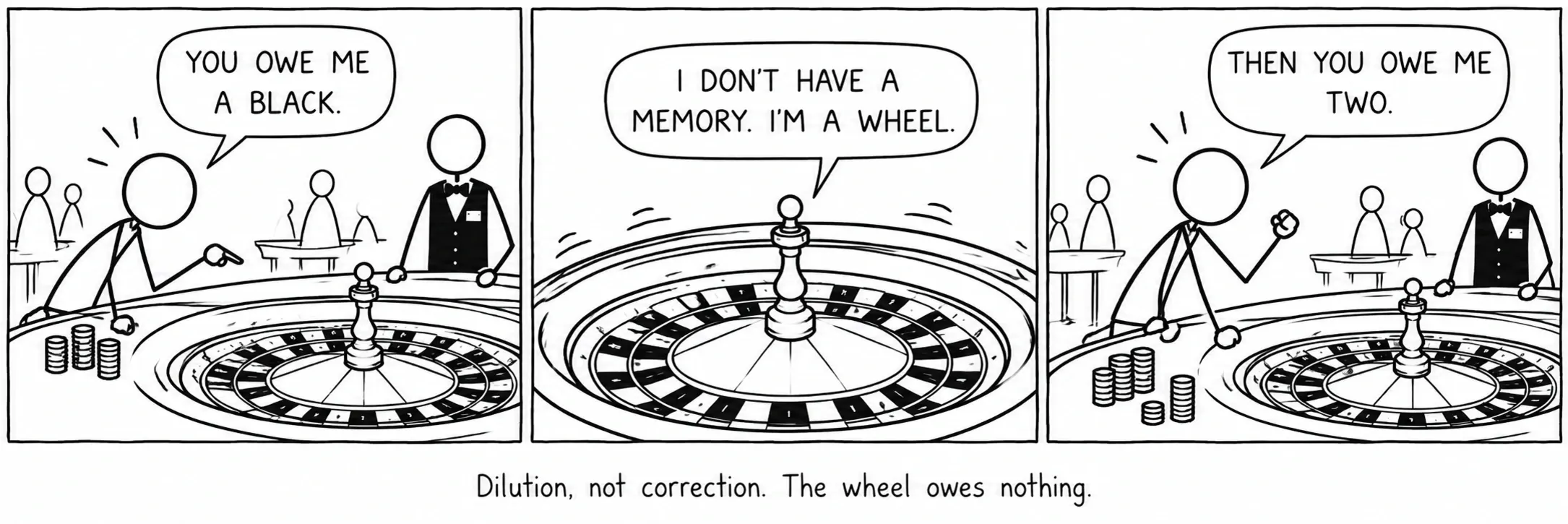
Dilution, not correction. The wheel owes nothing.
Sources
- Feller, W. An Introduction to Probability Theory and Its Applications, Vol. 1.
- Schwartz, D. G. Roll the Bones: The History of Gambling.
- Ethier, S. N. The Doctrine of Chances: Probabilistic Aspects of Gambling.
- Epstein, R. A. The Theory of Gambling and Statistical Logic, 2nd ed.
- Croson, R. & Sundali, J. “The gambler’s fallacy and the hot hand: empirical data from casinos.”
- Chen, D. L., Moskowitz, T. J. & Shue, K. “Decision making under the gambler’s fallacy: evidence from asylum judges, loan officers, and baseball umpires.”
- Clotfelter, C. T. & Cook, P. J. “The ‘gambler’s fallacy’ in lottery play.”
- Gilovich, T., Vallone, R. & Tversky, A. “The hot hand in basketball: on the misperception of random sequences.”
- Miller, J. B. & Sanjurjo, A. “Surprised by the hot hand fallacy? A truth in the law of small numbers.”
- Hacking, I. “The inverse gambler’s fallacy: the argument from design. The anthropic principle applied to Wheeler universes.”