Roulette Wheel Physics
A rotor, a ball on a tilted track, eight deflectors and a lot of friction.
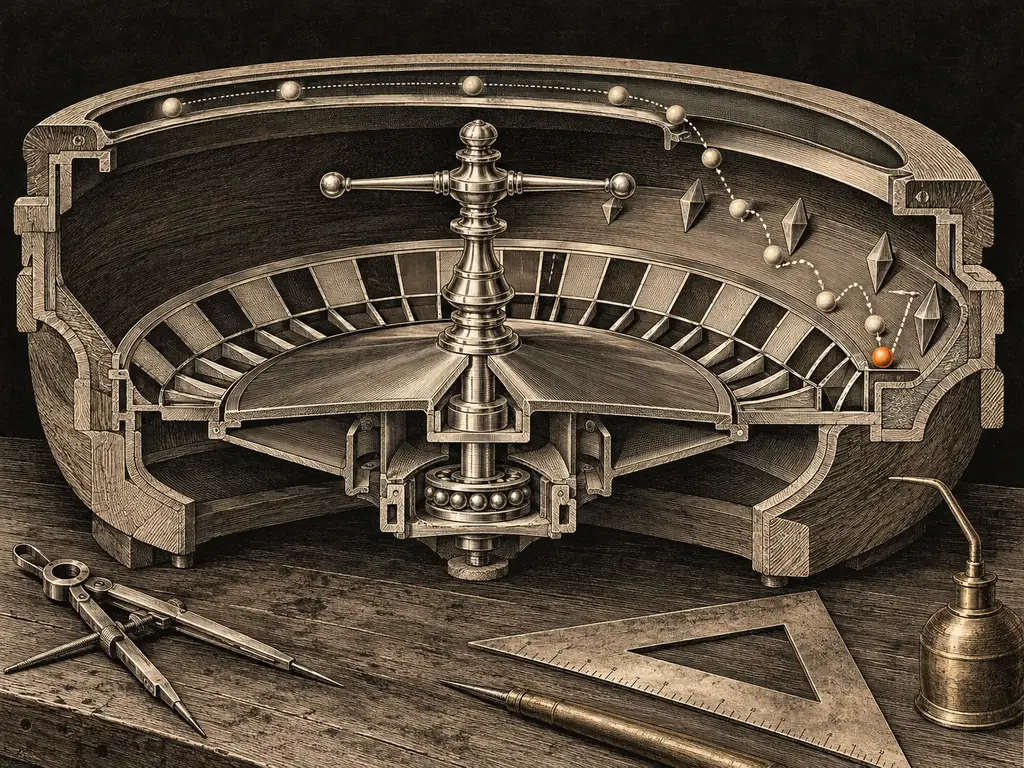
The ball loses energy to rolling friction and air drag, drops off the track when its speed can no longer hold it there, and is scattered by the deflectors and frets before settling.
Three phases
A spin has a deterministic phase, a transition, and a chaotic phase. On the track the ballequipmentBallThe small ball launched along the track against the rotor. Modern balls are ivorine or Teflon, 18–21 mm.Read full → decelerates smoothly under rolling friction and air drag; its position at any future moment can be predicted from a few timed laps. At the drop point it leaves the track at a speed set by the track geometry and rolls across the apronequipmentApronThe sloped area between the ball track and the pockets, where the deflectors sit.Read full →. From the first deflectorequipmentDeflectorOne of the metal obstacles on the apron that scatter the falling ball. Also: canoe, diamond, pin.Read full → strike onward the motion is sensitive to millimeters and milliseconds: this is where predictability ends and where the casino’s edge is defended by physics rather than by rules.
Ball released at 3–4 m/s against the rotor direction. 10–20 laps ahead.
Smooth deceleration. Lap times grow by a predictable amount each lap. Prediction possible.
Below a threshold speed the track’s tilt can no longer hold the ball. It leaves at ≈ 1–1.3 m/s.
Rolls inward across the sloped apron toward the rotor.
Usually strikes one of eight canoes. Direction and speed change sharply; small differences become large.
Bounces across pocket dividers, often several, sometimes jumping back out.
Comes to rest in a pocket. Scatter from the “predicted” pocket typically spans 10–15 pockets either way.
The track
The ball trackequipmentBall trackThe rim groove the ball runs along before it slows and falls. Also: upper track.Read full → is a shallow groove near the rim with a small inward tilt. A ball moving fast enough is pressed outward against the groove wall; as it slows, the component of gravity down the tilt wins and it rolls off. The speed at which that happens depends on the track’s angle and radius, not on how hard the ball was launched, which is why the drop speed is nearly constant while the launch speed varies. Launch speed decides how many laps you get, not where the drop happens.
The rotor
The rotorequipmentRotorThe spinning part of the wheel that carries the pockets.Read full → turns at roughly 0.3 to 0.5 revolutions per second, 11 to 18 pocketsequipmentPocketOne of the 37 numbered compartments on the rotor. Also: slot, cup.Read full → per second, and decays very slowly because its bearing is good and its mass is large; dealers top it up between rounds. Over a 15-second ball flight the rotor turns five to seven times, so the pocket beneath the drop point depends on rotor phase at the instant of the drop. A timing error of a tenth of a second is one or two pockets; half a second is a quarter of the wheel.
Deflectors and frets
The eight deflectors on the apron exist to randomize the ball’s path; wheels without them, in the 18th century, were beaten by players who simply watched the drop. Modern fretsequipmentFretThe metal divider between two pockets on the wheel.Read full → are low and sometimes curved so that the ball skips across several pockets before settling. Both are deliberate scatter: the manufacturer is building a device that destroys the information the track phase provides. Measured scatter distributions on modern wheels are wide and roughly symmetric, with a mode near the predicted pocket and tails that wrap the wheel.
Why it is hard to predict
The deterministic part can be timed, and has been: wearable computers from 1961 onward and phone cameras since the 2000s have estimated drop time and rotor phase well enough to name a drop sectorwheelSectorA contiguous arc of pockets on the wheel, as distinct from a group on the layout.Read full →. The chaotic part cannot be timed, only characterized statistically. The best a predictor can do is bet a sector around the expected landing point and accept a scatter distribution that, on a well-maintained wheel, barely tips the odds. Small and Tse (2012) report edges of a few percent under laboratory conditions with a full view of the wheel and bets accepted late. Studios allow neither.
Where to go next
The ball physics, deceleration, rotor speed and ball speed pages take each phase in turn with measurements. The advantage play page covers what people have done with them and what happened.
Questions
Not to a pocket; the scatter is too wide. Possibly to a sector, with great consistency, which is the dealer-signature hypothesis.
Convention since the 19th century. Fewer would scatter less; more would make the apron a pinball machine. Eight alternating orientations is the standard compromise.
Yes, to the track friction, which is why predictors recalibrate every few spins and why the same wheel behaves differently on different days.
Comic relief
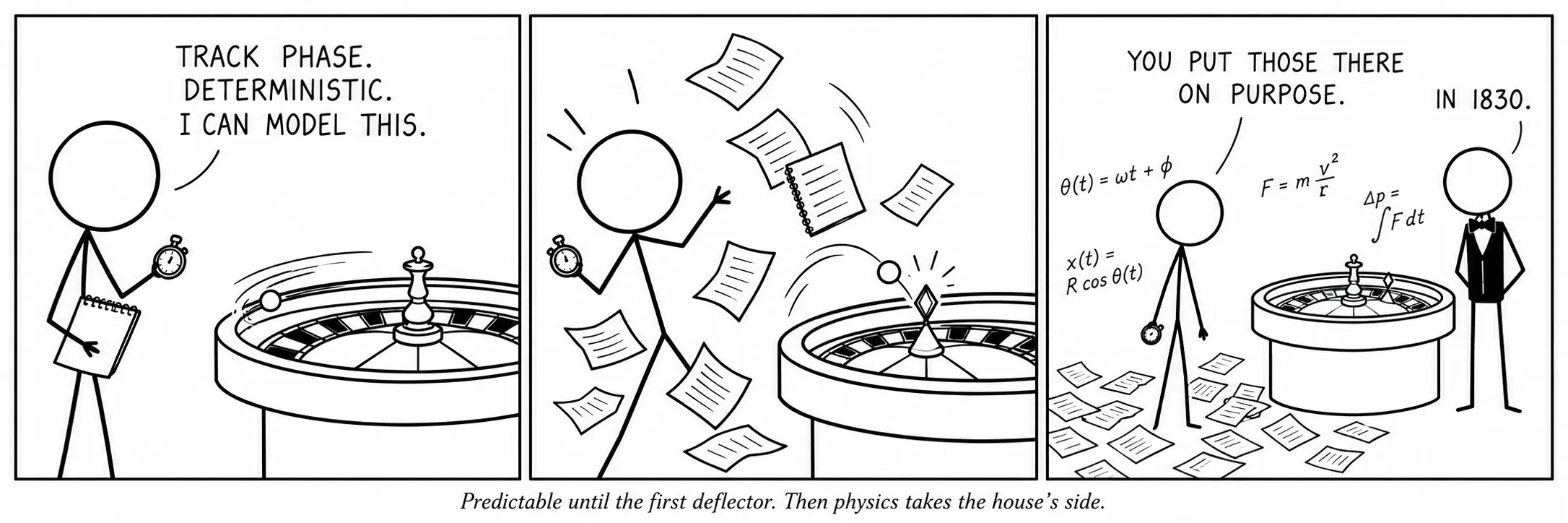
Predictable until the first deflector. Then physics takes the house’s side.
Sources
- Small, M. & Tse, C. K. “Predicting the outcome of roulette.”
- Bass, T. A. The Eudaemonic Pie.
- Barnhart, R. T. Beating the Wheel.