Walkthrough: Oscar’s Grind
One unit up after a win, same stake after a loss, stop the cycle one unit ahead. The slowest system there is, for a hundred spins.
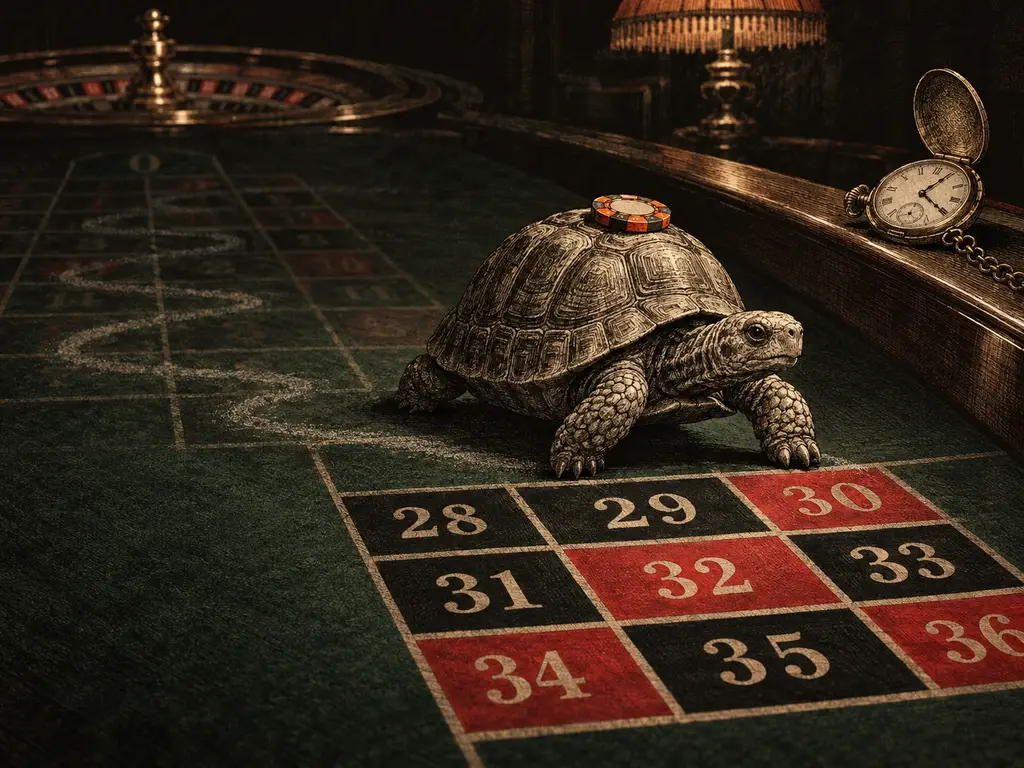
A simulated 100-spin Oscar’s Grind session at $10 a unit on blackbetBlackEven-money bet on the 18 black numbers. French: noir.Read full →. Eight cycles closed for +$10 each, one of them after 41 spins, a $50 stake and a $230 drawdown; the ninth was still open at −$140 when the session ended. Net −$60. Low variance, no cliff, same edge.
Walk the system
A loss keeps the stake. A win adds one unit, but never more than the cycle needs to reach +1. At +1 a new cycle starts.
Stakes and results are in units of the base bet.
The plan
Bet one unitmoneyUnitThe base stake a system or a player works in. Progressions are described in units so they apply at any table.Read full →. After a loss, bet the same again. After a win, raise by one unit, unless the raise would take the cycle past +1 unit, in which case bet only what is needed to finish at exactly +1. When the cycle is one unit ahead, start over at one unit. The stake rises only on wins, so a losing streak never inflates it; the grind comes from needing a run of wins to climb out of a hole dug at a small stake.
Spins 1–30
Four cycles closed. The longest ran eleven spins: L L L (−$30 at $10), W (−$20, stake to $20), L L (−$60), W (−$40, stake to $30), W (−$10; a raise to $40 would overshoot, so stake $20), L (−$30), W (−$10), W: cycle at +$10, closed. Net after 30 spins +$40. Stakes never above $30. It is the least exciting system on the site, which is a compliment.
Spins 31–71
The long cycle. Eight losses in the first ten spins dug −$50. Wins raised the stake to $20, $30, $40, $50; losses at those stakes dug further, to −$230 at spin 52. From there a favorable stretch, eleven wins in sixteen spins at stakes of $40–$50, climbed back, and the cycle closed at spin 71 for +$10. Forty-one spins, $230 at risk at the worst point, one unit earned.
- p10 −$1,000
- p25 −$1,000
- median −$1,000
- p75 +$710
- p90 +$880
Spins 72–100
Three more cycles closed, one abandoned at spin 100 standing at −$140 with a $30 stake. Final −$60: eight cycles at +$10 and one open cycle at −$140 (the open cycle is the usual way an Oscar session ends, because cycles are long).
The accounts
Average stake about $22, total wagered about $2,200 against $1,000 flat. Expected lossmathExpected lossExpected value times total amount wagered; the average amount lost over a session or a period.Read full → $59; actual −$60. A session that lands on its expectation, which Oscar’s Grind does more often than other systems because its variancemathVarianceA measure of how widely results spread around the expected value. High for straight up, low for even-money bets.Read full → is low: the stake only grows when we are winning, and never doubles.
What the session shows
Oscar’s Grind is a system designed by someone who had understood the others. It has no cliff, the stake stays modest, and it produces long sequences of small wins. The price is time: cycles can run for forty spins, and the one-unit profit at the end has been bought with a drawdownmoneyDrawdownThe fall from a bankroll peak to a later low within a session. Maximum drawdown is the largest such fall.Read full → twenty times its size. The expected loss per dollar wagered is 2.70%, and the grind adds dollars.
Questions
A craps player described by Allan Wilson in The Casino Gambler’s Guide (1965). The system is older than the name.
It means your result will be close to the expectation. The expectation is negative. Low variance is good if you want a predictable price for an evening and bad if you want a chance at a big win.
Your bankrollmoneyBankrollThe total amount set aside for play. Bankroll management is deciding how much of it to risk per bet and per session.Read full → or your patience. The system has no stop rule; the player must bring one.
Comic relief
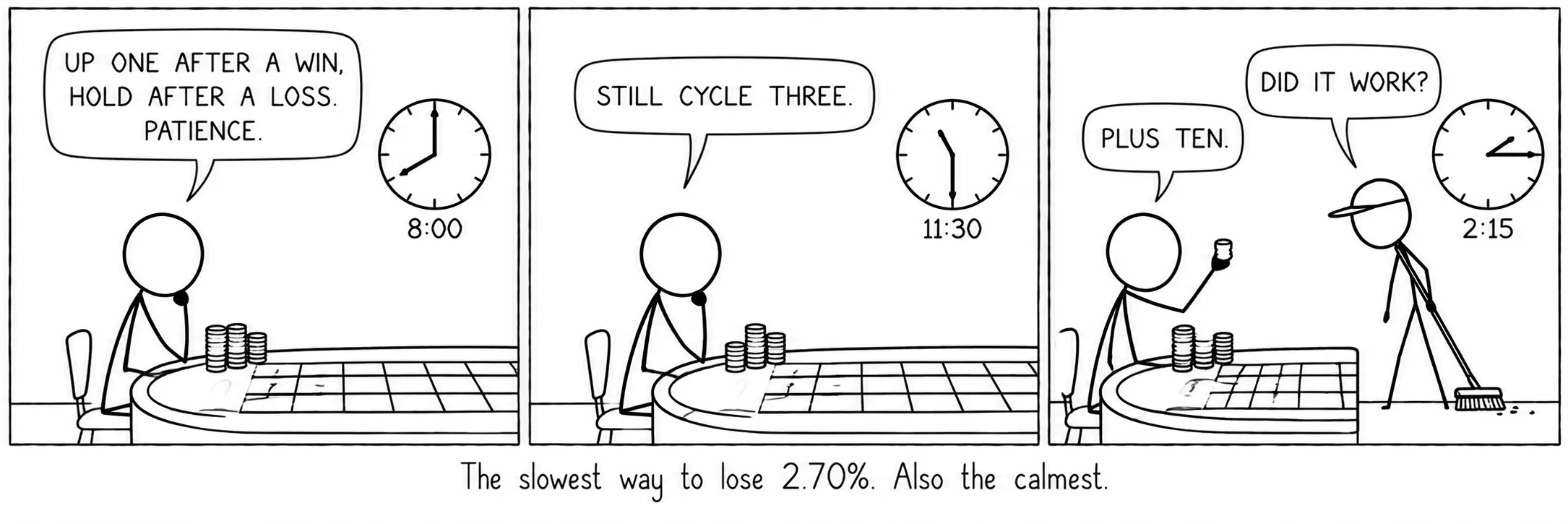
The slowest way to lose 2.70%. Also the calmest.
Sources
- Wilson, A. The Casino Gambler’s Guide.
- Ethier, S. N. The Doctrine of Chances: Probabilistic Aspects of Gambling.