Martingale Roulette Strategy
The Martingale roulette strategy doubles the bet after every loss and returns to the base bet after a win. A win recovers the losses in its current doubling cycle plus one base unit, provided every prescribed stake can be placed. The page below shows what that does to a bankroll, and why it cannot change the expected loss.

Try the limits with simulated money
Start with the fixed flat-betting versus Martingale comparison, then open its Martingale settings: a $1,000 bankroll, $10 base bet and $500 limit. Change one setting at a time, compare the mean result with the chance of finishing ahead, and save a scenario or download its data.
The strategy simulator resets to the base stake after a doubling would exceed the limit. Other demonstrations on this page use their own stated stopping rules; their results are not interchangeable. For the mathematical explanation, see expected value. For session boundaries, see bankroll management.
How does the Martingale roulette system work?
Lose, and double. Win, and go back to the base bet. With a $10 base bet, enough bankroll and a $500 table limit, six losses make the next prescribed stake too large. “Bankroll needed” includes all preceding losses and the next bet. The last column is the probability of reaching that step on an even-money bet, where each loss has probability 19/37.
| loss # | next bet | bankroll needed | p(reach) |
|---|---|---|---|
| 0 | $10 | $10 | 100.00% |
| 1 | $20 | $30 | 51.35% |
| 2 | $40 | $70 | 26.37% |
| 3 | $80 | $150 | 13.54% |
| 4 | $160 | $310 | 6.95% |
| 5 | $320 | $630 | 3.57% |
| 6 | $640 | $1,270 | 1.83% |
| 7 | $1,280 | $2,550 | 0.94% |
Base bet $10, table limit $500. After six losses the next bet is $640, above the limit: the progression breaks with $630 lost. The chance of six straight losses on red is (19/37)^6 = 1.83%, about 1 in 55 specified six-spin windows. Overlapping windows are not independent attempts.
Walk the system
A loss doubles the stake. A win goes back to the start.
Stakes and results are in units of the base bet.
What does a session look like?
A completed doubling cycle adds one base bet, but its balance can fall before the winning spin. With enough bankroll, six losses cost $630 in total and make the next prescribed stake exceed the $500 limit. That loss equals the profit from 63 completed cycles.
- p10 −$1,000
- p25 −$1,000
- median −$1,000
- p75 +$930
- p90 +$1,830
Simulator
Each setting runs 2,000 sessions of even-money bets from a $1,000 bankroll. Results update immediately.
In this simulation, 40.8% of sessions ended in profit. The average result was −$66.44. In 59.3% of sessions, a loss made the next doubled bet exceed the table limit, so the simulator reset the bet to the base amount. For comparison, betting a fixed $10 on every scheduled spin has an expected loss of about $27 on a standard single-zero wheel. This is a long-run average, not a prediction for one session.
Losing-streak probabilities
On a fair single-zero wheel without special zero rules, an even-money bet loses with probability 19/37 per spin. Each row is the chance that a given run of spins all lose, and what a Martingale player, who doubles after every loss, has lost by then.
| losses in a row | chance | about 1 in | lost so far | next bet |
|---|---|---|---|---|
| 1 | 51.4% | 2 | $1 | $2 |
| 2 | 26.4% | 4 | $3 | $4 |
| 3 | 13.5% | 7 | $7 | $8 |
| 4 | 7.0% | 14 | $15 | $16 |
| 5 | 3.6% | 28 | $31 | $32 |
| 6 | 1.8% | 55 | $63 | $64 |
| 7 | 0.94% | 106 | $127 | $128 |
| 8 | 0.48% | 207 | $255 | $256 |
| 9 | 0.25% | 403 | $511 | $512 |
| 10 | 0.13% | 784 | $1,023 | $1,024 |
| 11 | 0.065% | 1527 | $2,047 | $2,048 |
| 12 | 0.034% | 2974 | $4,095 | $4,096 |
| 13 | 0.017% | 5792 | $8,191 | $8,192 |
| 14 | 0.0089% | 11279 | $16,383 | $16,384 |
| 15 | 0.0046% | 21965 | $32,767 | $32,768 |
The chance is 19/37 multiplied by itself once per loss, counted from one given spin. A longer session offers more possible starting positions, so its chance of containing a run can be higher. Overlapping windows are not independent. The stakes assume enough bankroll and no table limit.
Fifteen losses have a probability of about 1 in 22,000 from one specified starting spin. A longer session offers more possible starting positions, whose windows overlap. Here the stake limit matters sooner: from a $10 base, six losses put the next doubled stake above $500. A smaller bankroll can stop the sequence earlier.
Why can it not change the odds?
On a fair single-zero wheel, each standard even-money stake has a conditional expected return of −1/37. Over a finite number of spins, expected net result is therefore −1/37 times expected total stake. Stakes may depend on past results, but not on the next outcome. Record a zero stake after stopping; this is an expectation across possible sessions, not a prediction for one realized session.
Finite horizon; bᵢ is chosen before spin i, and is zero after stopping. Independent spins; Xᵢ = +1 on a win, −1 on a loss.
Common misconceptions
Comic relief

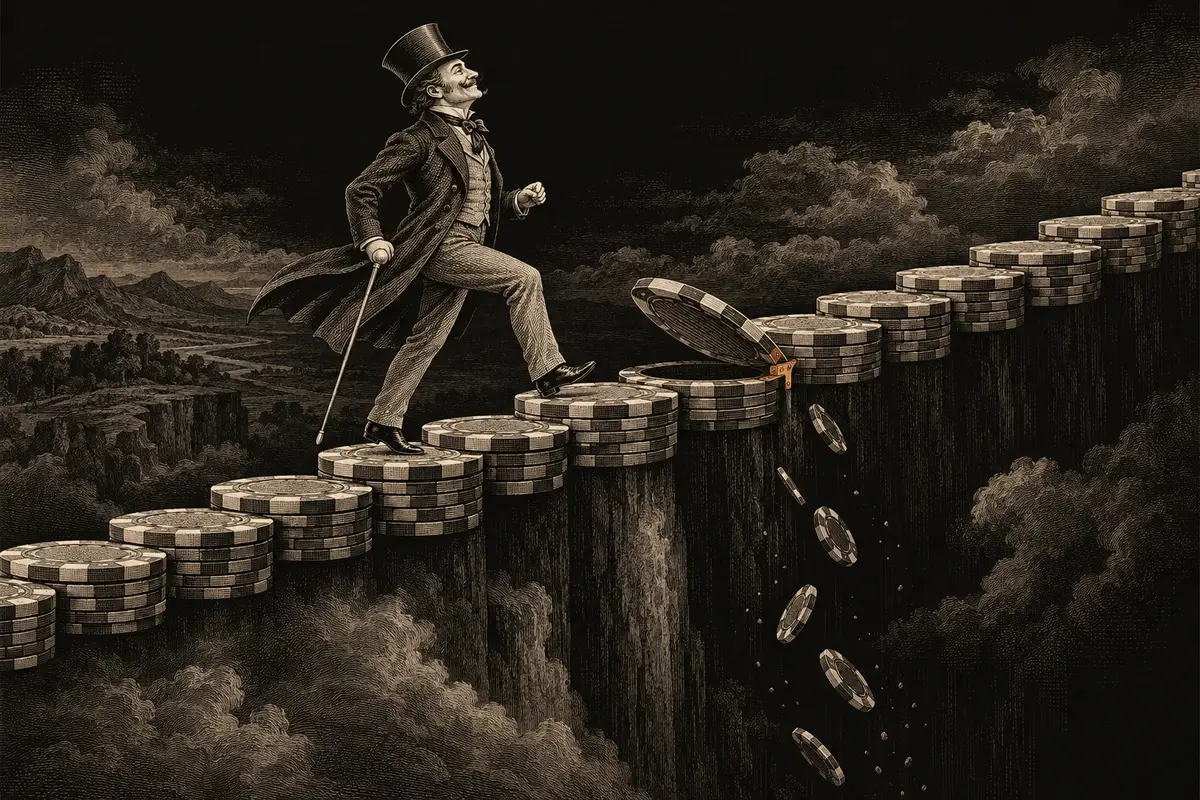
A completed cycle gains one base unit. A losing run can cost many units.