Expected Loss
Expected value times the total you wager: what the session costs on average.

Expected loss = total wagered × 1/37. Stake $10, 100 spins: $1,000 wagered, $27 expected loss. Progressions wager more, so they lose more.
Turnover, not bankroll
Expected lossmathExpected lossExpected value times total amount wagered; the average amount lost over a session or a period.Read full → depends on how much passes across the table, not on how much you brought. A $100 bankrollmoneyBankrollThe total amount set aside for play. Bankroll management is deciding how much of it to risk per bet and per session.Read full → re-bet many times can carry $2,000 of turnovermoneyTurnoverThe total amount wagered over a session or period, counting re-bet winnings. Also: handle, action.Read full → and $54 of expected loss; a $10,000 bankroll bet once on redbetRedEven-money bet on the 18 red numbers. French: rouge.Read full → carries $10,000 of turnover and $270. The casino’s income is a toll on traffic, and the traffic is every chipmoneyChipA token representing a fixed amount, placed on the layout to make a bet. Also: check.Read full → on every spin.
The formula
E[loss] = Σ stakes / 37. For a flat bettor that is stake × spins / 37. For a progressionstrategyProgressionAny rule that changes the stake based on previous results. Negative progressions raise it after losses, positive after wins.Read full → it is the average stake × spins / 37, and the average stake is higher than the base, because stakes rise during losing stretches. MartingalestrategyMartingaleProgression that doubles the bet after each loss. See the Strategy section for what it does and does not do.Read full → from a $10 base at a $500 limit averages about $28 a spin over a long session, so it loses nearly three times as much as flat $10 betting, without changing the odds of any individual bet.
Pace
Live tables run 40–60 spins an hour, casino floors 30–50, speed tables 90 or more, RNG tables as fast as you click. At the same stake, pace is the biggest single lever on expected loss per hour: moving from a slow floor table to an RNG table played at 200 spins an hour quadruples the cost of the evening with no change in the odds.
Over a year
A regular who plays two hours a week at $10 on a 50-spin live table turns over $52,000 a year and pays about $1,400 in expected loss on a European wheel, $700 on a French one, $2,700 on an American one. The arithmetic is dull and the conclusion is not: the choice of wheel and table is worth more than any system by a factor of infinity, since systems are worth exactly zerowheelZeroThe single green pocket that no even-money, dozen or column bet covers; the source of the house edge. Also: single zero, 0.Read full →.
A game worth more than any bank
The St. Petersburg game, posed by Nicolaus Bernoulli in 1713, tosses a coin until it lands heads and pays $2 if that takes one toss, $4 if two, $8 if three, doubling each time. Every possible length adds $1 to the expected valuemathExpected valueThe average result per bet over the long run. −1/37 of the stake for every standard European bet.Read full →, so on paper the game is worth an infinite amount. No bank can pay infinite prizes, and once the prizes are capped at what the bank holds, the value collapses: with a bank of $1 million the game is worth about $21, with $1 billion about $31. The Martingale is the same game seen from the other side. It wins one unitmoneyUnitThe base stake a system or a player works in. Progressions are described in units so they apply at any table.Read full → nearly every cycle and loses everything on a rare long run; without a limit the long runs would be paid off by ever larger wins, and with one they are not, which is why the table limittableTable limitMinimum and maximum bet allowed. The maximum is what stops doubling progressions.Read full → decides how a Martingale fails but not whether it does.
Expected loss is not the result
Any single session will differ from its expected loss, often by more than the expected loss itself. Over 100 even-money spins at $10 the standard deviationmathStandard deviationSquare root of variance; the typical distance of a result from the expected value.Read full → is $100 against an expected −$27; a winning session is unremarkable. The expected loss is the price; the variancemathVarianceA measure of how widely results spread around the expected value. High for straight up, low for even-money bets.Read full → is the packaging; the result on a given night is a sample of one.
Formula
Questions
No. 2.70% of everything you wager. Re-betting winnings wagers them again.
Per hour, yes, at the same pace. Per target reached, no: see risk of ruinmathRisk of ruinProbability of losing the whole bankroll before reaching a target or spin count.Read full →.
Casinos estimate your expected loss from average bet and time played and return a fraction of it as comps. They are rebating part of the price, not giving you an edge.
Comic relief
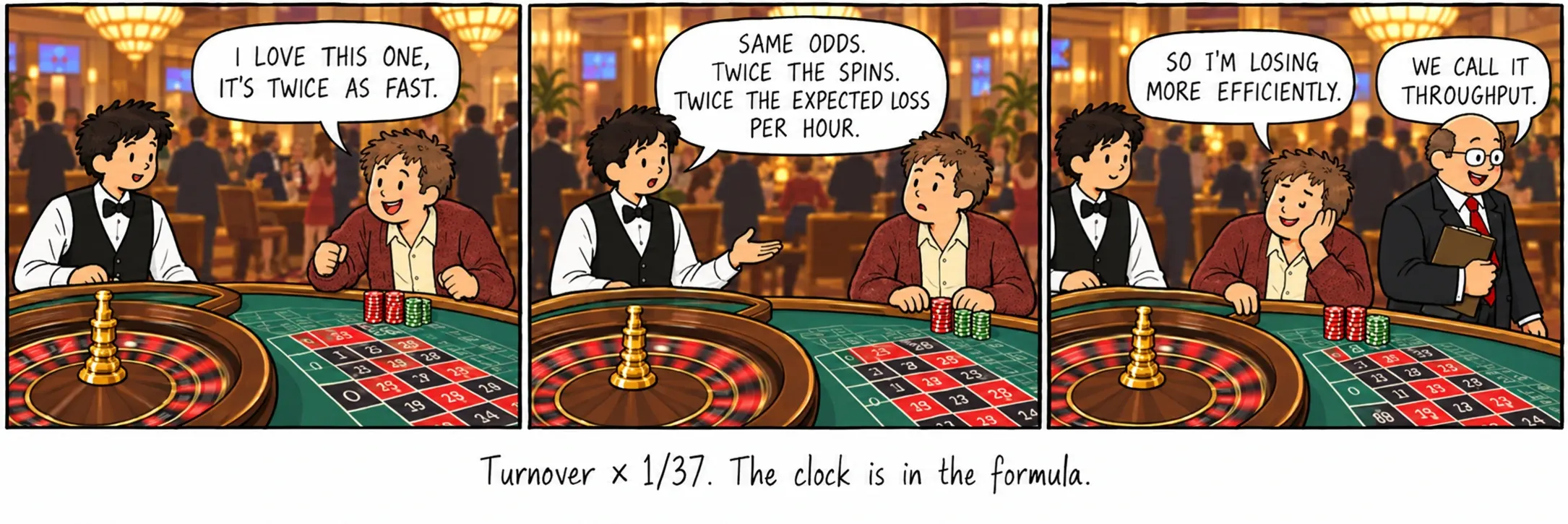
Turnover × 1/37. The clock is in the formula.
Sources
- Ethier, S. N. The Doctrine of Chances: Probabilistic Aspects of Gambling.
- Epstein, R. A. The Theory of Gambling and Statistical Logic, 2nd ed.
- Taylor, D. G. Games, Gambling, and Probability: An Introduction to Mathematics, 2nd ed.