Blaise Pascal: The Roulette Wheel Legend
Pascal’s connection to probability is documented. The claim that he invented roulette needs different evidence.
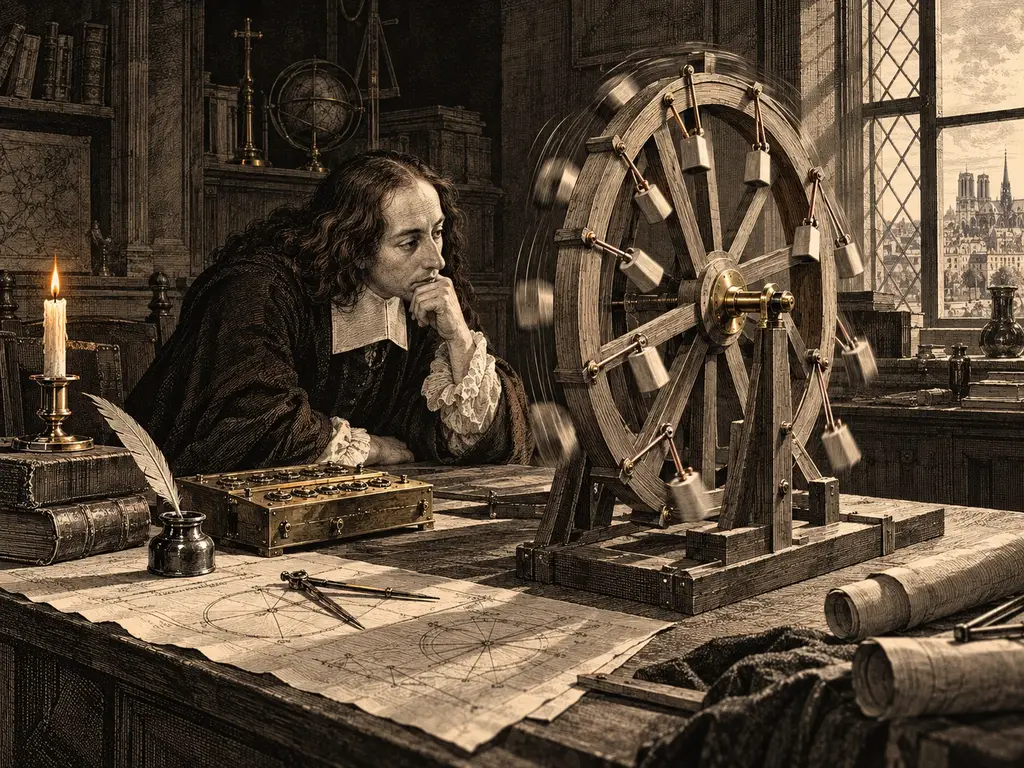
Blaise Pascal (1623–1662) helped develop probability through his 1654 correspondence with Pierre de Fermat. Those letters show how to value an unfinished game; they do not establish the familiar story that a perpetual-motion experiment became the roulette wheel.
The mathematician
Pascal worked on geometry, mechanical calculation and pressure as well as probabilitymathProbabilityA measure of how likely an event is, from zero to one. Percentages express the same scale from 0% to 100%.Read full definition →. His exchange with Fermat in 1654 is an important milestone in the study of games of chance. Earlier writers had also considered gambling problems, so calling him the sole inventor of probability would go too far.
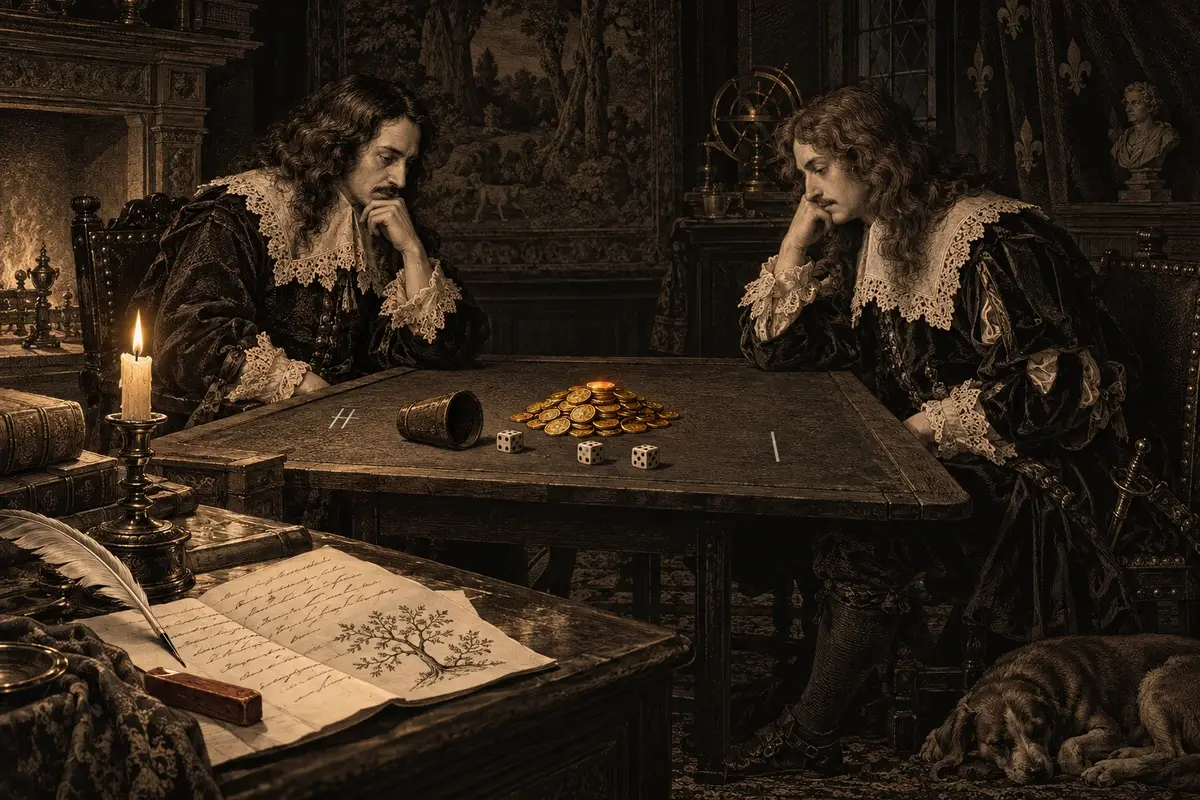
Was there a Blaise Pascal roulette machine?
The often-repeated story connects a spinning-wheel experiment with the later casino game. The sources linked here establish Pascal’s mathematical work, but do not document that chain of invention. A plausible mechanical resemblance is not evidence that one device directly became another.
| claim | what supports it here |
|---|---|
| Pascal and Fermat discussed the division of stakes | Their surviving 1654 correspondence. |
| Pascal built the ancestor of the roulette rotor | Not established by the sources cited here. |
| Pascal invented roulette’s betting layout | Not established by the sources cited here. |
| Expected value helps analyze roulette | A mathematical application, independent of who invented the wheel. |
Probability, in his words and ours
In the letter of July 29, 1654, Pascal considers two players who each stake 32 pistoles and need three points to win. At a score of 2–1, with equally likely point winners, the leader should receive 48 of the 64 pistoles if play stops. In modern notation, the leader’s chance of winning is 1/2 + (1/2 × 1/2) = 3/4. The fair division is therefore 48–16, not a division proportional to the current score.
| possible continuation | leader’s share of the pot |
|---|---|
| leader wins next point | 64 pistoles |
| other player wins next point; score becomes 2–2 | 32 pistoles as the fair value at the tied position |
| average of the two equally likely cases | 48 pistoles |
The wager
Pascal’s wager in the Pensées concerns belief in God. It is a philosophical argument involving uncertainty and possible consequences, not a roulette strategy or evidence about the origin of the wheel.
The useful connection
You do not need the invention story to use the mathematics. For a standard straight-up bet on an independent, uniform single-zerowheelZeroThe 0 outcome, conventionally shown in green. Ordinary color, parity, high/low, dozen and column bets do not include it.Read full definition → wheel, a one-unitmoneyUnitA base amount used to express stakes or results.Read full definition → wager has expected net return (35 × 1/37) − (36 × 1/37) = −1/37. That average says nothing certain about the next spin; it explains the disadvantage built into the payoutmoneyPayoutThe amount paid on a winning wager. Check whether the quoted figure is net profit or total return including the stake.Read full definition →.
Questions
No. A contribution to probability and the invention of a particular game are separate historical claims.
As an attribution that is not established by the sources cited here, rather than as a documented invention.
Comic relief
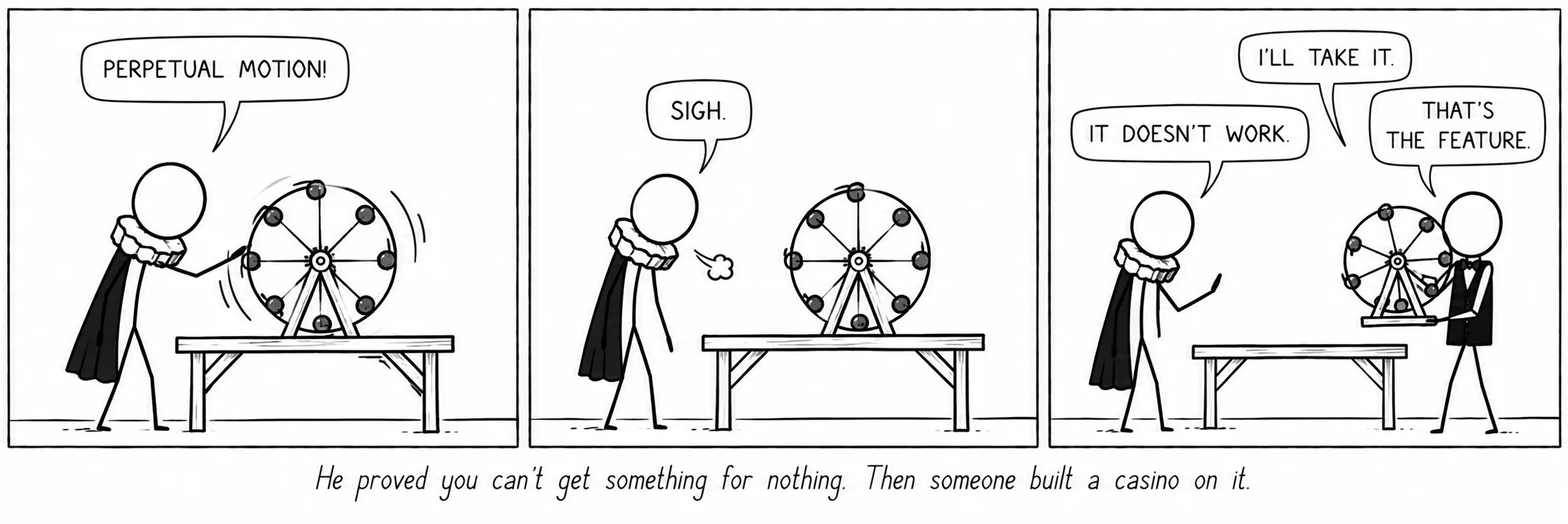
A famous name is not proof of an invention.
Sources
- Pascal–Fermat correspondence, including July 29, 1654
- MacTutor, Blaise Pascal — biography and bibliography