Tier et Tout Roulette Strategy
Tier et Tout divides a bankroll into one-third then two-thirds stakes. It is not a way to replenish a bankroll after both bets lose.
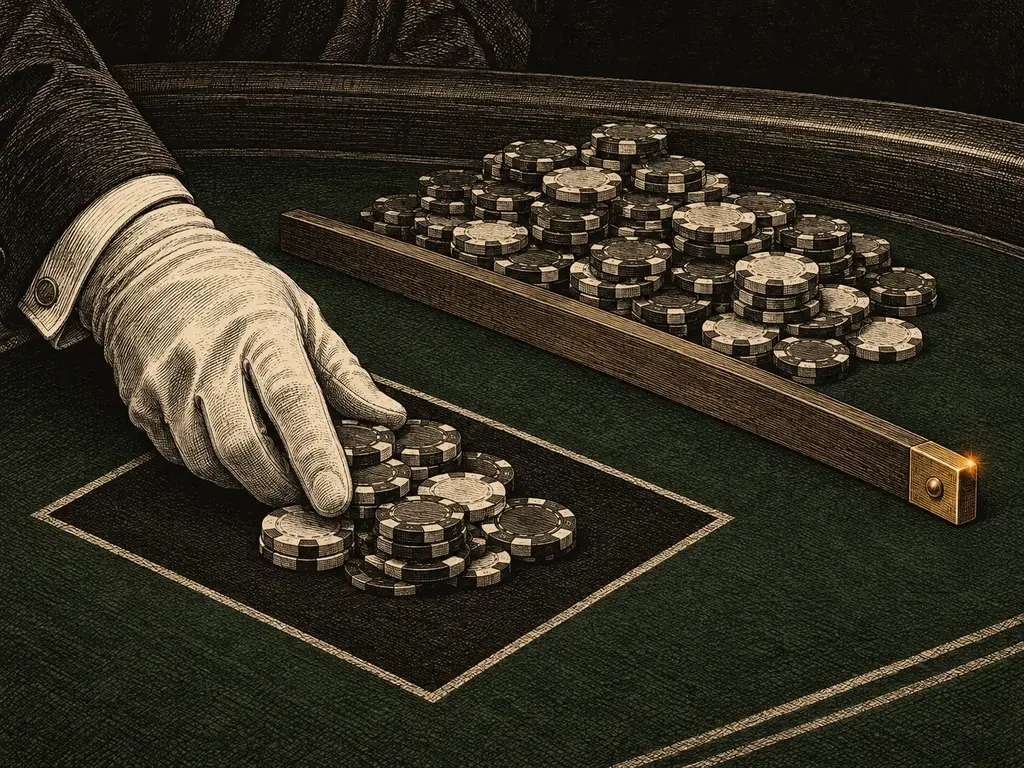
With a $90 bankroll, the rule bets $30 then $60 after a loss. One success nets $30; two losses deplete the full $90.
Rule as described
Tier et Tout is an even-money two-stage pattern. Divide the bankrollmoneyBankrollThe amount set aside for play. Bankroll management concerns stakes and limits within that amount.Read full definition → into one-third and two-thirds; bet the first third, then if it loses bet the remaining two-thirds. After both bets lose, restarting requires a new bankroll allocation, so the pattern is not self-contained recovery.
Two-stage table
A $90 example makes the cash flow plain.
| path | bets placed | net from $90 start |
|---|---|---|
| win first bet | $30 | +$30 |
| lose first, win second | $30 then $60 | +$30 |
| lose both | $30 then $60 | −$90 |
Worked example
Bet $30 on blackbetBlackAn even-money bet on the 18 black numbers. French: noir.Read full definition →. A win leaves the session at $120, a $30 gain. If the first bet loses, bet the remaining $60 on black on the next spin. Winning that second spin returns $120 including stake, restoring the original $90 plus $30. Losing it leaves $0. After a success, the next cycle uses the new $120 bankroll: $40 first, then the remaining $80 if that bet loses. After two losses, “restarting” means allocating new money, not recovering from the same bankroll.
Cost and risk
On a standard European wheel, a specified two-loss fresh cycle has probabilitymathProbabilityA measure of how likely an event is, from zero to one. Percentages express the same scale from 0% to 100%.Read full definition → (19/37)^2 = 26.37%. The pattern creates a common +$30 outcome and a rarer full-cycle −$90 outcome, but it has no opportunity to magically replenish after depletion. For this two-stage cycle, expected lossmathExpected lossThe probability-weighted average net loss under a stated model. With a constant edge, it equals edge times expected total stakes.Read full definition → equals 1/37 of expected total stakes. Repeated fresh cycles require separately budgeted money. A stop target alters when play ends, not the value of the bets.
Questions
No. The original $90 has been entirely staked and lost. A restart requires a new bankroll allocation.
If it wins, the two-spin sequence nets +$30; that possibility is offset by the −$90 two-loss path and the casino edge.
Comic relief
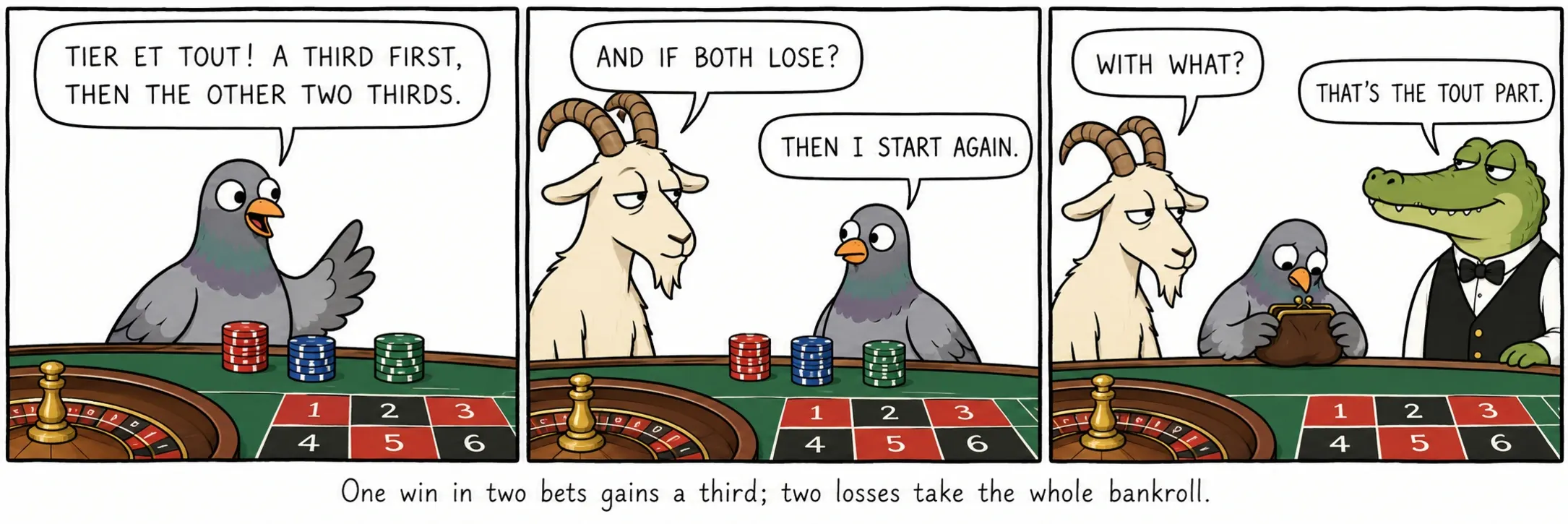
Bet one-third on an even-money outcome; after a loss, bet the remaining two-thirds. Stop the cycle at the first win.
Sources
- RouletteDoc, “Tier et Tout system” — stated two-stage rule
- Roulette77. Strategy description and examples.
- Roulettesystemen, “Tier et Tout roulette systeem” — two-stage staking description
- Wizard of Odds, Roulette Basics — standard even-money roulette rules
- Wizard of Odds, The Truth about Betting Systems