Card Roulette
Roulette dealt from a deck, for places where the law forbids the ball. The cards keep the odds; the extras around them do not.
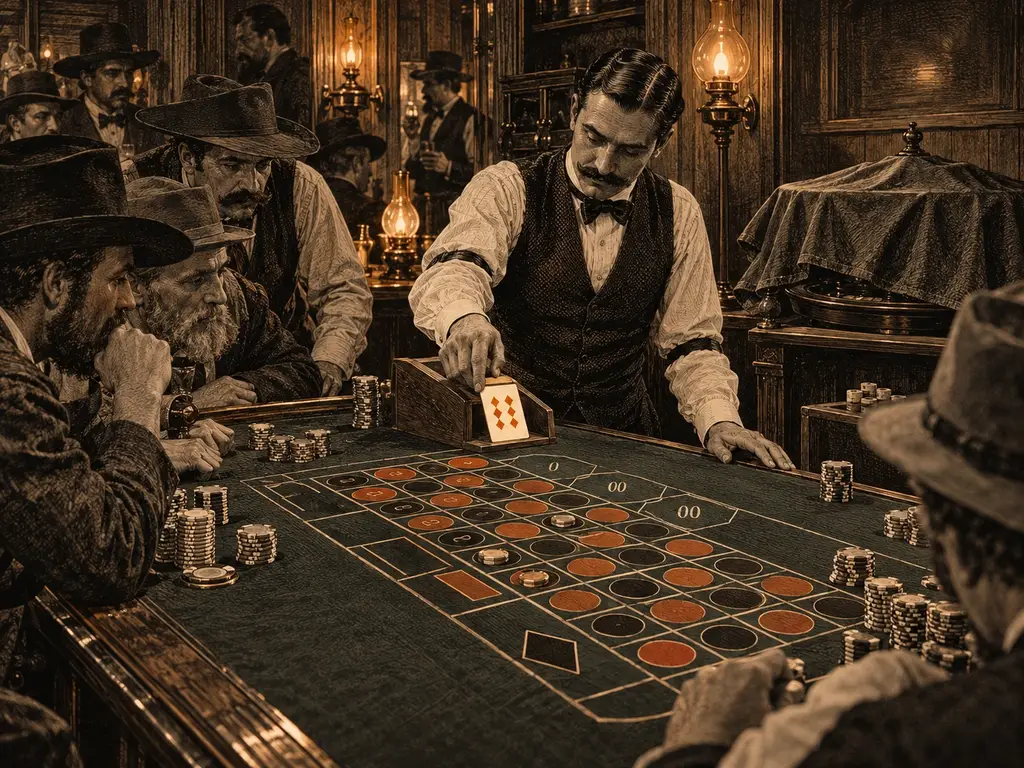
California does not allow dice or a ball to settle a bet, so its casinos deal roulette from cards. A 38-card deck that stands in for the 38 pockets copies the American wheel and its 5.26% exactly. The house gains on what the cards add: suit symbols, colored pockets and poker hands, priced from 6% to 36%.
Why roulette is dealt from cards
California law forbids dice or a ballequipmentBallThe small ball launched along the track against the rotor. Modern balls are ivorine or Teflon, 18–21 mm.Read full → as the device that decides a bet, and the state’s tribal casinos are bound by it too. A shuffled deck is neither, so designers rebuild roulette around cards and keep the odds. Oklahoma’s 2004 tribal compact allowed card games but not roulette or craps, and the same card versions spread there until a 2018 law allowed the ball and dice back. The page on roulette in California covers the $1 antemoneyAnteA fixed amount paid to take part in a round, before anything is decided. It is gone whatever happens.Read full → that came with that change.
A deck in place of the wheel
The plainest versions put 38 cards where the 38 pocketsequipmentPocketOne of the 37 numbered compartments on the rotor. Also: slot, cup.Read full → were: 36 numbers and two that play the zeroswheelZeroThe single green pocket that no even-money, dozen or column bet covers; the source of the house edge. Also: single zero, 0.Read full →. If every card is equally likely and the payoutsmoneyPayoutWhat a winning bet returns, quoted as “X to 1” on top of the returned stake.Read full → are the wheel’s, the price is the wheel’s too.
Richer Roulette: a 30% bonus
Valley View Casino in Valley Center, California, replaced the ball with a pointer and three rings that turn independently and lock together as they slow. The middle ring holds 38 face-down tiles, one per number, each also printed with a playing card to satisfy the law; the card plays no part in the game. The inner ring carries six suit symbols, two hearts and four spades. The main bets are American roulettevariantAmerican rouletteWheel with 0 and 00, 38 pockets, house edge 5.26%. Not the default model on this site.Read full →. The Richer Bonus bet wins only if your number comes up and a suit symbol lines up with it: 100 to 1 for a spade, 300 to 1 for a heart. That happens 3 times in 722, and the bet loses 30.33% of every stake, nearly six times the main game.
Pala Roulette: the Super Green bet
Pala Casino in California keeps a ball but takes the numbers off the wheel. Its pockets are colored instead: 12 redbetRedEven-money bet on the 18 red numbers. French: rouge.Read full →, 12 white, 12 blue and 2 green. Four cards from a 38-card deck, numbered and colored like an American wheel, are dealt face down, one for each pocket color, and the color where the ball stops says which card to turn over. The main bets keep American odds. The Super Green bet needs the ball in a green pocket and that card to be 0 or 00, a chance of (2/38)² = 1 in 361. It pays 275 to 1 and costs 23.55%. To cost the same 5.26% as the main game, it would have to pay 341 to 1.
San Diego County: eight casinos, four ways round the ban
In 2008 the Wizard of Odds visited all eleven casinos around San Diego; eight dealt roulette, and each had found its own way round the law. Barona dealt the only single-zero game in the area. Three cards from a 37-card deck went face down on the regions 1–12, 13–24 and 25–36, and the card in the region where the ball stopped settled every bet: 2.70%, half what the other casinos charged. Pala used its colored wheel, described above. Pauma and Sycuan simply dealt one card from a 38-card deck. Harrah’s Rincon, Pechanga, Valley View and Viejas set 38 cards round an upright wheel like a big six and turned up the one the pointer stopped at; Harrah’s had earlier drawn from a hopper of 76 bingo balls, two of each number.
Triple Flop: poker on the side
Triple Flop Roulette, introduced at the Orchid Casino in Aruba in 2018, deals from 38 cards: six to ace in each suit, plus two jokers that play the part of 0 and 00 (a 37-card version has one joker). The first card settles the roulette bets, which keep the usual payouts and the 5.26% edge. Two more cards complete a three-card poker hand for a set of side betsbetSide betAn optional extra wager attached to the main game, usually on a streak, a bonus event or a jackpot. Almost always dearer than the standard bets.Read full →, with the jokers wild. Every poker bet costs more than the roulette.
Fixing a 36% bet
The Royal Jackpot shows how much one line of a pay tablemoneyPay tableThe list of what each bet or result pays. On machines and side bets, it is where the house edge is set.Read full → can carry. Of the 8,436 hands, 40 are royals, and 36 of those use a joker, so the jokered payout sets the price far more than the 1,000-to-1 headline does. Bollman works through the alternatives.
Ca$h Card: a deck of 55
Ca$h Card, devised by Nicholas Kallabat at 18 and launched in 2019 for California card rooms, uses a full deck, two jokers and a Ca$h Card: 55 cards on a 13-by-4 layoutequipmentLayoutThe printed betting grid on the table. Also: table, felt, cloth.Read full →, a row for each rank and a columnbetColumnTwelve numbers in one vertical column of the layout, pays 2:1.Read full → for each suit, with the jokers and the Ca$h Card on top where the zeros would be. Three cards are dealt each round. The second settles the main bets, and all three make a hand for a $5 poker bonus. Bets on more than one card pay (52 − n)/n to 1, so the three extra cards give them an edge of 3/55, 5.45%, between the European and the American wheel. A single card pays 50 to 1 rather than the rule’s 51, which raises it to 7.27%. It was pitched to other states as better for players and for the house, and both are true: 50 to 1 beats 35 to 1, and 5.45% beats 5.26%.
Joker Seven: one point apart
Joker Seven, played on English cruise ships around the 1960s, sold roulette’s variety without a wheel. Each hand is seven cards from a freshly shuffled 54-card deck that includes two jokers, and players bet on colors, pairs and three of a kind. No Pair and Two Pair both paid 3 to 1. No Pair comes up 23.81% of the time and Two Pair 22.65%, counting four of a kind as two pairs and two jokers as a pair. One percentage point of probabilitymathProbabilityChance of an outcome, from 0 to 1 or 0% to 100%. One number: 1/37 = 2.70%.Read full → nearly doubles the price: 4.75% against 9.40%. Two Pair comes in eight shapes, and one of them, two pairs and three odd cards, makes up nearly nine tenths of it.
Side by side
The main bets of every card game here cost what the wheel they copy costs, or a little more. The extras are where the price is.
What carries over
A deck is a wheel with a different way of choosing the pocket. What matters is the same in both.
- Equally likely cards and the wheel’s payouts give the wheel’s edge, to the decimal.
- The house earns on what the cards add: suit symbols, colored pockets, poker hands.
- A payout one unitmoneyUnitThe base stake a system or a player works in. Progressions are described in units so they apply at any table.Read full → short of the rule, like Ca$h Card’s 50 to 1, works like the American five-number bet.
- A long-shot bet is priced by its most common winning line: the jokered royal, not the natural one.
Questions
The main bets cost what the wheel they copy costs, or slightly more on Ca$h Card; a 37-card deck, as at Barona in 2008, costs the European 2.70%. The extra bets cost more.
California law does not allow a ball or dice to decide a bet. Oklahoma lifted its version of the rule in 2018.
Of those priced here, Joker Seven’s No Pair at 4.75%, then the main bets at 5.26%.
Fun with Math
Try these yourself first. Each solution is folded; open it when you are ready.
Ca$h Card deals from 55 cards: 52, two jokers and a Ca$h Card. Bets on 2 cards pay 25 to 1, on 4 cards 12 to 1, on 13 cards 3 to 1 and on 26 cards 1 to 1, but a single card pays 50 to 1. Find the rule behind the group bets and what each kind of bet costs.
Show the solution
Answer Group bets pay (52 − n)/n to 1 and cost 3/55 = 5.45%. The single card, at 50 to 1, costs 7.27%.
Check: 50/2 = 25, 48/4 = 12, 39/13 = 3, 26/26 = 1. The rule treats the deck as 52 cards, so the jokers and the Ca$h Card are three house cards out of 55: 3/55 = 5.45%.
The rule would pay a single card 51 to 1. At 50 to 1 it returns 51 unitsmoneyUnitThe base stake a system or a player works in. Progressions are described in units so they apply at any table.Read full →, stake included, once in 55 tries: 51/55 − 1 = −4/55, 7.27%.
An earlier version had three jokers and the Ca$h Card, 56 cards in all. Its group bets cost 4/56 = 7.14%, and a bet on the three jokers would need 49/3 = 16⅓ to 1 to match them. At 16 to 1 it would cost 8.93%, at 17 to 1 only 3.57%.
Triple Flop deals roulette from 38 cards, six to ace in four suits plus two jokers, at the usual roulette odds, but its layoutequipmentLayoutThe printed betting grid on the table. Also: table, felt, cloth.Read full → has no bet on a suit. How would you bet a suit with chipsmoneyChipA token representing a fixed amount, placed on the layout to make a bet. Also: check.Read full → the layout does take, and what does it cost? What would a suit bet have to pay?
Show the solution
Answer Three $1 streetbetStreetThree numbers in a row of the layout, pays 11:1. French: transversale.Read full → bets, 6-7-8, 9-10-J and Q-K-A of the suit, win $9 or lose $3. That costs 5.26%, and a suit bet would pay 3 to 1.
A suit has nine cards, and three streets of three cover them. Whichever of the nine comes first, one street wins 11 to 1 and the other two lose: +11 − 2 = +$9. On the other 29 cards all three lose: −$3.
On average, per deal: (9 × 9 − 29 × 3)/38 = −6/38 of a dollar on $3 staked. That is 2/38 of each dollar, 5.26%, the same as every other bet on a double-zerowheelZeroThe single green pocket that no even-money, dozen or column bet covers; the source of the house edge. Also: single zero, 0.Read full → layout.
The rule (36 − n)/n would pay nine cards 27/9 = 3 to 1. Spinette, an Oklahoma card wheel, has exactly that bet. The three streets are the same bet in three pieces: $9 won on $3 is 3 to 1.
Ca$h Card’s $5 poker bonus uses all three cards dealt from 55: the 52, two jokers and the Ca$h Card, none of them wild. How likely is a straight flush, royals included? And why does a straight pay more than a flush?
Show the solution
Answer About 1 in 547. A straight pays more because it is rarer: 720 hands against 1,096.
There are 26,235 three-card hands in 55 cards. A poker hand needs three ordinary cards, and 22,100 hands, 84% of them, have no special card.
A straight flush is three cards of one suit in a row. Each suit has 12 runs, from A-2-3 to Q-K-A, so there are 48, four of them the A-K-Q royals: 48 in 26,235, about 1 in 547.
Plain straights and flushes are counted as for the 52-card deck on the card-roulette poker bets page: 720 and 1,096. The pay tablemoneyPay tableThe list of what each bet or result pays. On machines and side bets, it is where the house edge is set.Read full →, $25 for a straight and $20 for a flush, has them in the right order.
At the Barona casino in California, where the law says cards, not a ballequipmentBallThe small ball launched along the track against the rotor. Modern balls are ivorine or Teflon, 18–21 mm.Read full →, must decide the game, a single-zero wheel is spun and three cards are dealt from a 37-card deck numbered 0 to 36. If the wheel shows 0 to 12, the first card is the result; 13 to 24, the second; 25 to 36, the third. Does this change the chance of any number?
Show the solution
Answer No. Every number still comes up 1 time in 37.
Whichever card the wheel picks, that card is a random draw from 37, so it shows any given number with probabilitymathProbabilityChance of an outcome, from 0 to 1 or 0% to 100%. One number: 1/37 = 2.70%.Read full → 1/37. Averaging 1/37 over the wheel’s three choices still gives 1/37.
The wheel does not decide the number; it only decides which card counts. The cards decide the game, which is what the law asks for, and the odds and the 2.70% edge are those of an ordinary single-zero wheel. Bollman (2024) sets it as an exercise.
Comic relief
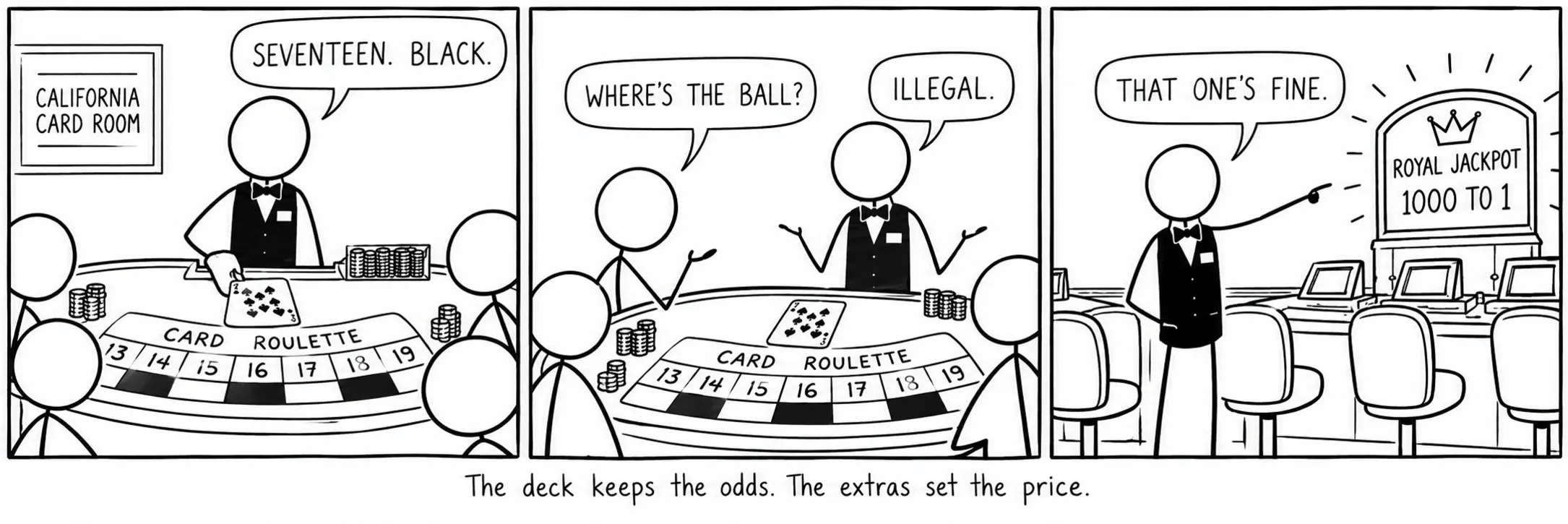
The deck keeps the odds. The extras set the price.
Sources
- Bollman, M. Mathematics of the Big Four Casino Table Games: Blackjack, Baccarat, Craps, & Roulette.
- Wizard of Odds. “San Diego Roulette.”