A Pit Boss’s View
The person behind the dealers watches the money, the wheels and the players, and sees roulette as a logistics problem.
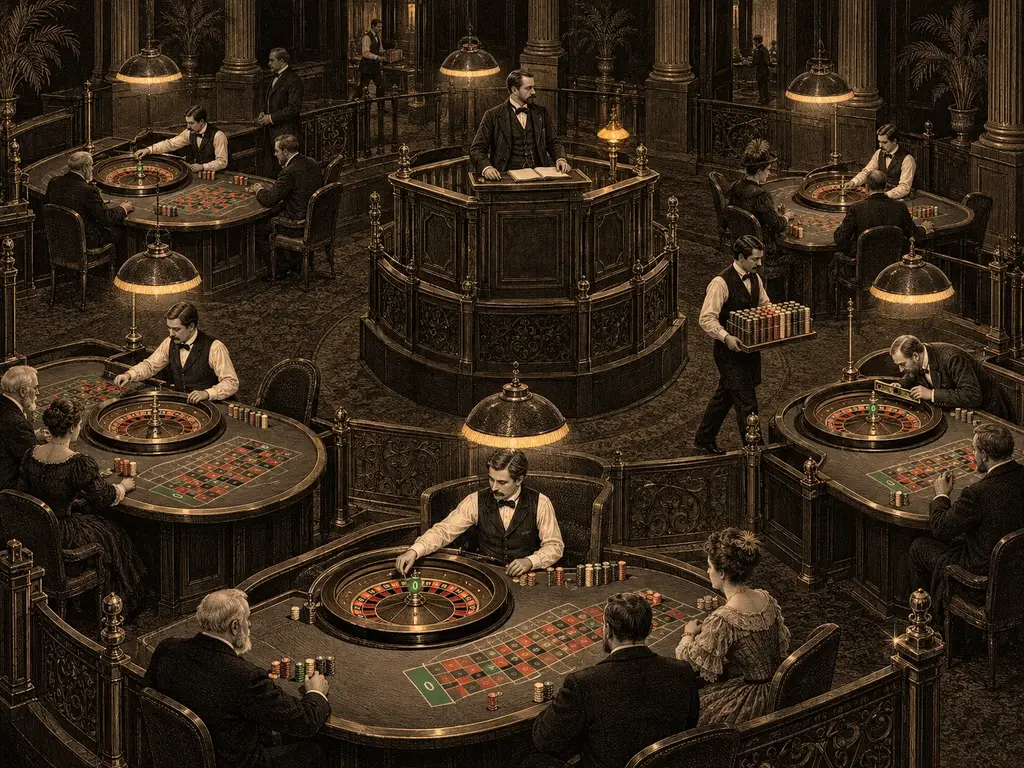
A composite account from the pit: what a pit boss checks, what they worry about (disputes, fatigue, wheels, chasers), how comps are calculated from expected loss, and why the pit is happiest when nothing happens.
The job
A pit boss supervises a group of tables: dealers’ procedure, buy-instableBuy-inExchanging cash for chips at the table. Done between spins, with the cash placed on the layout rather than handed to the dealer.Read full → and payoutsmoneyPayoutWhat a winning bet returns, quoted as “X to 1” on top of the returned stake.Read full → above a threshold, disputes, chipmoneyChipA token representing a fixed amount, placed on the layout to make a bet. Also: check.Read full → fills and credits, player ratings for comps, and the wheels. They are the first escalation from the dealer and the last before surveillance and management. A good shift is one with no stories.
Theoretical win
Every rated player’s average bet and time at the table are logged. Multiply by spins per hour and the house edgemathHouse edgeThe share of each stake the casino keeps on average: 2.70% in European roulette.Read full → and you have the player’s expected lossmathExpected lossExpected value times total amount wagered; the average amount lost over a session or a period.Read full → for the session: the “theo”. Comps (meals, rooms, show tickets) are a percentage of theo, typically 20–40%. A player who wins $500 and had a theo of $60 gets the same comp as one who lost $500 with the same theo, because the casino budgets on expectation, not results. The pit boss is, in effect, running the expected-loss formula on this site for every seat.
What the pit watches
Dealers: procedure, speed, errors, fatigue; rotation every 20–40 minutes. Wheels: level checked each shift, any run of results that surveillance flags. Chips: fills when a table runs low, credits when it is flush, every movement signed. Players: the chaser who has bought in three times, the one explaining a system to the dealer, the one whose bets have doubled since the last buy-in. Regulated markets require the pit to act on signs of harm; the better casinos do.
Disputes
A late chip, a splitbetSplitTwo adjacent numbers, pays 17:1.Read full → read as a straight upbetStraight upA single number, pays 35:1.Read full →, a payout the player thinks is short. The pit boss can see the camera and decides. Most are resolved in thirty seconds in the dealer’s favor because the dealer’s reading was right; some are resolved for the player because the camera shows the chip was down in time. The pit boss’s job is to be boring about it.
On systems and bias
Pit bosses have seen every system and watched the arithmetic. They have also, rarely, seen a wheel flagged by surveillance’s statistics and pulled before any player could have found it. Their view of bias play is practical: the casino measures its wheels more often and with more data than any player can, so the opportunity does not reach the floor. Their view of systems is the dealers’ view, with a spreadsheet.
Why the pit likes you to leave
A player who sets a budget, plays it slowly and leaves on time generates theo, gets a comp, and comes back. A chaser generates a dispute, a welfare conversation and a complaint. The incentives are more aligned than players assume: the house wants your 2.70% of a long, calm relationship, not all of your money tonight.
Questions
Yes, within house rules. It changes where the MartingalestrategyMartingaleProgression that doubles the bet after each loss. See the Strategy section for what it does and does not do.Read full → cliff is, not the slope.
They track everyone’s average bet and time. Results are noted; theo is what drives comps.
Abuse, touching chips during the dollyequipmentDollyThe marker placed on the winning number on the layout while bets are settled.Read full →, late bets repeatedly, devices. Not winning.
Comic relief
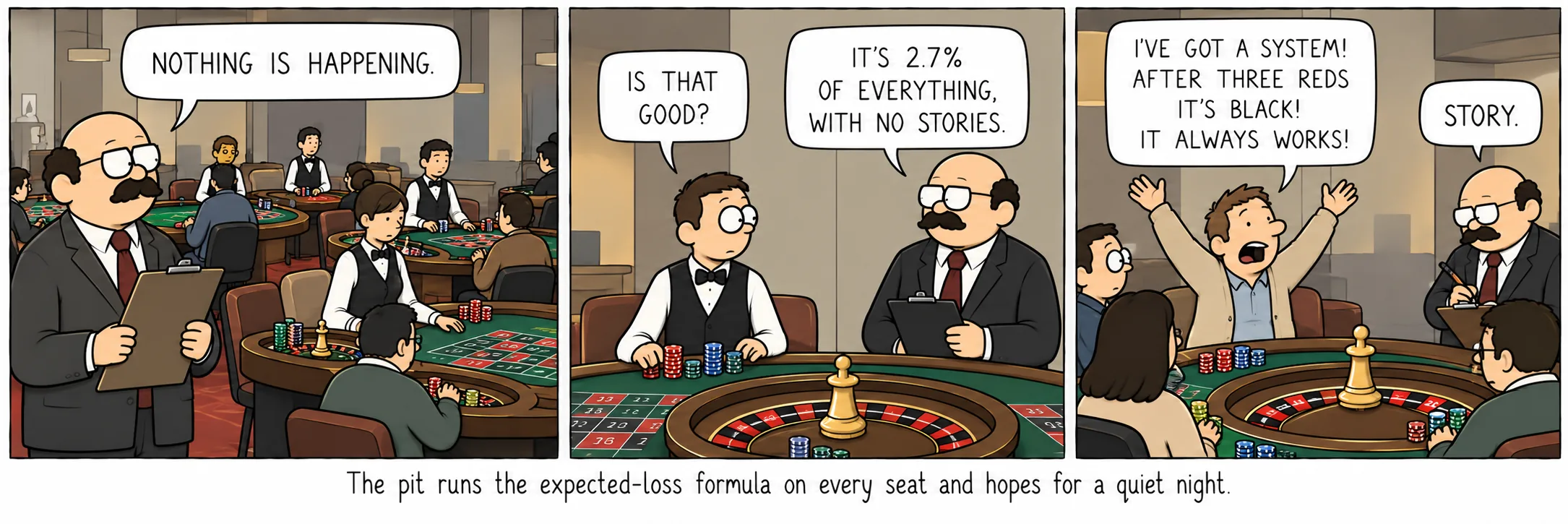
The pit runs the expected-loss formula on every seat and hopes for a quiet night.
Sources
- UK Gambling Commission. Remote gambling and software technical standards.
- Schwartz, D. G. Roll the Bones: The History of Gambling.