François Blanc
The operator who removed the double zerovariantDouble zeroThe 00 pocket of the American wheel. Its presence raises the house edge from 2.70% to 5.26%.Read full →, and understood exactly what it would do.
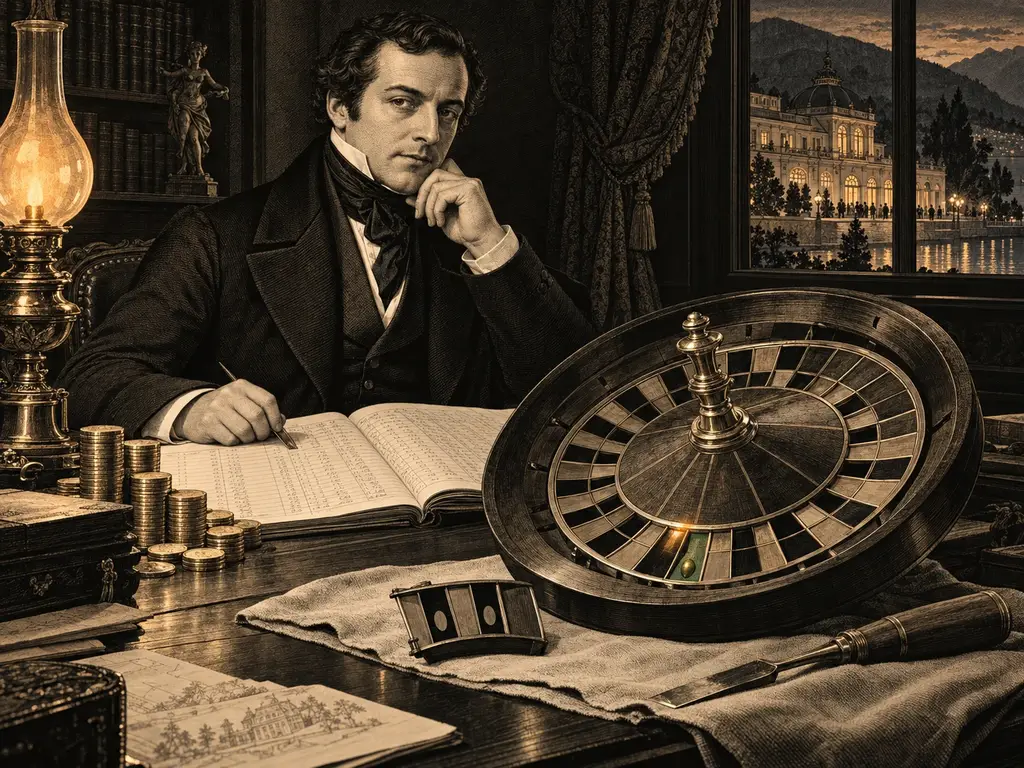
François Blanc (1806–1877) introduced the single-zero wheel at Bad Homburg in 1843 to undercut rival spa casinos, then built Monte Carlo on the same wheel. The “gift” to players was a price cut that bought market share.
Before Homburg
François and his twin brother Louis began as speculators in Bordeaux in the 1830s, where they were convicted of bribing telegraph operators to learn Paris bond prices ahead of the market, an early case of information arbitrage. After a short sentence they moved into casino operation, first in Luxembourg, then taking the concession for the small spa town of Bad Homburg in 1841.
The single zero
Homburg competed with the established spas at Baden-Baden and Wiesbaden, whose wheels had two zeroswheelZeroThe single green pocket that no even-money, dozen or column bet covers; the source of the house edge. Also: single zero, 0.Read full →. The Blancs advertised a wheel with one. The house edgemathHouse edgeThe share of each stake the casino keeps on average: 2.70% in European roulette.Read full → fell from 5.26% to 2.70%, and the advertising wrote itself: the only casino in Europe where the player’s odds were twice as good. Players came, Homburg grew, and the rivals eventually followed. It was not generosity. It was a price cut in a market where the product was identical and the price was the only lever.
Monaco
When Prussia annexed Hesse-Homburg in 1866 and German gambling was wound down (the last tables closed in 1872), Blanc had already moved. He bought the failing Monaco concession in 1863, invested in the railway and the hotels, and ran the casino as a resort rather than a gaming room. The single zero came with him and became the European standard. The Blanc family held a share of Monaco’s casino income for generations; his daughter married into the Radziwiłł princes and a granddaughter into the Bonapartes.
Born in Courthézon, Vaucluse, with his twin Louis.
Bordeaux: speculation, telegraph bribery, conviction.
Concession for Bad Homburg.
Single-zero wheel introduced at Homburg.
Buys the Monaco concession; founds the Société des Bains de Mer.
Railway to Monte Carlo opens.
German casinos closed; Monte Carlo is the only game on the continent.
Dies in Switzerland, one of the richest men in Europe.
What he understood
That the house edge is a price, that players compare prices even when they cannot compute them, and that a lower price with higher volume beats a higher price with lower volume. Monte Carlo’s income at 2.70% dwarfed Homburg’s at 5.26% because there were more players, more tables and more spins. The arithmetic of expected lossmathExpected lossExpected value times total amount wagered; the average amount lost over a session or a period.Read full → (edge × turnovermoneyTurnoverThe total amount wagered over a session or period, counting re-bet winnings. Also: handle, action.Read full →) was his business model before anyone wrote it down for players.
Legacy
Every single-zero wheel in the world is Blanc’s. So is the modern casino resort: the idea that the casino is one part of a destination with hotels, an opera house and a railway station. The American wheel kept the second zero because no Blanc arrived to undercut it; the triple-zero wheel of 2016 is the opposite move, made where the players did not have a Monte Carlo to compare against.
Questions
He introduced and popularized it. Single-zero wheels may have been tried earlier; Homburg made it a policy.
The opposite. Volume rose more than the margin fell.
A journalist’s nickname for turning a small spa into Europe’s gambling capital in a decade.
Comic relief
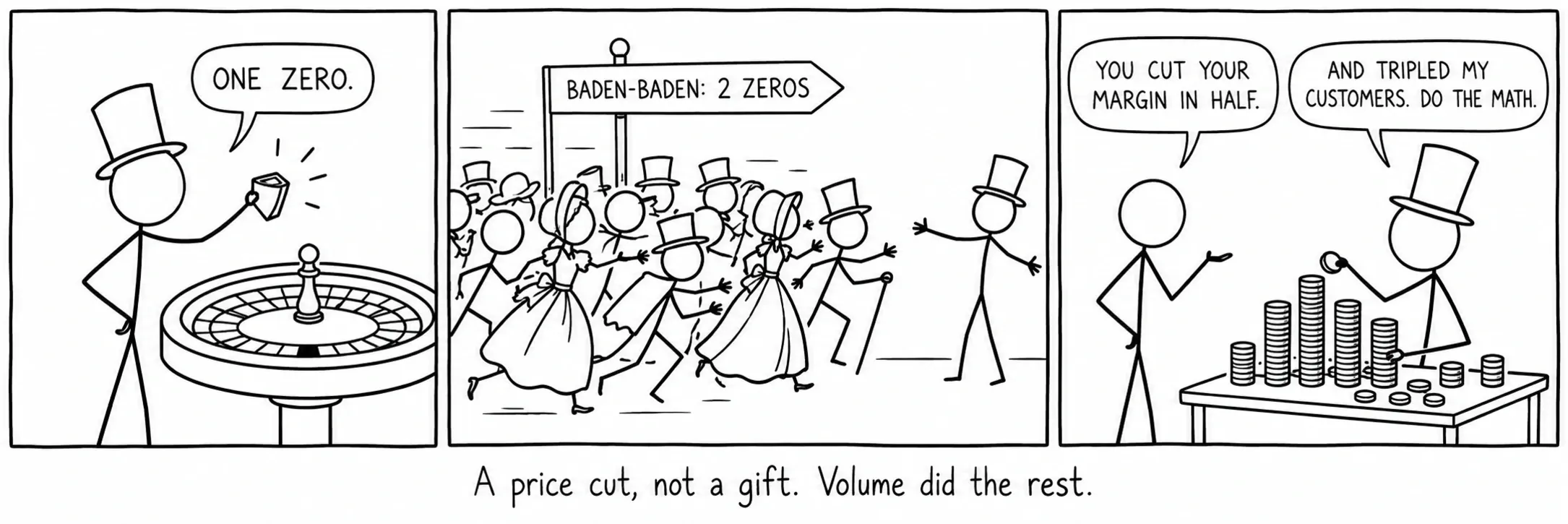
A price cut, not a gift. Volume did the rest.
Sources
- Schwartz, D. G. Roll the Bones: The History of Gambling.
- Kavanagh, T. M. Dice, Cards, Wheels: A Different History of French Culture.