Boule and Small Wheels
Roulette’s small cousins: a nine-number wheel in French casinos, a twenty-sided die, a pin board, a wheel paired with a hopper of balls and a star of lights. One rule prices them all.
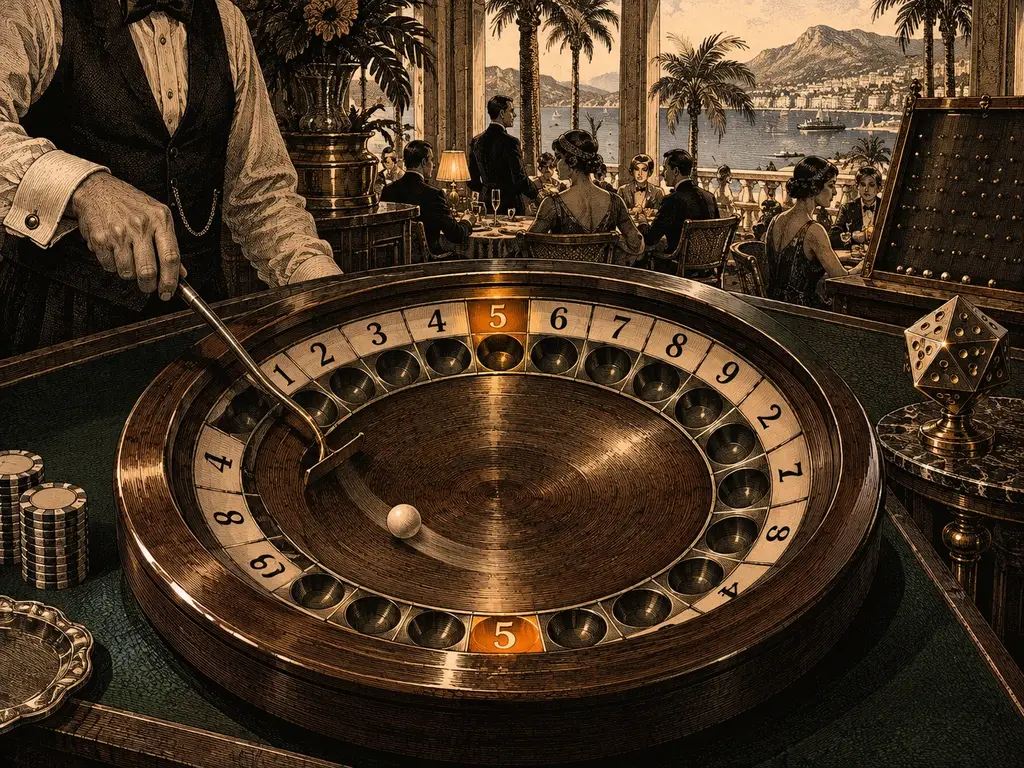
Boule, still dealt in some French casinos, has nine numbers and pays 7 to 1 on one of them: 11.11%, four times a European wheel. Roulette-18 rolls a die instead of spinning a wheel and costs 5.26%. Online, Pin Ball and Spingo cost 2% to 4.76%, and Lucky Star, a light running round a star, 2.22% to 4%. Diamond Roulette dropped red and black for six colors and sold one bet at 15.79%.
One rule, small wheels
The rule from the unusual-wheels page prices these games too: count the results the payoutsmoneyPayoutWhat a winning bet returns, quoted as “X to 1” on top of the returned stake.Read full → ignore and divide by all the results. On a European wheel the zerowheelZeroThe single green pocket that no even-money, dozen or column bet covers; the source of the house edge. Also: single zero, 0.Read full → is 1 pocketequipmentPocketOne of the 37 numbered compartments on the rotor. Also: slot, cup.Read full → in 37. On a small wheel one house pocket is a bigger share, so small games tend to cost more, unless the payouts are set some other way.
Boule: nine numbers
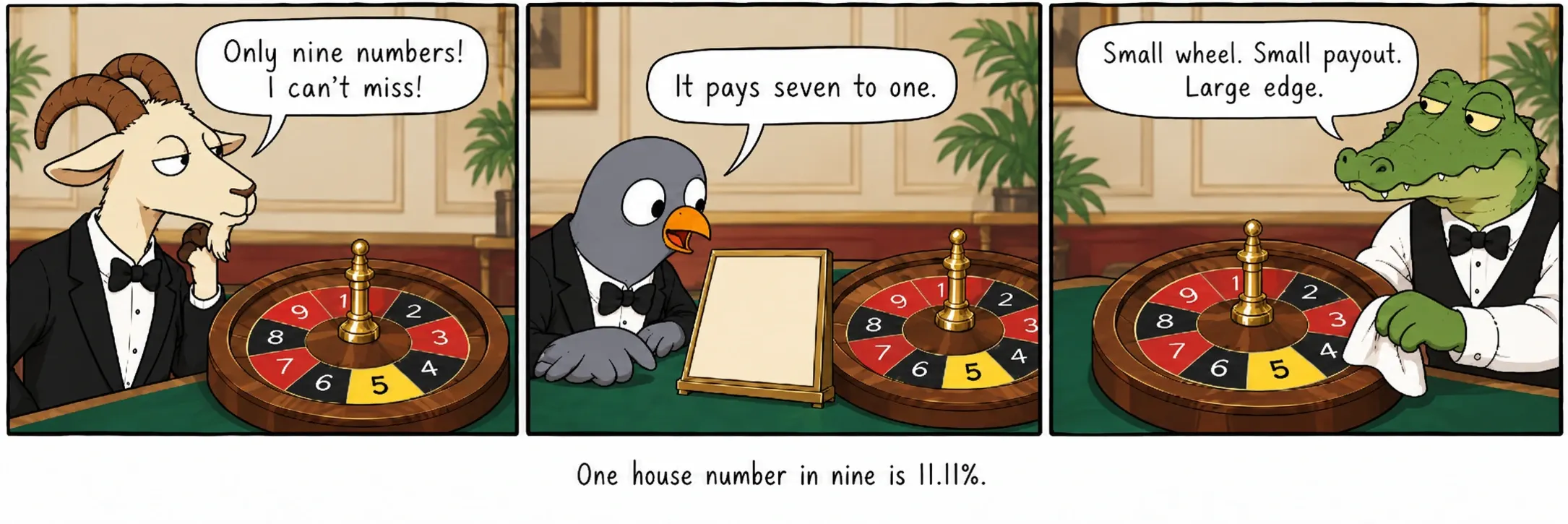
Boule is the small French cousin of roulette, still dealt in some casinos in France; the Wizard of Odds took its rules from the booklet of a casino in Antibes. The ballequipmentBallThe small ball launched along the track against the rotor. Modern balls are ivorine or Teflon, 18–21 mm.Read full → settles on one of nine numbers. Four are blackbetBlackEven-money bet on the 18 black numbers. French: noir.Read full → (1, 3, 6, 8), four redbetRedEven-money bet on the 18 red numbers. French: rouge.Read full → (2, 4, 7, 9), and the 5, in yellow, is the house number. A single number pays 7 to 1. The even-money betsbetEven-money betRed/black, odd/even, high/low. 18 numbers, pays 1:1.Read full →, red or black, odd or even, low (1 to 4) or high (6 to 9), all lose when the 5 comes up. Every bet costs 1/9 = 11.11%, four times a European wheel. A version at Genting in Malaysia numbers its wheel 0 to 9 and pays 8 to 1 on one number and 2 to 1 on three: 10%.
Avions: seventeen numbers
Epstein (2013) records another small wheel, Avions, dealt for a while at Monte Carlo, with 17 numbers. A single number paid 15 to 1, groups of four paid 3 to 1, and the even-money bets covered eight numbers each, leaving out the 9, which played the part of the zero. Every bet works out at 1/17 = 5.88%, a little more than the American 5.26%, on a wheel half the size of a European one.
Roulette-18: a die instead of a wheel
Roulette-18 was shown at the Global Gaming Expo in 2014 and dealt in some Grosvenor casinos in the United Kingdom. A twenty-sided die replaces the wheel, with the numbers 1 to 18, a 0 and a 00. On 00 nothing is settled and the die is thrown again, which leaves 19 live faces with payouts set for 18: a straight upbetStraight upA single number, pays 35:1.Read full → pays 17 to 1, a splitbetSplitTwo adjacent numbers, pays 17:1.Read full → 8 to 1, a streetbetStreetThree numbers in a row of the layout, pays 11:1. French: transversale.Read full → 5 to 1, a cornerbetCornerFour numbers sharing a corner on the layout, pays 8:1.Read full → 7 to 2, a line 2 to 1. Every bet costs 1/19 = 5.26%, the American price, except the even-money bets, which lose only half on 0: 2.63%.
Pin Ball and Spingo: online games
Pin Ball, from Realistic Games, drops a ball through a board of pins into one of 25 slots, 0 to 24. Bets pay as if there were 24: a single number 23 to 1, a split 11 to 1, so each costs 1/25 = 4%, and the even-money bets lose only half on 0, which brings them to 2%. Spingo, from Microgaming, joins two draws: a ball from a hopper of 21, two each of 1 to 10 and one 0, and a wheel of 25 segments, eight each yellow, red and blue and one green. A number pays 9 to 1 and costs 4.76%; a color pays 2 to 1 and costs 4%. The longest shot on the board, a number and a color together, pays 31 to 1 for a chance of 16 in 525 and costs only 2.48%: the cheapest bet in the game.
Lucky Star: a light on a star
Lucky Star, offered at some online casinos for British players, has no ball. A light runs round a five-pointed star drawn with five straight lines and stops on one of 40 spots numbered 0 to 8. The five spots where the lines cross are all numbered 1, and the light passes each of them twice on a circuit, so a circuit has 45 stops and 1 is the likeliest result, 10 stops in 45. Bets are on a number, a color (0 and 8 green; 1, 3 and 6 red; 2, 4, 5 and 7 black), odd or even, low (1–4) or high (5–8), In or Out, and on five Chinese elements, one for each line. Payouts are “for 1” and come in fractions, such as 2.2 for red, which lets every bet be priced within two points of the others: from 2.22% to 4%.
Diamond Roulette: six colors and no red
Diamond Roulette appeared in Atlantic City in 2008 on a double-zero wheel with the numbers in six colors of six numbers each, and no red or black bet. A color paid 5 to 1: 5.26%, the usual American price, or 2.70% on a single-zero wheel. The trap was a color with 0 and 00 added: eight numbers at 3 to 1, where the rule asks for 3¾ to 1. It cost 15.79%. Rounding a payout down by a fraction of a unitmoneyUnitThe base stake a system or a player works in. Progressions are described in units so they apply at any table.Read full → can make one bet three times as dear as the others.
What the small wheels show
The device changes; the arithmetic does not.
- One house number in nine costs 11.11%; one in 37 costs 2.70%. The fewer the numbers, the dearer a zero.
- A die, a pin board or a hopper changes nothing: the price is in the count of results and the payouts.
- Half back on zero, as on Pin Ball and Roulette-18, halves the even-money edge, as la partageruleLa partageFrench rule: when zero hits, half of an even-money stake is returned. Halves the house edge on those bets to 1.35%.Read full → does.
- Payouts in fractions, as on Lucky Star, let a designer price every bet within a point or two of the others.
- Look for the bet whose payout is rounded down: Diamond’s 3 to 1 instead of 3¾.
Questions
No. At 11.11% it costs four times a European wheel. It survives because it is quick and simple, not because it is cheap.
Boule is still dealt in some French casinos. Roulette-18 was dealt in British casinos in the 2010s. Pin Ball, Spingo and Lucky Star were online games, and Diamond Roulette has gone from Atlantic City.
Because its payout of 31 to 1 is closer to fair, 31.8 to 1, than the payouts of the single bets are. Each bet is priced on its own.
Fun with Math
Try these yourself first. Each solution is folded; open it when you are ready.
Spingo draws a ballequipmentBallThe small ball launched along the track against the rotor. Modern balls are ivorine or Teflon, 18–21 mm.Read full → from a hopper of 21 (two each of 1 to 10, one 0) and spins a wheel of 25 segments (eight each of three colors, one green). A number pays 9 to 1, a color 2 to 1, and a number and a color together 31 to 1. Price all three.
Show the solution
Answer Number 4.76%, color 4.00%, number and color 2.48%: the longest shot is the cheapest bet.
A number: 2 balls in 21. A winning $1 brings back $10, so the bet returns 2/21 × 10 = 20/21: an edge of 1/21 = 4.76%.
A color: 8 segments in 25, bringing back $3: 24/25, an edge of 4%.
Both together: the ball and the wheel are separate draws, so the chances multiply: 2/21 × 8/25 = 16/525. A winner brings back $32, so the bet returns 16 × 32 = 512 for 525 staked: an edge of 13/525 = 2.48%.
A fair payoutmoneyPayoutWhat a winning bet returns, quoted as “X to 1” on top of the returned stake.Read full → would be 509/16, about 31.8 to 1, so 31 to 1 falls short by less than one unitmoneyUnitThe base stake a system or a player works in. Progressions are described in units so they apply at any table.Read full → in thirty-two. Each bet on a board is priced on its own, and the long shots are not always the dear ones.
On Roulette-18 a bet on redbetRedEven-money bet on the 18 red numbers. French: rouge.Read full → covers 9 of the 19 live faces of the die, pays even money and loses only half when the 0 comes up. What does it cost?
Show the solution
Answer 1/38, about 2.63%.
Throw the die 19 times, leaving out the re-thrown 00s. On average red comes 9 times (+9), blackbetBlackEven-money bet on the 18 black numbers. French: noir.Read full → 9 times (−9) and the 0 once, which takes half the stake (−½).
Net: −½ in 19 throws, which is 1/38 = 2.63%.
Without the half back it would be −1 in 19, 5.26%, the price of every other bet on the die. Giving back half on zerowheelZeroThe single green pocket that no even-money, dozen or column bet covers; the source of the house edge. Also: single zero, 0.Read full → halves the edge, as la partageruleLa partageFrench rule: when zero hits, half of an even-money stake is returned. Halves the house edge on those bets to 1.35%.Read full → does on a French table.
Multicolore, played at Monte Carlo in the 1950s, spun a ball onto 25 sectorswheelSectorA contiguous arc of pockets on the wheel, as distinct from a group on the layout.Read full →: six each of green, red, white and yellow, and one blue. A bet on a color is paid at the odds printed on the sector where the ball stops: 4, 3, 3, 3, 2 and 2 to 1 on the six sectors of each color, and 24 to 1 on the blue. What does each bet cost?
Show the solution
Answer Blue is a fair bet and costs nothing. Every other color costs 8%.
Imagine 25 spins in which every sector comes up once. A $1 bet on green wins on its six sectors, 4 + 3 + 3 + 3 + 2 + 2 = $17, and loses $1 on the other 19: −$2 in 25 spins, 8%.
Blue wins $24 once and loses $1 on the other 24 sectors: exactly even.
A casino game with a fair bet on it is rare. Next to boule’s 11.11%, the blue was the one bet in the room worth making. Bollman (2024) sets the game as an exercise.
Comic relief
One house number in nine is 11.11%.
Sources
- Wizard of Odds. “Boule”, “Roulette-18”, “Pin Ball”, “Spingo”, “Lucky Star” and “Diamond Roulette”.
- Epstein, R. A. The Theory of Gambling and Statistical Logic, 2nd ed.